The Internet relies on a coordinated system of unique identifiers. Public IPv4 addresses, IPv6 addresses and Autonomous System Numbers must be administered in a way that prevents conflicting registrations and allows independently operated networks to communicate.
Table of Contents
ToggleSeveral organisations contribute to this system. They include the Internet Corporation for Assigned Names and Numbers, the Internet Assigned Numbers Authority, the Number Resource Organization and the five Regional Internet Registries.
The ICANN Address Supporting Organization, commonly known as the ASO, connects these institutions and the regional Internet number communities.
The ASO provides a formal channel through which the Internet numbers community can advise ICANN on global IP address policy. It does not normally allocate IP addresses directly or replace the Regional Internet Registries.
What Is the Address Supporting Organization?
The Address Supporting Organization is one of the three Supporting Organizations recognised within ICANN’s governance structure.
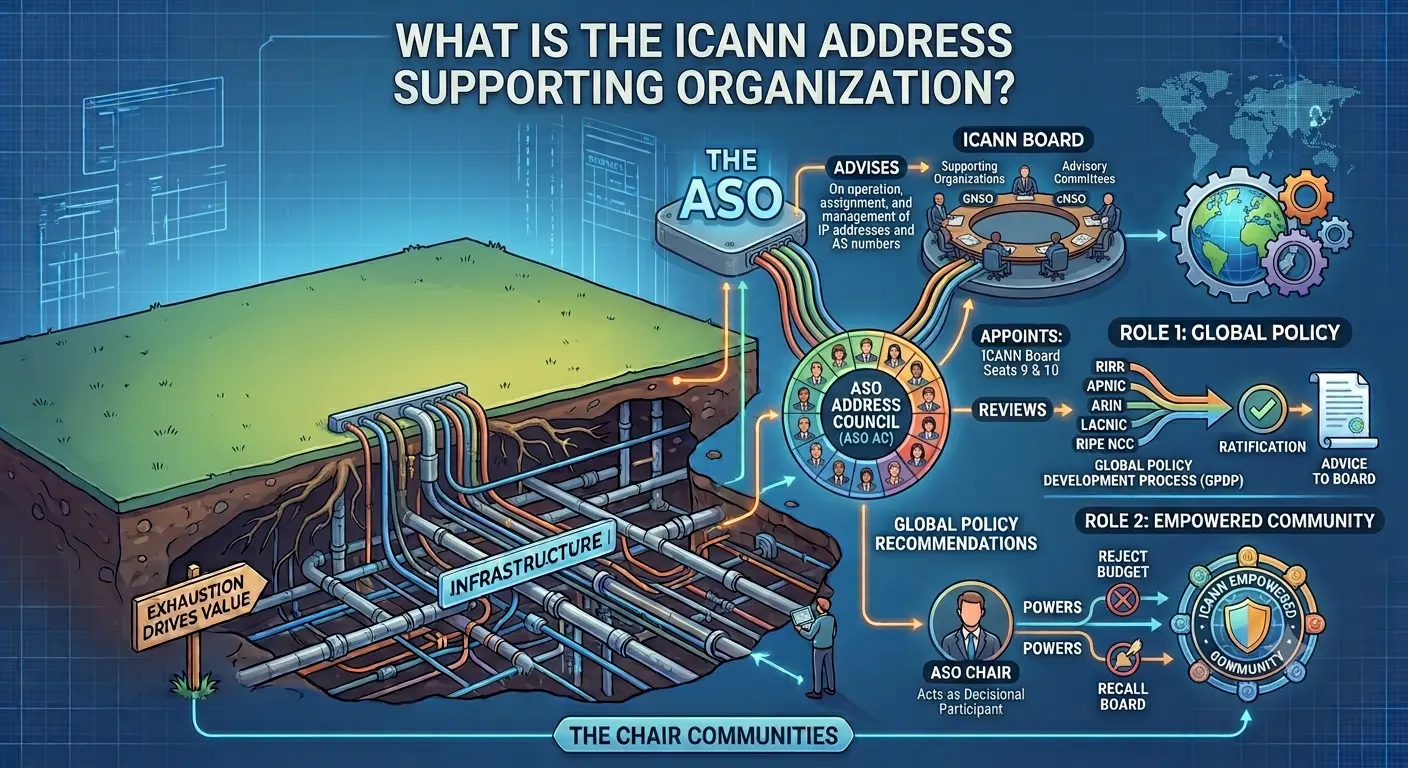
Its purpose is to review and develop recommendations concerning Internet Protocol address policy and advise the ICANN Board on matters involving the operation, assignment and management of IP addresses.
The three ICANN Supporting Organizations are:
- The Address Supporting Organization, or ASO
- The Country Code Names Supporting Organization, or ccNSO
- The Generic Names Supporting Organization, or GNSO
Each Supporting Organization concentrates on a different part of ICANN’s work. The GNSO primarily addresses policies affecting generic top-level domains, while the ccNSO concentrates on country-code top-level domains.
The ASO represents the Internet numbers community on matters involving IP addresses and related number resources.
Readers seeking a broader explanation of the organisations involved can also read NRS.help’s guide to Internet governance institutions.
Why Does ICANN Need the ASO?
ICANN coordinates systems involving the Internet’s globally unique identifiers. However, most policies governing the regional distribution and administration of IP addresses are not developed exclusively within ICANN.
They are discussed through the open policy-development processes operated by the five Regional Internet Registries.
The ASO gives these regional communities a recognised route for contributing to global number-resource policy within ICANN.
It helps ensure that decisions affecting global IP address administration remain connected to the organisations, network operators and communities that use and administer Internet number resources.
The ASO therefore serves as a bridge between:
- ICANN
- The Number Resource Organization
- The five Regional Internet Registries
- Regional policy communities
- The wider Internet numbers community
What Is the Relationship Between the ASO and the NRO?
The ASO and the Number Resource Organization are closely connected, but they are not identical.
The Number Resource Organization, or NRO, is the coordinating organisation formed by the five Regional Internet Registries. It supports cooperation among the registries and represents their collective interests in selected global Internet governance matters.
The ASO is the Supporting Organization recognised within ICANN for Internet number-resource matters.
Under the ICANN ASO Memorandum of Understanding, the NRO fulfils the role, responsibilities and functions of the ASO.
In practical terms:
- The NRO coordinates the five Regional Internet Registries.
- The ASO provides the formal connection between the numbers community and ICANN.
- The NRO Executive Council performs organisational functions associated with the ASO.
- The NRO Number Council serves as the ASO Address Council.
- The NRO also performs activities outside its role within ICANN.
This overlap explains why official documents frequently use the combined term NRO NC/ASO AC.
For a more detailed explanation, see NRS.help’s article, What Is the Number Resource Organization and What Does It Do?
Which Regional Internet Registries Participate in the ASO?
The ASO structure connects ICANN with the communities of the five Regional Internet Registries, commonly called RIRs.
The five RIRs are:
- AFRINIC, serving Africa
- APNIC, serving the Asia-Pacific region
- ARIN, serving the United States, Canada and parts of the Caribbean and North Atlantic
- LACNIC, serving Latin America and much of the Caribbean
- RIPE NCC, serving Europe, the Middle East and parts of Central Asia
Each RIR administers Internet number resources within its service region and operates its own community-based policy-development process.
These resources include:
- IPv4 addresses
- IPv6 addresses
- Autonomous System Numbers
- Associated registry information
NRS.help provides a separate introduction to Regional Internet Registries and their responsibilities.
The official IANA number-resources page also explains the global hierarchy through which number resources are coordinated and allocated.
What Is the ASO Address Council?
The ASO Address Council, or ASO AC, is the principal policy-related body within the ASO structure.
The ASO Address Council consists of the same 15 volunteers who form the NRO Number Council.
Each of the five RIR regions selects three council members:
- Two are selected by the relevant regional community.
- One is appointed by the RIR’s Executive Board.
The ASO and the ASO Address Council are not the same entity.
The ASO is the complete Supporting Organization through which the NRO and Internet numbers community interact with ICANN. The ASO Address Council is a specific body that performs policy-review, advisory and appointment functions.
What Does the ASO Address Council Do?
The ASO Address Council has several important responsibilities.
Overseeing the Global Policy Development Process
The council monitors global number-resource policy proposals and confirms whether the required regional processes were followed.
It does not simply write a global policy and impose it on the five RIR regions.
Instead, it reviews whether the proposal was considered properly by all five regional communities and whether a common text received the necessary support.
Advising the ICANN Board
The council provides advice and recommendations to the ICANN Board concerning Internet number-resource allocation policy.
This allows ICANN to receive input from people with experience in IP address administration, network operations and regional policy processes.
Supporting RIR Recognition
The ASO Address Council can provide recommendations concerning the recognition of new Regional Internet Registries.
This function is important because an RIR is responsible for critical registry and allocation services within its region.
Appointing ICANN Board Members
The ASO Address Council appoints directors to two seats on the ICANN Board.
These positions are commonly known as Seat 9 and Seat 10.
The appointment process gives the Internet numbers community a role in selecting individuals who participate in ICANN’s highest decision-making body.
Does the ASO Create IP Address Policies?
The ASO does not normally create regional IP address policies.
Regional policies are proposed, discussed and accepted through the policy-development process operated by each RIR.
Depending on the region, participants may include:
- Internet service providers
- Network operators
- Hosting and cloud companies
- Governments
- Technical specialists
- Researchers
- Civil-society organisations
- Other interested community members
The ASO becomes especially important when a proposal qualifies as a global policy.
What Is a Global Internet Number-Resource Policy?
A global policy concerns how Internet number resources are issued from the global IANA-level pool to the five Regional Internet Registries.
The RIRs then distribute or assign those resources according to policies developed within their respective regions.
The ASO website explains that global policies govern how Public Technical Identifiers, which performs the IANA functions, issues Internet number resources to the RIRs.
A global policy must therefore receive consideration across all five RIR regions.
The process differs from a regional proposal that applies only within one registry’s service area.
NRS.help’s guide to how IP address blocks are allocated globally provides additional background on the allocation hierarchy.
How Does the Global Policy Development Process Work?
The Global Policy Development Process, or GPDP, provides a structured method for considering number-resource policies that require global implementation.
The process generally follows these stages.
1. A Global Policy Is Proposed
A proposal may be introduced through an RIR policy forum or submitted to the ASO Address Council.
A global proposal must address a matter requiring coordinated action across the Internet number registry system rather than a change affecting only one region.
2. Every RIR Community Reviews the Proposal
The proposed policy must pass through the established policy-development process in each of the five RIR regions.
This allows communities in Africa, the Asia-Pacific region, North America, Latin America, the Caribbean, Europe and the Middle East to consider the proposal.
3. A Common Policy Text Is Agreed
Discussions in different regions may initially produce different wording or requirements.
The proposal must eventually be reconciled into a common text that can be approved through the applicable process in every RIR region.
4. The ASO Address Council Reviews the Process
Once the proposal has received approval in all five regions, it is forwarded to the ASO Address Council.
The council reviews whether the regional processes were followed properly and whether significant viewpoints were adequately considered.
This is primarily a procedural review rather than an opportunity for the council to replace regional community decisions with its own policy preferences.
5. The Proposal Goes to the ICANN Board
After completing its review, the ASO Address Council may forward the proposal to the ICANN Board.
The Board can then consider the proposal according to the procedures established in the ASO agreement.
This structure supports bottom-up policy development while providing a formal route for global implementation.
What Does the ASO Not Do?
The ASO’s close relationship with ICANN, the NRO and the RIRs can create confusion about its operational role.
The ASO does not normally:
- Allocate IP addresses directly to companies or individuals
- Process ordinary applications for IPv4 or IPv6 resources
- Issue Autonomous System Numbers to network operators
- Maintain every regional Internet number registry
- Replace the five Regional Internet Registries
- Develop every policy used by an individual RIR
- Control how operators route Internet traffic
- Manage domain-name registrations
- Act as a global regulator of the Internet
Organisations seeking IP addresses or Autonomous System Numbers generally need to approach the RIR, National Internet Registry, Local Internet Registry or service provider operating in their region.
Businesses considering an ASN can read NRS.help’s guide on how to obtain an Autonomous System Number.
Why Is the ASO Important?
The Internet operates globally, but the administration of number resources is divided among five regional organisations.
This structure creates a need for coordination.
A policy involving resources from the global pool cannot operate effectively if the five regions follow incompatible procedures. At the same time, placing all policy authority in one central organisation could reduce regional participation and weaken the bottom-up model.
The ASO helps balance these concerns.
It creates a framework in which:
- Regional communities can participate in policy development.
- Global proposals must be considered across all five regions.
- ICANN receives advice from the Internet numbers community.
- Policy procedures can be reviewed before global implementation.
- The RIR system has formal representation within ICANN.
- Global coordination can occur without replacing regional processes.
The ASO is therefore important not because it controls every IP address decision, but because it connects regional policy development with global Internet coordination.
Why Does the ASO Matter to IP Resource Holders?
Policies involving Internet number resources can affect the organisations that rely on IP addresses and Autonomous System Numbers to operate their networks.
These organisations may include:
- Internet service providers
- Data centres
- Cloud-service providers
- Content-delivery networks
- Hosting businesses
- Telecommunications companies
- Financial institutions
- Enterprises operating their own networks
Changes to number-resource policy may influence eligibility, transfers, registration requirements, operational continuity and the procedures through which resources are administered.
Resource holders therefore benefit from understanding where policies are developed, who represents their region and how global proposals move through the ASO structure.
NRS believes that Internet number-resource governance should remain transparent, accountable and responsive to the organisations whose infrastructure depends on these resources.
For more information on the business importance of number resources, read The Benefits of Owning Your IP Addresses.
How Can the Internet Community Participate?
Most participation in number-resource policy begins at the regional level.
Interested parties can:
- Follow policy discussions within their RIR
- Subscribe to public policy mailing lists
- Attend RIR meetings in person or remotely
- Review active policy proposals
- Submit comments and supporting evidence
- Propose new policies
- Participate in ASO AC selection processes
- Observe ASO Address Council meetings
- Review published agendas, minutes and work plans
Participation is not necessarily limited to governments, RIR members or large telecommunications companies.
Network operators, businesses, technical experts, researchers and civil-society participants may all contribute according to the applicable regional procedures.
ASO, NRO, RIR and IANA: What Is the Difference?
The organisations can be distinguished as follows:
Address Supporting Organization
The ASO connects the Internet numbers community with ICANN and advises ICANN on global number-resource policy.
Number Resource Organization
The NRO coordinates the five RIRs and fulfils the role of the ASO within ICANN.
Regional Internet Registries
The RIRs administer Internet number resources in their respective service regions and operate regional policy-development processes.
Internet Assigned Numbers Authority
The IANA functions coordinate the global pools of IP addresses and Autonomous System Numbers and allocate resources to the RIRs according to global policy.
These organisations are closely connected, but each performs a different role within the Internet number registry system.
Final Thoughts
The ICANN Address Supporting Organization is an important link between ICANN and the communities responsible for Internet number resources.
It does not normally issue IP addresses, process resource applications or replace the Regional Internet Registries.
Instead, the ASO connects regional, community-based policy development with ICANN’s global governance structure.
Through its relationship with the NRO, the five RIRs and the ASO Address Council, it helps ensure that global number-resource policies are developed through coordinated and transparent processes.
The long-term legitimacy of this model depends on meaningful community participation, accountable representatives and reliable regional institutions.
A stable Internet requires technical coordination, but it also requires governance systems that remain transparent, inclusive and responsive to the businesses, network operators and communities that depend on Internet number resources.
Related NRS.help Reading
- What Is the Number Resource Organization and What Does It Do?
- Understanding Internet Governance Institutions
- What You Need to Know About Regional Internet Registries
- How IP Blocks Are Allocated Globally
- How Do I Get an Autonomous System Number?
- The Benefits of Owning Your IP Addresses
Official External Resources
Frequent Asked Questions
ASO stands for Address Supporting Organization.
Yes. The ASO is one of the Supporting Organizations recognised within ICANN’s governance structure.
The ASO Address Council consists of 15 volunteers.
Each RIR region selects three members. Two are selected by the regional community, and one is appointed by the relevant RIR Executive Board.
No. The ASO does not normally allocate IP addresses to individual organisations.
Applicants generally obtain resources through the RIR or another recognised registry channel serving their region.
No. Regional policies are developed through each RIR’s policy-development process.
The ASO Address Council primarily oversees the process for policies requiring coordinated global implementation.