
Number Resource Society
ICANN vs IANA: What’s the Difference and How Do They Work Together?
Separate ICANN’s institutional role, PTI’s operation of IANA, community policy development and independent network operation.
On this page
The original article’s institutional distinctions and argument are retained. Primary sources checked on 13 October 2026.
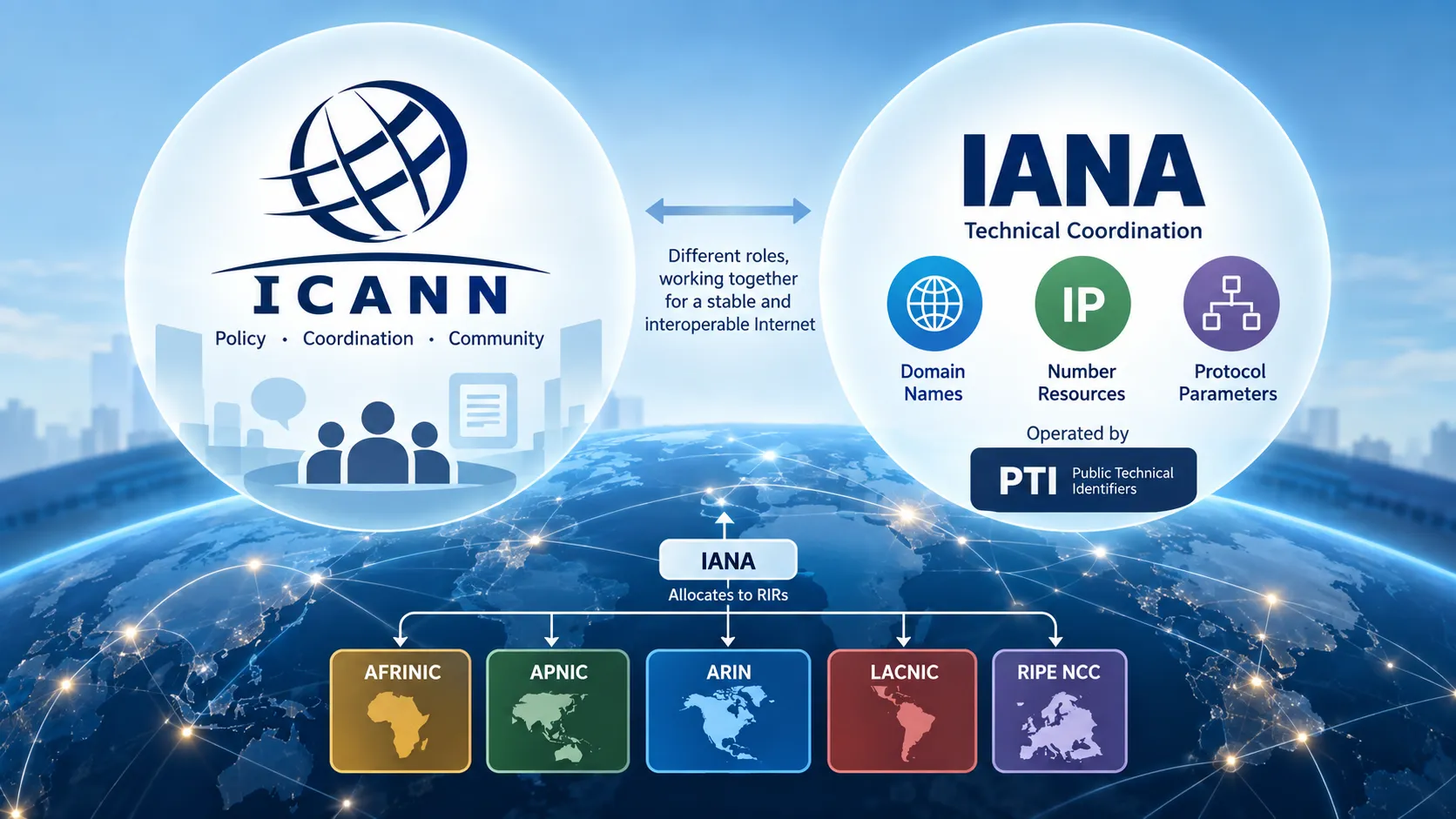
Original illustration. Arrows show functional and resource-allocation relationships, not a chain of command over independently operated networks.
ICANN and IANA are closely connected, but they are not the same. ICANN is the nonprofit organization that coordinates key Internet identifier systems and supports related policy processes. IANA refers to technical functions for domain names, Internet number resources and protocol parameters. Those functions are performed by Public Technical Identifiers (PTI), an ICANN affiliate.
The difference can seem confusing because ICANN, IANA and PTI operate within the same wider coordination framework.
However, their responsibilities are not interchangeable.
Understanding where policy is developed, where technical functions are performed and where Internet number resources are administered provides a clearer picture of how the Internet's identifier system actually works.
What Is ICANN?
ICANN stands for the Internet Corporation for Assigned Names and Numbers.
It is a nonprofit public-benefit organization involved in coordinating important systems of unique Internet identifiers.
Those identifiers include domain names and Internet number resources, while ICANN also provides organizational structures through which different communities participate in related policy processes.
ICANN's role is therefore primarily one of coordination rather than control.
It does not operate the entire Internet, control every network, determine what users can publish online or create all Internet technical standards.
Instead, ICANN forms one part of a much larger Internet ecosystem involving technical standards organizations, Regional Internet Registries, network operators, governments, businesses, civil society and other communities.
For a broader discussion of that institutional role, NRS.Help separately examines The Role of ICANN in Internet Governance.
What Is IANA?
IANA stands for the Internet Assigned Numbers Authority.
Rather than being a separate Internet government or policymaking body, IANA refers to a set of technical coordination functions.
These functions are commonly divided into three areas.
| IANA function | What it coordinates |
|---|---|
Domain names | Technical responsibilities associated with the DNS root zone and top-level domain information |
Number resources | Global registries for IPv4 addresses, IPv6 addresses and Autonomous System Numbers |
Protocol parameters | Registries containing identifiers and values used by Internet protocols |
These registries provide common reference points that independently operated networks and technical systems can rely on.
That common coordination is important because the Internet is decentralized at the network level.
Thousands of networks operate independently, but some identifiers still need to remain globally consistent and unique.
ICANN vs IANA: What Is the Main Difference?
The main difference is between a broader organization and coordination framework and a set of specific technical functions.
| Aspect | ICANN | IANA |
|---|---|---|
Full name | Internet Corporation for Assigned Names and Numbers | Internet Assigned Numbers Authority |
Main role | Coordinates key unique-identifier systems and supports related governance and policy processes | Performs technical registry and coordination functions |
Organization or function? | Organization | Set of functions and services |
Domain-name role | Supports DNS coordination and relevant policy structures | Performs technical root-zone and related registry functions |
Internet number role | Provides part of the institutional framework connecting the numbers community to ICANN | Maintains global number registries and implements applicable global policies |
Protocol parameters | Not the standards-development body | Maintains protocol parameter registries according to policies developed through the IETF process |
Operational performer | ICANN and its organizational structures | Public Technical Identifiers (PTI) |
One of the most important distinctions is that IANA does not independently decide the policies governing the registries it operates.
IANA states that it implements policies developed by the communities served by those registries.
That distinction becomes particularly important for Internet number resources.
Is IANA Part of ICANN?
IANA and ICANN are closely connected, but describing IANA simply as a “department of ICANN” does not accurately reflect the current structure.
The operational IANA functions are performed by Public Technical Identifiers (PTI).
PTI was incorporated in 2016 as a nonprofit public-benefit corporation and an affiliate of ICANN. ICANN is PTI's sole member.
PTI performs the IANA functions on behalf of ICANN for the communities those registries serve.
A more accurate simplified relationship is therefore:
ICANN → PTI → IANA functions
However, that should not be interpreted as meaning ICANN independently determines all of the policies that IANA implements.
Different operational communities are responsible for developing policies in different areas.
What Does IANA Do With Domain Names?
The Domain Name System, or DNS, helps translate human-readable names such as website domains into information computers can use.
At the highest level of this system is the DNS root.
The IANA naming functions include technical responsibilities related to management of the DNS root zone and other top-level domain information.
ICANN has the broader institutional role surrounding much of the domain-name ecosystem, including policy processes involving generic and country-code top-level domains.
IANA, through PTI, performs defined technical functions within that system.
This distinction is useful:
policy development and institutional coordination are not the same as technical implementation.
What Does IANA Do With IP Addresses?
IANA also performs global coordination functions for Internet number resources.
The three principal number-resource categories are:
IPv4 addresses, IPv6 addresses and Autonomous System Numbers (ASNs).
IANA maintains the global registries for these resources and issues number resources to the five Regional Internet Registries according to applicable global policies.
The five RIRs are AFRINIC, APNIC, ARIN, LACNIC and RIPE NCC.
These organizations then manage and register Internet number resources within their respective service regions according to regional policies developed through their own communities.
A simplified view is:
IANA → Regional Internet Registries → Network operators and other organizations
Depending on the region and situation, Local Internet Registries, National Internet Registries, Internet service providers and other organizations may also form part of the resource-distribution structure.
NRS.Help explains this layer in more detail in What Is an IP Address Registry and How Does It Work?
Who Actually Makes Internet Number Policy?
This is one of the most important distinctions in the ICANN–IANA relationship.
IANA does not independently create global Internet number policy.
For number resources, global policy is developed through the communities of the five Regional Internet Registries.
A global policy proposal must proceed through the applicable regional policy-development processes. The Address Supporting Organization Address Council then has responsibilities within the Global Policy Development Process before a qualifying proposal proceeds to the ICANN Board.
Once an applicable global policy is in place, the IANA number functions implement it.
Regional number-resource policies are also developed separately within the individual RIR communities.
This produces an important separation:
Policy development → community processes
Technical implementation → IANA/PTI
The distinction helps prevent a common misunderstanding that the organization maintaining a registry automatically creates all of the rules governing that registry.
What Does IANA Do With Protocol Parameters?
Internet protocols depend on standardized identifiers and numerical values.
Different implementations need to agree on what those values mean. Otherwise, software and networks using the same protocol could interpret information differently.
IANA maintains protocol-parameter registries used by Internet technical standards.
However, IANA does not independently determine those standards.
The Internet Engineering Task Force, or IETF, develops relevant technical standards and policies through its standards process, while IANA maintains the associated protocol registries according to those specifications.
This again demonstrates the difference between developing a rule and operating the registry that records or implements it.
How Do ICANN, IANA, PTI and the RIRs Fit Together?
The structure becomes easier to understand when each entity is separated by function.
| Entity | Primary role in this context |
|---|---|
ICANN | Broader coordination organization and institutional framework for unique Internet identifiers |
PTI | ICANN affiliate that operationally performs the IANA functions |
IANA | Technical functions covering names, numbers and protocol parameters |
RIRs | Regional organizations that manage and register Internet number resources within their service regions |
NRO | Coordination body formed by the five RIRs |
ASO | ICANN Supporting Organization connecting the Internet numbers community with ICANN's global number-policy process |
The Number Resource Organization and Address Supporting Organization are also closely connected.
Within ICANN's structure, the NRO fulfils the role, responsibilities and functions of the ASO under the applicable Memorandum of Understanding.
NRS.Help provides further background in its coverage of NRO History and Structure.
Does ICANN Allocate IP Addresses Directly to Companies?
Generally, no.
A business, hosting provider or network operator normally does not approach ICANN directly to request ordinary IPv4 or IPv6 resources.
At the global level, the IANA number functions maintain the relevant global registries and issue number resources to the RIR system according to applicable global policies.
RIRs then administer number resources within their respective service regions under the relevant regional frameworks.
The exact path through which an organization obtains or uses address resources can vary by region, resource type and operational arrangement.
This is why saying simply that “ICANN gives companies IP addresses” is misleading.
What Changed With IANA in 2016?
The modern organizational relationship largely reflects the IANA stewardship transition completed in 2016.
Before the transition, the U.S. National Telecommunications and Information Administration maintained a stewardship role associated with the IANA functions.
As part of the transition process, PTI was formed as an ICANN affiliate.
On 1 October 2016, PTI began performing the IANA functions on behalf of ICANN under the post-transition structure.
The transition is one reason older descriptions of IANA can now be misleading.
Calling IANA merely an internal ICANN department ignores the PTI structure established during the transition.
Does ICANN Control the Internet?
No. ICANN plays an important role in coordinating unique Internet identifiers, but it does not control the Internet as a whole.
The Internet consists of independently operated networks, infrastructure providers, standards organizations, registries, businesses, governments, technical communities and users.
No single institution operates all of those components.
The same principle applies to IANA.
Maintaining a globally coordinated registry does not mean operating the networks that rely on the registry.
For example, an IANA registry entry does not route packets across the Internet. Network operators make routing decisions through their own infrastructure and interconnection relationships.
Coordination and network operation are related, but they are not the same thing.
Why Does the ICANN–IANA Distinction Matter for Internet Governance?
The distinction matters because discussions about Internet governance often combine policy, technical implementation and institutional authority as though they were one activity.
They are not.
A technical registry may implement a policy without creating that policy.
A policy-development community may develop rules without operating the registry that implements them.
A coordination organization may provide an institutional framework without operating the networks that ultimately use the resources.
For NRS, keeping these roles clear is important because technical coordination should not automatically be interpreted as general authority over independently operated Internet infrastructure.
The Internet depends on coordination, but it also depends on distributed operation, clear responsibilities, accountability, resilience and the ability of independent networks to function without a single central operator.
This distinction becomes increasingly important when discussing Internet number governance.
The useful question is not simply:
Who maintains the database?
It is also:
Who developed the policy? Who implements it? Who operates the affected networks? What happens if these responsibilities become concentrated or unclear?
Those questions help separate necessary coordination from broader governance claims.
For readers exploring that wider topic, NRS.Help's Internet Governance and Its Importance provides additional context.
Common Misunderstandings About ICANN and IANA
| Misunderstanding | More accurate explanation |
|---|---|
ICANN controls the Internet. | ICANN coordinates specific unique-identifier systems. It does not operate or govern every part of the Internet. |
IANA is simply an ICANN department. | The IANA functions are operationally performed by PTI, an ICANN affiliate created in 2016. |
IANA decides global IP address policy. | IANA implements applicable policies; global number policy is developed through the RIR communities and ASO process. |
ICANN assigns individual IP addresses to companies. | Internet number resources are generally administered through the RIR system and other applicable regional structures. |
The RIRs are departments of ICANN. | The five RIRs are separate organizations that coordinate collectively through the NRO and participate in ICANN's number-policy structure through the ASO. |
Maintaining a registry means controlling the underlying networks. | Registry coordination and network operation are separate functions. |
Conclusion
ICANN and IANA are closely connected, but understanding their differences makes the wider Internet governance system much easier to follow.
ICANN provides the broader organizational and coordination framework. PTI performs the IANA functions. IANA maintains critical technical registries for domain names, Internet number resources and protocol parameters.
Just as importantly, operating those registries does not automatically mean creating the policies behind them.
For Internet number resources, policy development involves the five RIR communities and the ASO process, while IANA/PTI performs the technical implementation required at the global registry layer.
This separation helps clarify a central principle of Internet governance:
coordination, policy development and network operation are different responsibilities.
Understanding those boundaries makes it easier to evaluate how Internet institutions work, where decisions originate and how independently operated networks remain coordinated.
For the next step, readers can explore The Role of ICANN in Internet Governance for the broader institutional picture, or What Is an IP Address Registry and How Does It Work? for a deeper look at Internet number-resource coordination.
Frequently asked questions
Is ICANN the same as IANA?
No. ICANN is a nonprofit organization involved in coordinating key Internet identifier systems and supporting related institutional and policy processes. IANA refers to technical functions involving domain names, Internet number resources and protocol parameters.
Who operates IANA?
The IANA functions are performed by Public Technical Identifiers (PTI), an affiliate of ICANN. PTI began performing the post-transition IANA functions in October 2016.
What does IANA stand for?
IANA stands for Internet Assigned Numbers Authority.
What does ICANN stand for?
ICANN stands for Internet Corporation for Assigned Names and Numbers.
Does IANA make Internet number policy?
No. IANA implements applicable policies rather than independently creating them. Global policies for IP addresses and ASNs are developed through the five RIR communities and the ASO global policy process.
Does IANA allocate IP addresses?
At the global level, the IANA number functions maintain registries for IPv4, IPv6 and Autonomous System Numbers and issue resources to the RIRs under applicable global policies. RIRs then administer number resources within their service regions.
Does ICANN give IP addresses directly to businesses?
Generally, no. Organizations normally interact with an RIR or another applicable resource provider or registry structure rather than requesting ordinary address space directly from ICANN.
Is IANA responsible only for IP addresses?
No. The IANA functions cover three broad areas: domain names, Internet number resources and protocol parameters.
Is IANA independent of ICANN?
Not completely. The IANA functions are performed by PTI, which is an affiliate of ICANN and has ICANN as its sole member. However, the communities served by the different IANA functions develop the relevant policies and maintain separate oversight arrangements.
Are Regional Internet Registries part of ICANN?
No. The five RIRs are separate organizations. They coordinate through the NRO and participate in ICANN's global number-policy framework through the ASO.
Sources and scope
Institutional relationships checked on 13 October 2026 against IANA, ICANN and ASO primary sources. The original author, publication date and modification date are retained. The distinction between registry operation, policymaking and network operation underpins NRS’s argument. The previously blank comparison-table header is labeled ‘Aspect’ for accessible reading; the original source is preserved.
Primary sources and further reading
Locate your own resource concern
If your business depends on IP addresses, identify the applicable policies, registry responsibilities and community processes you can participate in. NRS Shield offers a route to discuss a specific resource or governance concern. Authorizing representation through a POA is a separate, voluntary decision: understand its scope, duration and withdrawal terms. Reading, requesting help or donating does not grant authority.
Explore NRS Shield · POA and representation · Current actions