
Number Resource Society
The Role of ICANN in Internet Governance
Understand what ICANN coordinates, how IANA, RIRs, the NRO and the ASO fit together, and how different communities take part in Internet governance.
On this page
The Internet connects billions of people, devices, businesses, and networks across the world. But no single government, company, or organization controls the entire Internet.
Instead, different organizations coordinate different parts of how the Internet works.
One of the most important is the Internet Corporation for Assigned Names and Numbers (ICANN).
ICANN plays a specific role in Internet governance by helping coordinate the Internet’s unique identifier systems. These include the Domain Name System (DNS), Internet Protocol (IP) address space at the global coordination level, and protocol parameter assignments.
Its purpose is not to control everything that happens online. Rather, ICANN helps ensure that important Internet identifiers remain stable, secure, globally coordinated, and interoperable.
Understanding this distinction is essential to understanding the role of ICANN in Internet governance.
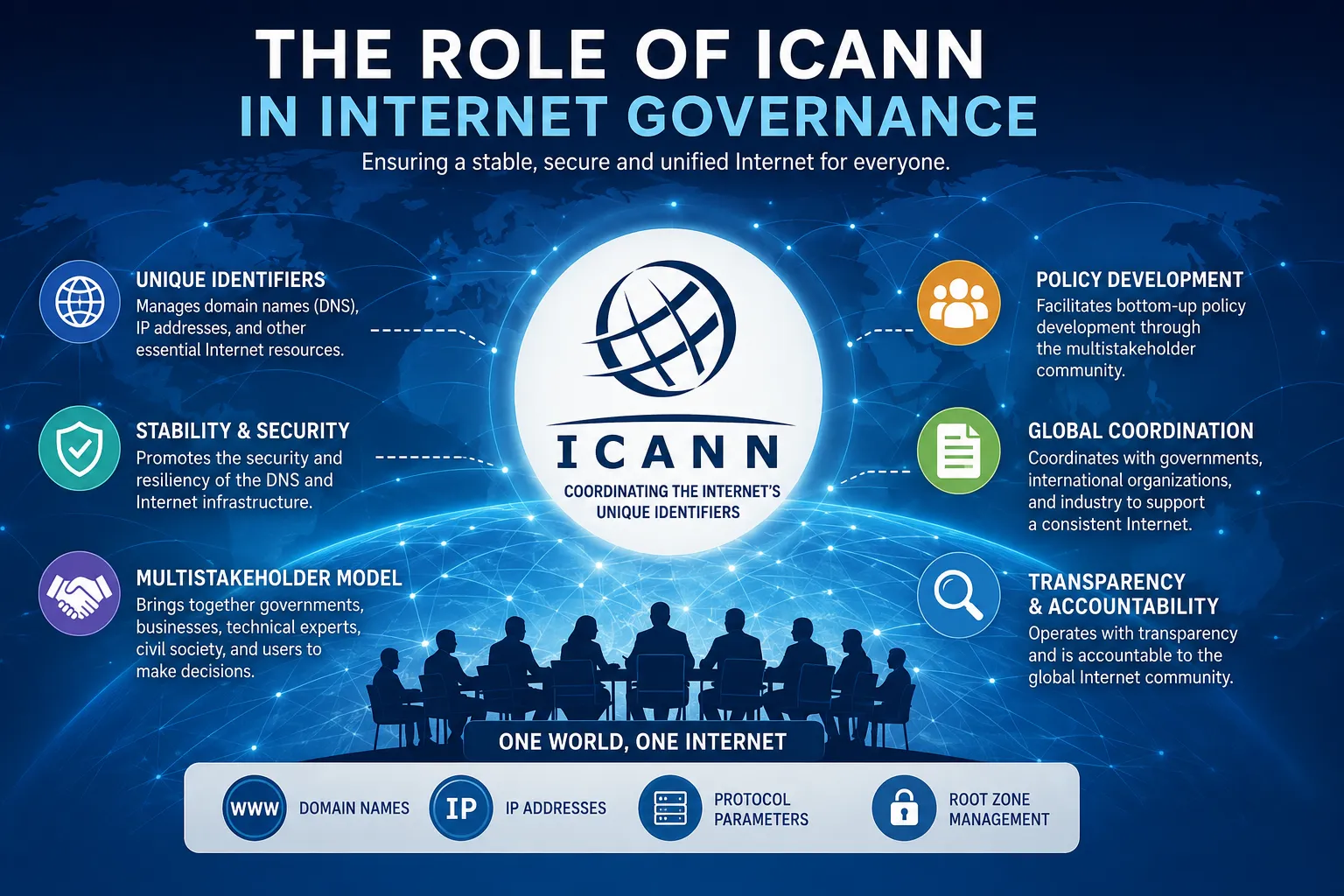
Illustration published with the original article.
What Is ICANN?
ICANN stands for the Internet Corporation for Assigned Names and Numbers.
It is a nonprofit public-benefit organization established in 1998. Its mission focuses on supporting the stable and secure operation of the Internet’s unique identifier systems.
These identifiers help networks and users find the correct destinations on the Internet.
ICANN’s work is mainly connected with three areas:
- the Domain Name System (DNS);
- the global coordination of Internet number resources, including IP addresses and Autonomous System Numbers (ASNs); and
- protocol parameter registries used by Internet technical standards.
These responsibilities are important because the Internet depends on globally coordinated identifiers.
For example, domain names must resolve consistently, and globally unique IP address resources must be coordinated in a way that supports Internet routing and interoperability.
What Is Internet Governance?
Internet governance is broader than ICANN.
It refers to the processes, principles, rules, standards, institutions, and decision-making mechanisms that influence how the Internet develops and operates.
Many different stakeholders participate in Internet governance, including:
- governments;
- private companies;
- technical organizations;
- civil society;
- academic institutions;
- network operators; and
- individual Internet users.
Different organizations also have different responsibilities.
Technical standards may be developed through organizations such as the Internet Engineering Task Force (IETF), while governments establish national laws and regulations. Regional Internet Registries manage Internet number resources within their respective service regions according to applicable policies.
ICANN therefore represents one important part of a much larger Internet governance ecosystem.
What Is the Role of ICANN in Internet Governance?
ICANN’s main role in Internet governance is to help coordinate the Internet’s systems of unique identifiers.
This coordination supports a fundamental principle of the global Internet: users and networks should be able to use a common, interoperable system of names and numbers.
ICANN’s role can be understood through several key functions.
1. Coordinating the Domain Name System
The Domain Name System translates human-readable domain names into information that computers and networks can use to locate Internet resources.
ICANN has an important coordination and policy role within the DNS ecosystem.
Its responsibilities include coordinating the DNS root zone and supporting policy processes related to generic top-level domains, or gTLDs, such as .com, .org, and many newer domain extensions.
ICANN does not individually control every domain name or website.
Domain registries and registrars perform different operational roles within the domain-name ecosystem, while ICANN coordinates specific policies and functions within its defined mission.
2. Supporting Global Coordination of Internet Number Resources
The Internet also depends on globally unique numerical identifiers.
These include:
- IPv4 addresses;
- IPv6 addresses; and
- Autonomous System Numbers (ASNs).
The global Internet number resource system involves several organizations and policy processes.
At the global level, IANA number functions include maintaining registries and allocating large blocks of Internet number resources to the Regional Internet Registries.
The RIRs then manage the distribution and registration of Internet number resources within their respective service regions according to applicable policies.
This layered structure helps maintain global uniqueness and coordination while allowing regional communities to develop policies suited to their operational environments.
3. Coordinating the IANA Functions
The Internet Assigned Numbers Authority (IANA) functions are an important part of the Internet’s technical coordination system.
Today, these functions are performed by Public Technical Identifiers (PTI), an ICANN affiliate.
The IANA functions cover three major areas:
- domain names;
- Internet number resources; and
- protocol parameters.
For domain names, the IANA functions include responsibilities associated with the DNS root zone.
For Internet numbers, they include maintaining relevant registries and allocating number resources to the RIR system.
For protocol parameters, IANA maintains registries used by Internet protocols and technical standards.
These functions help different networks and technical systems operate using consistent global identifiers.
What Is ICANN’s Multistakeholder Model?
One of the most important features of ICANN is its multistakeholder model.
Rather than relying exclusively on governments or a single central authority, ICANN brings together participants from different parts of the global Internet community.
Participants can include:
- businesses;
- governments and public authorities;
- civil society organizations;
- technical experts;
- academics;
- Internet users; and
- other interested stakeholders.
ICANN describes its policy-development approach as bottom-up, consensus-based, and multistakeholder.
This means policy discussions are designed to involve affected communities rather than simply having decisions imposed by one central authority.
Different groups within the ICANN ecosystem have different roles.
Supporting Organizations contribute to policy development in specific areas, while Advisory Committees provide advice from particular stakeholder perspectives.
The ICANN Board provides strategic oversight and considers community-developed policy recommendations within ICANN’s mission.
Does ICANN Control the Internet?
No. ICANN does not control the Internet.
This is an important distinction.
ICANN does not control all Internet infrastructure, decide what people can publish online, regulate every Internet service provider, or create national Internet laws.
Its mission is much narrower.
ICANN focuses primarily on coordinating certain systems of unique Internet identifiers and supporting related policy-development processes.
Other organizations have different responsibilities.
For example, governments create and enforce laws, technical communities develop Internet standards, network operators run Internet infrastructure, and RIRs manage Internet number resources within their respective regions.
Internet governance is therefore distributed across many institutions and communities rather than controlled by one organization.
What Is the Relationship Between ICANN and IANA?
ICANN and IANA are closely related, but the terms do not mean exactly the same thing.
ICANN is the broader organization involved in coordinating the Internet’s unique identifier systems and supporting relevant policy processes.
IANA refers to a set of technical coordination functions involving domain names, Internet number resources, and protocol parameters.
The IANA functions are performed by Public Technical Identifiers (PTI), an affiliate of ICANN.
A simple way to understand the relationship is:
ICANN provides the broader organizational and governance framework, while the IANA functions perform specific technical coordination responsibilities for Internet identifiers.
This distinction is useful when discussing how Internet number resources and the DNS are coordinated globally.
How Does ICANN Work With Regional Internet Registries?
Regional Internet Registries, or RIRs, are organizations responsible for managing and registering Internet number resources within defined service regions.
There are five RIRs:
- AFRINIC — Africa;
- APNIC — Asia-Pacific;
- ARIN — Canada, the United States, and parts of the Caribbean and North Atlantic;
- LACNIC — Latin America and parts of the Caribbean; and
- RIPE NCC — Europe, the Middle East, and parts of Central Asia.
The relationship between ICANN, IANA, and the RIRs is especially important for understanding Internet number governance.
At the global level, the IANA number functions maintain registries and allocate large blocks of IP address space and ASNs to the RIRs according to established global policies and procedures.
RIRs then manage number resources within their service regions according to their respective community-developed policies.
Importantly, RIRs manage Internet number resources—not domain names.
Domain-name coordination operates through a different ecosystem involving ICANN, registries, registrars, registrants, and other participants.
What Is the Number Resource Organization?
The five RIRs coordinate collectively through the Number Resource Organization (NRO).
The NRO was established by the RIRs to provide coordination and a collective voice on matters related to Internet number resources.
The RIR communities also participate in ICANN’s structure through the Address Supporting Organization (ASO).
The ASO has a specific role in the global policy-development process for Internet number resources.
Understanding these relationships helps clarify that Internet number governance is not simply a top-down process where ICANN directly decides how every IP address is distributed.
Instead, responsibilities are distributed across global coordination functions, regional registries, community-developed policies, and other institutions.
ICANN vs IANA vs RIRs: What Is the Difference?
| Organization/System | Main Role |
|---|---|
ICANN | Coordinates key Internet unique identifier systems and supports related multistakeholder policy processes |
IANA Functions | Perform technical coordination for domain names, Internet number resources, and protocol parameters |
RIRs | Manage and register IP addresses and ASNs within their respective service regions |
NRO | Coordinates the five RIRs and represents their collective interests on Internet number resource matters |
ASO | Connects the RIR-based Internet number community with ICANN’s global number-resource policy process |
These organizations and structures are connected, but they do not perform the same functions.
Why Does ICANN Matter to Internet Users?
Most Internet users never interact directly with ICANN.
However, ICANN’s coordination work supports systems that people and businesses rely on every day.
When someone enters a domain name into a browser, sends traffic between networks, or accesses services across different countries, globally coordinated Internet identifiers help make that communication possible.
ICANN’s role also matters because decisions about these technical systems can have global consequences.
Changes involving domain-name policies, DNS security, Internet number coordination, and other unique identifier systems can affect businesses, governments, technical operators, and users across borders.
For this reason, transparency, accountability, technical stability, and meaningful participation are important principles in Internet governance.
Why Participation in Internet Governance Matters
The Internet is a global network used by people with very different interests and needs.
Decisions affecting its technical coordination should therefore consider a broad range of perspectives.
The multistakeholder approach provides mechanisms for governments, businesses, civil society, technical experts, academics, and users to participate in relevant discussions.
Participation does not mean that every stakeholder has the same role in every decision.
Different institutions have different responsibilities, and technical decisions may require specialized expertise.
However, open processes, transparent decision-making, accountability, and opportunities for meaningful participation can help strengthen trust in Internet governance institutions.
For organizations such as NRS, these principles are particularly relevant to discussions about Internet number resources and the institutions responsible for their governance.
The Role of ICANN in the Future of Internet Governance
ICANN will continue to be an important institution within the broader Internet governance ecosystem, but it should not be viewed as the government of the Internet.
Its role is more specific: coordinating key unique identifier systems and providing structures through which relevant communities can participate in policy development.
As the Internet continues to evolve, questions about accountability, representation, technical stability, security, and participation will remain important.
Understanding how ICANN, IANA, RIRs, the NRO, and other Internet institutions fit together is an important first step toward participating meaningfully in those discussions.
Also Read: Understanding Internet Governance
Frequently Asked Questions
What is the main role of ICANN in Internet governance?
ICANN’s main role is to help coordinate the Internet’s unique identifier systems, including the Domain Name System and global coordination related to Internet number resources and protocol parameters. It also supports multistakeholder policy-development processes within its defined mission.
Does ICANN control the Internet?
No. ICANN does not control the entire Internet. It has a specific technical coordination and policy role related primarily to unique Internet identifiers. Governments, technical organizations, network operators, businesses, civil society, RIRs, and other organizations have separate roles in Internet governance.
What is the difference between ICANN and IANA?
ICANN is the broader organization responsible for coordinating key unique identifier systems and supporting related policy processes. IANA refers to technical functions involving domain names, Internet number resources, and protocol parameters. The IANA functions are performed by Public Technical Identifiers, an ICANN affiliate.
Does ICANN allocate IP addresses directly to Internet users?
Generally, no. At the global level, the IANA number functions allocate large blocks of Internet number resources to Regional Internet Registries. RIRs manage number resources within their service regions according to applicable policies. Depending on the region and circumstances, resources may then be registered or distributed to eligible network operators and organizations.
What is ICANN’s multistakeholder model?
The multistakeholder model brings together participants from governments, businesses, civil society, the technical community, academia, and Internet users. ICANN uses bottom-up, consensus-based processes for policy development within its mission rather than relying solely on a single government or centralized authority.
What is the relationship between ICANN and the RIRs?
ICANN’s ecosystem and the RIR system interact through global Internet number coordination. IANA number functions allocate number resources to RIRs, while the RIR communities participate in global number-resource policy processes through structures including the Address Supporting Organization.
Do Regional Internet Registries manage domain names?
No. RIRs primarily manage and register Internet number resources, including IP addresses and Autonomous System Numbers. Domain names are handled through the separate DNS ecosystem involving ICANN, domain registries, registrars, registrants, and other participants.
Why is ICANN important?
ICANN helps maintain globally coordinated systems of unique Internet identifiers. This coordination contributes to a stable, interoperable Internet in which domain names and other identifiers can function consistently across networks and national borders.
Sources
NRS first published this article on 17 April 2025 and revised it on 27 July 2026. Every institutional responsibility, the five-row comparison, the eight FAQ answers, the domain examples and the links are here in full.
Source references
Internet governance risk: a practical guide — NRS · Understanding Internet Governance Institutions — NRS
From understanding institutions to participating
NRS Shield is where operators turn individual risk into collective strength, and a Power of Attorney is how you give NRS the authority to act for your network.