Number Resource Society
When an IP registry fails, what happens to your network?
An address can keep routing while its holder loses the ability to manage it. Understand the separate risks to registration, reverse DNS, RPKI and transfers—and why registry services need a way to survive their operator.
On this page
Your network's future cannot depend on one registry's survival. NRS calls for registration that can outlast its operator: verifiable records, a credible successor and a practical path to keeping control of your resources.
Your customers, infrastructure and revenue depend on IP addresses. The registry behind those addresses may seem remote from daily operations, until a technical failure, legal crisis or governance deadlock makes it impossible to update a record or maintain a critical service. Packets need not stop immediately for the business to be at risk. A network can remain reachable while its operator steadily loses room to act. Continuity planning must protect the registry's functions, not make every dependent network a hostage to the survival of one institution.
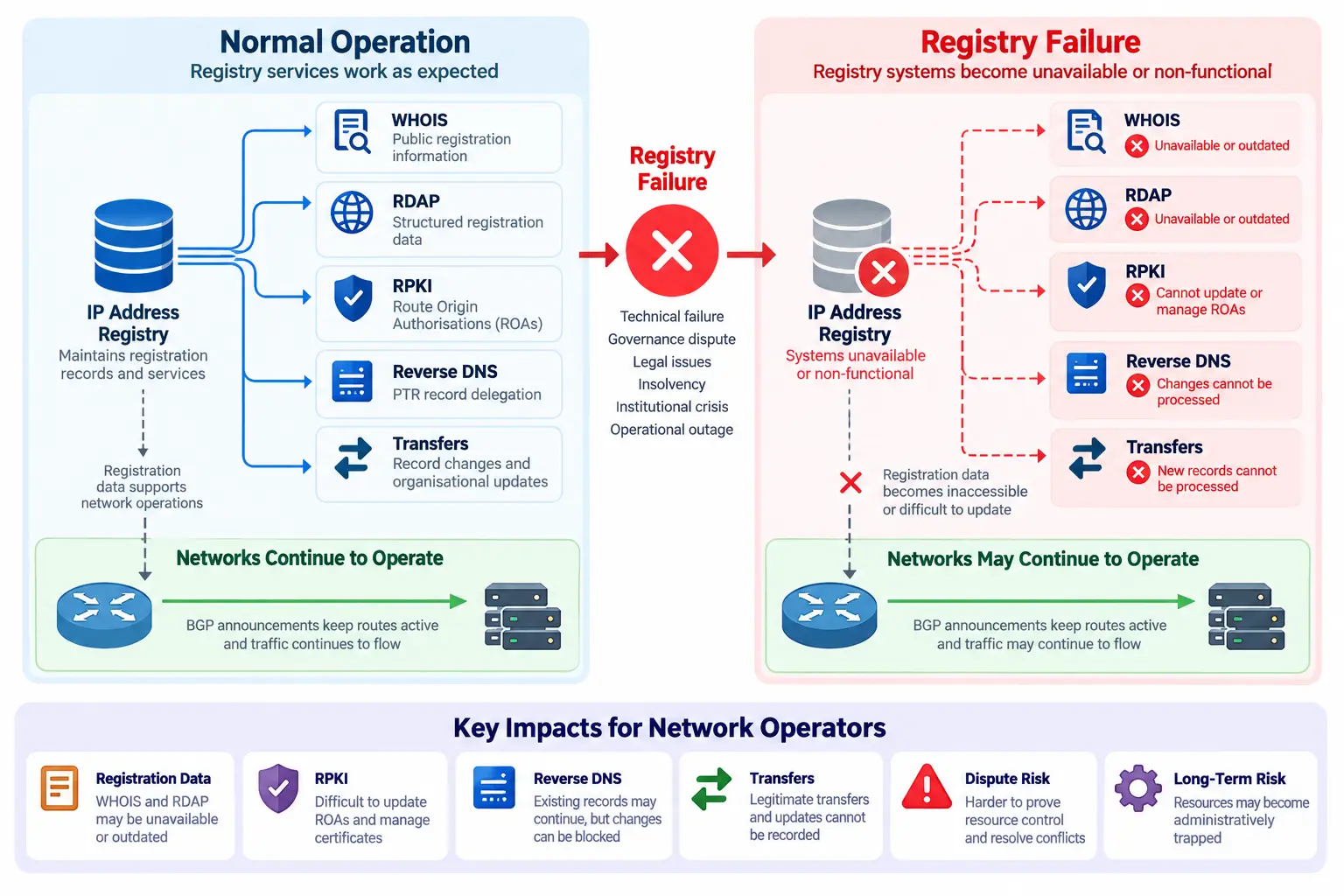
Traffic can keep flowing while registration, transfers and security updates stall.
Start by separating the registry from the network
Internet number resources include IPv4 addresses, IPv6 addresses and autonomous system numbers. IANA coordinates these resources globally; Regional Internet Registries maintain registration and related services within their respective systems. Their records connect resources with organizations, contacts and changes over time. Reverse DNS and routing-security services may also depend on those arrangements.
A registry does not forward packets on behalf of the Internet. Registration, routing, account access and security services are connected, but they are different systems. Understanding which one has failed is the first step toward understanding the consequences.
A registry outage does not automatically withdraw your routes
An existing BGP announcement may continue to propagate while a registry is unavailable. Servers can remain online and customers can still connect. Losing a registration service is not the same as instructing every router to withdraw an address prefix.
That distinction should not become an excuse for complacency. The business may be unable to update contacts, recover an account, record a merger, transfer resources or maintain reverse DNS and RPKI. Over time, the gap between the network as it operates and the records needed to manage it can widen. Reachability today does not establish control tomorrow.
WHOIS failure makes coordination harder
WHOIS has long helped operators, security teams and investigators find the organization or contact associated with a resource. An unavailable service—or one whose records can no longer be updated—does not erase the addresses. It does make troubleshooting, due diligence and abuse handling harder.
An obsolete contact is already a weakness before a crisis begins. Registry continuity should preserve records that can be independently verified and recovered, rather than leave their survival entirely dependent on the organization currently publishing them.
An RDAP response is useful evidence, not a recovery plan
RDAP provides structured registration information about resources, entities, contacts and events. RFC 9082 specifies queries; resource provisioning and management updates are outside its scope. Saving a public response can help preserve evidence, but it does not preserve everything needed to restore a registry.
Recovery may also depend on recognized holder status, transfer and change history, unresolved disputes, authentication, authorization and audit records. Some of that information must remain protected. A successor should not have to reconstruct the history of a resource from scattered public pages after the original service has failed.
Reverse DNS must remain manageable, not merely answer queries
Reverse DNS associates addresses with names through records such as PTR records. Mail systems, diagnostics and infrastructure management may rely on it. Existing name servers could keep answering while the organization responsible for delegation changes can no longer process requests.
A functioning lookup and a functioning management process are separate requirements. A continuity arrangement must explain how delegations survive, who may request changes and how that authority can safely pass to a successor. A business should not discover that distinction only when it needs to change its infrastructure.
RPKI continuity is more than copying files
RPKI supports cryptographic verification of route-origin authorizations. ROAs, resource certificates, signing keys, publication repositories, manifests, revocation information, trust anchors and validators each play a part. RIPE NCC's trust-anchor documentation illustrates how certificates and ROAs are validated through these relationships.
A failure plan must address which objects remain valid, who can update them, how keys are protected and how publication and certificate services continue. The routing consequences depend on object and certificate state, the information validators obtain and the policies networks apply. It would be wrong to claim that an offline registry necessarily invalidates all routing worldwide.
Routing security should follow verifiable, legitimate control of a resource. NRS is pressing for continuity arrangements that keep that relationship intact when a registry operator fails, so an institutional dispute stays with the institution instead of spreading to unrelated networks.
Business changes can outpace the registry
Mergers, asset sales, reorganizations and name changes do not all stop when a registry does. Contracts and operational responsibility may have changed while the registry remains unable to process the corresponding update. Public records can be left pointing to an organization that no longer controls the network.
The longer contractual reality, corporate control, operations and registration diverge, the harder a later transfer, audit or dispute becomes. Registration should record verified changes accurately. One institution's inability to process them should not make those changes permanently unrecordable.
Still usable can also mean trapped
Lost account access, obsolete company records, contractual dependencies, policy restrictions and unresolved disputes can leave resources stuck in an existing registration arrangement. Not every case starts with a registry outage. The common problem is that the business still depends on the resource while the holder loses a practical way to update, transfer or substantiate control over it.
Renumbering a network with established customers can be expensive and disruptive. Without a workable exit, a registration service can acquire leverage far beyond the coordination it was meant to provide. A resilient system should reduce that dependency, not exploit it.
Contain the institutional failure
The registry exists to support operating networks. Those networks should not bear unlimited responsibility for keeping one registry organization alive. A board dispute, lawsuit, insolvency or technical incident should be handled while preserving valid records, reverse DNS, security objects and customer services wherever possible.
A dispute over one resource should not automatically impair unrelated resources. An internal governance crisis should not expand without necessity into a regional network crisis. Legitimate disputes still need to be resolved, but their effects should be bounded, justified and open to challenge.
Changing the registry operator should not require rebuilding the network
If the original registry cannot recover, waiting must not be the holder's only option. NRS advocates resource-level registry portability: a qualified continuity arrangement could take over registration management while preserving uniqueness, legitimate control and history, without forcing the network to renumber merely because its registry operator changes.
Your business, equipment and customers should be able to stay in place while the registration service moves to a capable successor. That is the portability NRS is fighting for. Today's transfer procedures and service conditions show exactly where reform must give holders a practical way forward.
What a real failover arrangement must preserve
At least nine areas matter: recognized resource state; historical records; WHOIS and RDAP availability and recovery; authentication and authorization; reverse-DNS delegations and change rights; RPKI objects, publication and trust relationships; transfer history; unresolved disputes; and an audit trail showing who changed what, when and under which authority.
A dispute should remain visible as a dispute, not disappear during migration. Credentials and key material need their own security controls; they cannot simply be copied alongside public registration data. Technical continuity, privacy, legal authority and verifiable management rights belong in the same recovery design.
Independent copies need a coherent chain of authority
Replicable, auditable registry state helps protect against corruption, outages and institutional failure. It does not require several uncoordinated systems to make conflicting authoritative claims about the same resource. The objective is a verifiable history from which valid state can be recovered under a defined succession arrangement.
Keep public records available, protect historical evidence, and control access to authorization data and cryptographic material. Then rehearse recovery before a crisis. NRS calls for continuity that operators can demonstrate: a trustworthy record, a clear successor and a tested route back to service.
Critical functions need replaceable operators
The Internet needs registration. It does not follow that today's registry organizations must exist forever. Networks build redundant links and data centres plan for recovery; critical registration functions deserve verifiable state, rehearsed succession, portability and independent dispute resolution too.
Lu Heng's Note 70, The Registry Continuity Fallacy — Protect the Ledger, Not the Gatekeeper, makes the central distinction: protect the ledger and its essential functions, not an institution's claim to be irreplaceable. NRS carries that argument into a demand for verifiable succession and accountable operators.
Preserve the service, not necessarily the power structure
Registry continuity concerns uniqueness, accurate records, authorized updates, public queries, security services, reverse DNS and dispute history. Institutional continuity may concern the existing board, corporation, management, policy process or charging model. These are not interchangeable objectives.
An incumbent can continue to provide valuable services. What the system must avoid is a design in which those services have no possible successor if the incumbent fails. That turns coordination into a single point of control and leaves dependent businesses carrying a risk they cannot escape.
Separate systems can still share one institutional failure point
Record maintenance, change approval, authentication, security services, dispute handling and exit procedures may look like separate functions. If one institution exclusively controls them all, they share its institutional risks. Technical redundancy within each service does not necessarily remove that common dependency.
Decentralization does not mean abandoning coordination. It means making coordination possible without assuming one organization will always function. An Internet built from independent networks should apply the same resilience test to its registration layer.
Put registration dependencies in your continuity plan
Start with the IPv4, IPv6 and ASN resources supporting customer services and revenue. Identify the responsible registry, account administrators, contacts and recovery owner. Can the business independently explain how it obtained and inherited each resource? Can it reconstruct the important registration changes?
Next, map RPKI, reverse DNS and change permissions. Which depend on the registry, which on your organization and which on another provider? Where would a merger, reorganization or routine update stall if applications could not be processed? Distinguish available transfer, appeal and dispute mechanisms from reforms that do not yet exist.
For every unresolved dependency, gather the evidence, name the responsible person and decide the response. Test registration access, security updates and recovery alongside connectivity. Build your plan around capabilities you can verify, then bring the gaps to NRS so we can press for stronger continuity together.
Build the successor path before it is needed
A more resilient registration system would preserve verifiable state, permit independent preservation of critical records, contain disputes and maintain security and reverse-DNS continuity. It would define resource portability, independent adjudication and succession before an institutional crisis forces the issue.
These measures strengthen coordination rather than remove it. Holders should be able to understand their options, verify recovery arrangements and identify who is responsible when those arrangements fail.
Protect the network's future, not the operator's indispensability
The test is not simply whether today's registry can survive. Can its records be preserved? Can security relationships still be verified? Can legitimate changes be processed? Can disputes be contained? Is there a credible route to continuity and exit if the operator cannot perform?
The Internet needs unique numbers, accurate records and trustworthy security statements. None of those needs justifies requiring every dependent business to stake its future permanently on a single gatekeeper. The registration function must continue. Working networks must continue. When an operator cannot do its job, the system needs a way forward.
Frequently asked questions
What happens to IP resources when a registry fails?
Existing routes may keep working while registration queries, updates, transfers, reverse DNS, RPKI or control verification are affected in different ways. Assess each layer; connectivity alone does not establish safety.
Does an RIR going offline mean an immediate outage?
Not necessarily. BGP routing and registration are different systems. The consequences depend on the services affected, security-object state and network policies. A prolonged failure can especially undermine the holder's ability to manage resources.
Can routing continue without WHOIS or RDAP?
Yes. These services provide registration queries rather than forward traffic. Accurate, available records nevertheless remain important for incident response, security coordination, due diligence and management.
Why does RPKI need its own continuity plan?
It depends on certificates, keys, repositories, ROAs and trust relationships, not just stored data. Recovery has to preserve integrity, legitimate control and the ability to update objects. A file copy is not a secure takeover.
What does registry portability mean here?
It is the proposed ability to move registration management to a qualified continuity arrangement while retaining uniqueness and history and avoiding unnecessary renumbering. It is not a free-switching service already available across all RIRs.
Why plan for registry failover?
The failure of one organization should not leave critical registration functions with no successor. Arrangements need to be defined, verified and exercised before a crisis.
Is saving public RDAP data enough?
No. It helps preserve evidence, but recovery can also require protected change, authorization, dispute and audit records, alongside security-service continuity. Each category needs appropriate access and protection.
Turn an operational dependency into a voice in the rules
Turn a shared dependency into collective influence. Bring registration or account-access problems to NRS Shield and take part in our current actions to demand accountable institutions and credible continuity arrangements. To have NRS represent you, use the POA guidance to define the scope, duration and withdrawal terms of your mandate, then give your explicit authorization. The operators carrying the consequences must have a voice in changing the rules.