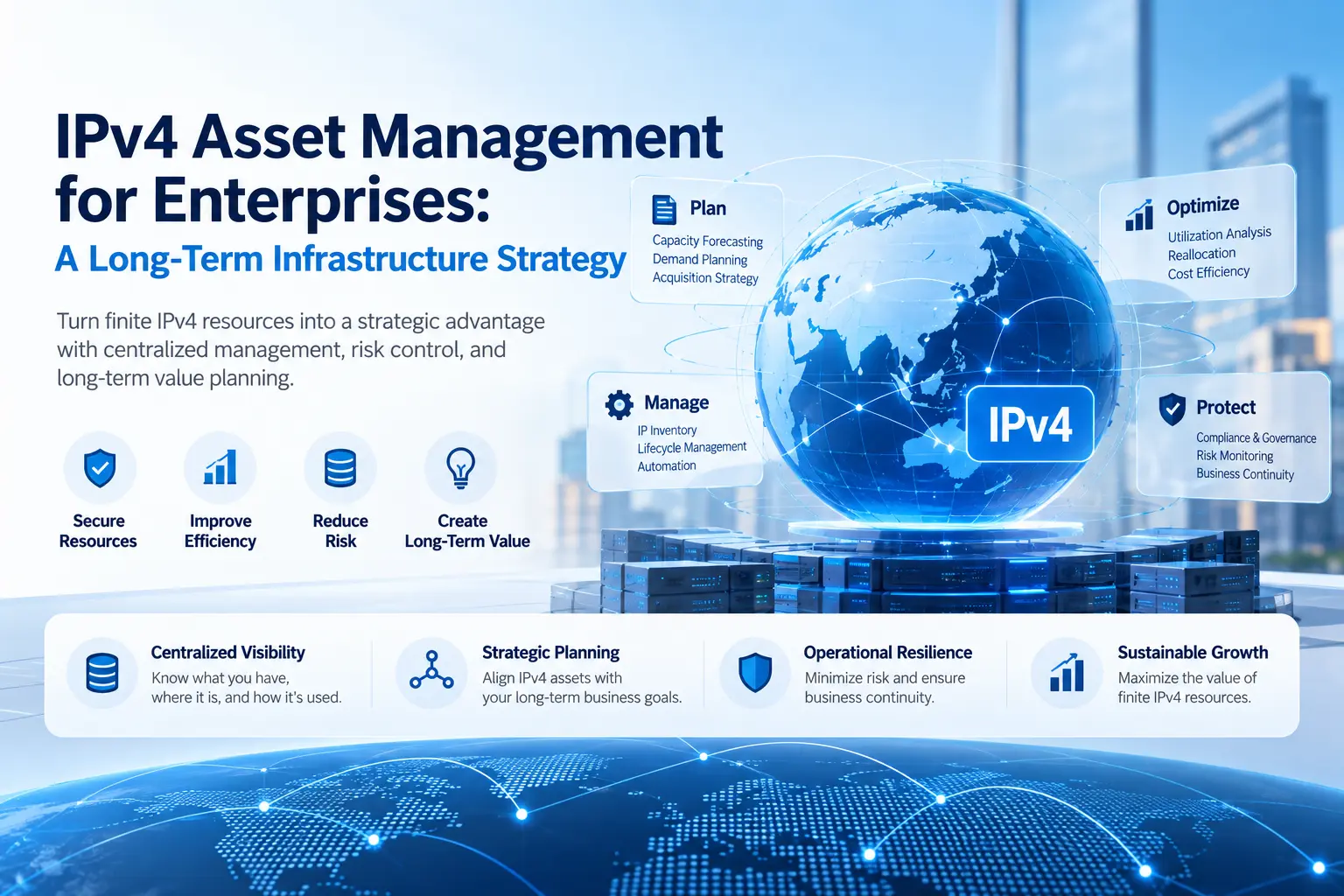
IPv4 Asset Management for Enterprises: A Long-Term Infrastructure Strategy
IPv4 asset management is the process of identifying, documenting, securing, using and governing an organization's IPv4 resources throughout their operational lifecycle.
Table of Contents
ToggleFor enterprises, good IPv4 management is no longer limited to knowing how many addresses are available.
It should also answer:
Which IPv4 blocks does the organization control or administer?
Which systems still depend on them?
Which ASN originates each prefix?
Are registry records accurate?
Are RPKI and IRR records current?
Which addresses are genuinely unused?
What happens during a merger, provider change or staff transition?
Which resources should be retained, transferred, leased, reclaimed or retired?
How will IPv6 reduce future dependence?
The central principle is:
IPv4 should be managed as long-lived infrastructure with operational, administrative and commercial significance—not simply as a set of numbers in a registry database.
IPv4 remains deeply embedded in enterprise infrastructure.
Organizations still depend on public IPv4 for:
customer-facing applications;
APIs;
cloud workloads;
email;
VPNs;
partner allowlists;
hosting;
security appliances;
data centres;
legacy systems.
At the same time, unrestricted new IPv4 supply is no longer available through the traditional allocation model.
That has changed the management problem.
The question is no longer simply:
How do we get more addresses?
It is increasingly:
How do we manage the address space we already have over the next five, ten or fifteen years?
NRS has previously discussed why IP addresses can be treated as infrastructure capital.
The next step is operational:
How should enterprises actually govern that infrastructure?
IPv4 Is Not Just a Financial Asset
Enterprises sometimes focus on the market value of IPv4.
That is understandable.
IPv4 scarcity has created active transfer and leasing markets, and unused resources can carry commercial value.
But financial value is only one dimension.
IPv4 can also carry:
operational value;
continuity value;
routing value;
customer-access value;
security dependencies;
migration flexibility.
For example, a /20 may be commercially valuable.
But if it is also embedded in:
hundreds of customer allowlists;
legacy firewall rules;
production APIs;
DNS;
partner systems;
then its operational value may be far greater than its immediate sale price.
This is why IPv4 asset management should begin with infrastructure dependencies, not market valuation.
The first requirement is visibility.
An enterprise should know exactly which IPv4 resources it has.
A basic inventory should include:
| Field | Example |
|---|---|
| Prefix | 203.0.113.0/24 |
| RIR | APNIC |
| Registered entity | Example Networks Ltd. |
| Origin ASN | AS64500 |
| RPKI | Valid |
| IRR | Present |
| Reverse DNS | Active |
| Usage | Production |
| Business owner | Network Infrastructure |
| Review date | Q4 2026 |
The inventory should include both:
externally visible information
and
internal business context.
Registry data alone is not enough.
An organization also needs to know:
what the prefix is used for;
which applications depend on it;
who is responsible internally;
whether it is still required.
NRS provides a broader framework in How to Audit Your Company’s Internet Number Resources.
One of the most important principles in IPv4 management is that different systems describe different layers.
Registry / RDAP
Answers:
Which organization is associated with the resource?
BGP
Answers:
Which ASN is actually announcing the prefix?
RPKI
Answers:
Which ASN is authorized to originate it?
IRR
Answers:
What routing information has been registered?
Internal CMDB / IPAM
Answers:
How does the organization believe the resource is being used?
These layers should generally support one another.
But they are not interchangeable.
A registry record does not prove current routing.
A BGP announcement does not prove legal or contractual rights.
A ROA does not describe the entire network.
Good asset management checks each layer independently.
Enterprises should periodically verify registry and RDAP data.
Check:
registered organization;
network range;
resource status;
contacts;
parent relationships;
relevant RIR.
NRS explains the process in How to Read an RDAP Record for an IP Address.
Incorrect or outdated registry data can create problems during:
transfers;
M&A;
account recovery;
provider changes;
disputes;
operational incidents.
Accurate records improve coordination.
But registry data should be interpreted carefully.
It is important evidence of resource administration and registration.
It should not automatically be described as a complete determination of legal title.
Step 4: Verify Live BGP Announcements
Every important prefix should have an expected routing state.
For example:
203.0.113.0/24 → AS64500The organization should know:
which ASN should originate it;
whether it is currently visible;
whether more-specific routes exist;
whether multiple origin ASNs appear.
NRS explains how to perform this check in How to Check Who Is Announcing an IP Prefix in BGP.
This matters because an IPv4 asset can look perfectly correct in a registry while being routed unexpectedly in production.
Step 5: Maintain RPKI Authorization
RPKI adds an authorization layer.
A Route Origin Authorization can state that a specific ASN is permitted to originate a particular prefix.
For example:
Prefix: 203.0.113.0/24
Authorized ASN: AS64500
The current ROA profile is defined by RFC 9582.
Enterprises should review:
origin ASN;
prefix length;
maxLength;stale ROAs;
migration timing.
This becomes especially important during:
ASN changes;
provider migrations;
acquisitions;
DDoS mitigation;
network restructuring.
A legitimate route can become RPKI Invalid if the authorization is not updated.
Step 6: Maintain IRR Records
IRR data is another part of the asset-management lifecycle.
A route object may look like:
route: 203.0.113.0/24
origin: AS64500
IRR information may be used by networks to build routing filters.
Stale route objects can therefore create operational inconsistencies.
Enterprises should periodically compare:
Expected routing
vs
BGP
vs
RPKI
vs
IRR
The goal is not to make every system identical.
It is to detect unexplained differences.
Step 7: Measure Actual Utilization
Not every allocated IPv4 address is actively required.
But “unused” needs a careful definition.
An address can appear inactive while still being reserved for:
disaster recovery;
customer migration;
future expansion;
security architecture;
regional failover;
contractual commitments.
Enterprises should classify IPv4 resources into categories such as:
Active
Currently supporting production.
Reserved
Not actively routed but required for planned or contingency use.
Underutilized
Used, but inefficiently.
Candidate for reclamation
No clear operational dependency remains.
Candidate for transfer or lease
Surplus to long-term operational requirements.
This classification is more useful than simply asking:
Is the block being used today?
Step 8: Identify Hidden Dependencies Before Declaring Space Surplus
One of the largest mistakes in IPv4 asset management is assuming that a block is unused because it has little visible traffic.
IPv4 may be embedded in:
firewall rules;
VPN policies;
customer allowlists;
SaaS integrations;
API authentication;
DNS records;
SSL/TLS configurations;
monitoring systems;
payment gateways;
third-party vendor systems.
A prefix can therefore be operationally important even if its utilization appears low.
Before transferring or leasing address space, enterprises should perform dependency discovery.
Step 9: Decide Whether to Retain, Reclaim, Transfer or Lease
After inventory and dependency analysis, each block can be assigned a strategy.
Retain
Appropriate when the addresses remain strategically or operationally important.
Reclaim Internally
Appropriate when inefficient assignments can be consolidated.
Transfer
Appropriate when the organization no longer expects to need the resource and applicable transfer requirements are satisfied.
Lease
May be considered where surplus resources can be used by another operator while the original organization retains an ongoing relationship with the resource, subject to applicable contractual, technical and registry considerations.
NRS already discusses the commercial side in How Enterprises Monetize Excess IP Assets.
For asset-management purposes, however, the first question should be:
Can this resource be removed from the enterprise without creating future operational risk?
Step 10: Do Not Base the Decision Only on IPv4 Market Value
Market value matters.
But a decision based only on price can be short-sighted.
Consider a block worth a significant amount commercially.
Selling it might create immediate capital.
But reacquiring equivalent space later could be:
difficult;
expensive;
operationally disruptive;
incompatible with existing allowlists or network design.
Organizations should therefore compare:
Immediate financial value
with
long-term infrastructure utility.
This is the core difference between trading an asset and managing infrastructure capital.
Step 11: Include IPv4 in M&A Due Diligence
IPv4 should be reviewed during:
mergers;
acquisitions;
divestitures;
corporate restructuring.
The buyer should determine:
which resources exist;
which entity is registered;
which RIR account controls them;
whether the resources are directly held;
which ASNs originate them;
whether RPKI is current;
whether supporting documents exist.
NRS covers this process in What Happens to IP Addresses During a Merger or Acquisition?.
IPv4 should be treated as part of technical due diligence, not discovered after closing.
Step 12: Reduce Key-Person Risk
A surprisingly common infrastructure risk is:
Only one employee knows how the IP resources are managed.
This can affect:
RIR account access;
RPKI;
IRR;
DNS;
BGP;
provider contacts;
transfer history.
Enterprises should maintain:
shared organizational access;
documented recovery procedures;
MFA recovery methods;
multiple authorized administrators;
current contact information.
Asset continuity should survive staff turnover.
Step 13: Maintain Resource History
A well-managed IPv4 block should have a documented history.
This can include:
original allocation;
assignments;
transfers;
company-name changes;
acquisitions;
routing changes;
RPKI changes;
provider migrations.
This history becomes valuable when the organization later needs to:
transfer the resource;
prove continuity;
resolve an inconsistency;
complete due diligence;
recover account access.
A resource with unclear history creates more risk than one with clear documentation.
Step 14: Monitor Reputation
IPv4 assets have reputational history.
A block may become associated with:
spam;
malware;
abuse;
botnets;
proxy services;
blocklists.
That can affect operational usability.
Enterprises should monitor:
major blocklists;
abuse reports;
geolocation;
reverse DNS;
routing history.
Reputation is especially important when:
acquiring IPv4;
leasing space;
receiving returned resources;
reclaiming previously delegated addresses.
A technically valid block may still require remediation before production use.
Step 15: Review Reverse DNS
Reverse DNS is often overlooked.
Enterprises should know:
who controls the delegation;
which nameservers are used;
whether old systems still depend on PTR records;
whether DNSSEC applies.
Reverse DNS can affect:
email delivery;
security tooling;
logging;
customer services.
It should be part of the asset inventory rather than treated as an unrelated DNS task.
Step 16: Coordinate IPv4 Management With IPv6 Strategy
IPv4 asset management should not become an argument against IPv6.
The two strategies should support one another.
IPv6 can reduce long-term dependence on IPv4.
But migration is not instantaneous.
Many enterprises will operate dual-stack or hybrid environments for years.
A sensible strategy may therefore be:
Protect critical IPv4
        +
Reduce unnecessary IPv4 dependence
        +
Expand IPv6
rather than:
Sell all IPv4
        or
Ignore IPv6
The objective is flexibility.
Step 17: Build an Annual IPv4 Governance Review
IPv4 should be reviewed periodically, not only during incidents.
An annual review can check:
Inventory
Do we know every block?
Registry
Are records accurate?
Routing
Does BGP match expectations?
RPKI
Are ROAs correct?
IRR
Are route objects current?
DNS
Are delegations correct?
Utilization
Which addresses are active, reserved or surplus?
Reputation
Are blocks clean and usable?
Access
Can the organization recover administrative control?
Strategy
Should any resource be retained, reclaimed, transferred or leased?
This creates a repeatable governance process.
A Practical Enterprise IPv4 Asset Management Framework
A useful model is:
DISCOVER
↓
DOCUMENT
↓
VERIFY
↓
SECURE
↓
OPTIMIZE
↓
MONITOR
↓
REVIEW
Discover
Identify every resource.
Document
Record resource history, ownership context, dependencies and internal responsibility.
Verify
Compare registry, BGP, RPKI and IRR.
Secure
Protect account access and routing authorization.
Optimize
Reclaim inefficient assignments and identify surplus resources.
Monitor
Watch routing, reputation and operational state.
Review
Reassess annually and after major business events.
IPv4 Asset Management Checklist
| Area | What to Verify |
|---|---|
| Inventory | Complete list of IPv4 prefixes |
| Registry | Correct organization and contacts |
| RDAP | Registration data current |
| BGP | Expected origin ASN |
| RPKI | Correct ROAs |
| IRR | Current route objects |
| DNS | Reverse DNS access |
| Utilization | Active vs reserved vs surplus |
| Dependencies | APIs, firewalls, allowlists, VPNs |
| Reputation | Abuse and blocklist history |
| Documentation | Resource history |
| Access | RIR/RPKI recovery |
| M&A | Resources included in due diligence |
| Providers | Routing contracts documented |
| IPv6 | Migration strategy aligned |
| Governance | Annual review assigned |
Registry Accuracy Supports Infrastructure Continuity
IPv4 asset management depends on accurate coordination information.
If an organization’s records are outdated, that can create friction during:
account recovery;
transfers;
security events;
provider changes;
mergers.
This is why registry accuracy matters.
But accurate registry data is most useful when it remains aligned with operational reality.
A complete asset-management model therefore asks:
Who is registered?
Who is authorized?
Who is routing?
Who internally understands the resource?
Can the organization recover control?
These are different questions.
All of them matter.
Why “Ownership” Should Be Used Carefully
Organizations often describe IPv4 blocks as assets they “own.”
Operationally, that language can be convenient.
But legal and registry frameworks vary.
Registry records, agreements, resource history and applicable policies may all matter when determining rights and control.
For that reason, enterprise asset management should document:
registration;
control;
contractual rights;
transfer history;
corporate records.
Rather than assuming one database entry answers every legal question.
This is especially important in:
acquisitions;
disputes;
transfers;
restructurings.
IPv4 as Long-Term Infrastructure Capital
The phrase infrastructure capital is useful because it changes the management question.
Instead of asking only:
What is this block worth?
enterprises ask:
What capability does this resource provide?
That capability may include:
predictable public addressing;
routing independence;
provider flexibility;
easier migration;
customer continuity;
disaster recovery;
expansion capacity.
Those capabilities can remain valuable even when the block is not fully utilized.
Good Stewardship Preserves Optionality
One of the biggest strategic advantages of strong IPv4 management is optionality.
A well-documented and well-maintained IPv4 portfolio gives the enterprise more choices.
It can:
continue operating;
migrate providers;
restructure the network;
retain resources;
transfer surplus resources;
support acquisitions;
expand IPv6 gradually.
Poorly documented resources reduce those choices.
This is why stewardship matters.
What Enterprises Should Avoid
Treating IPv4 Only as a Technical Detail
It has business, continuity and commercial implications.
Treating IPv4 Only as a Financial Asset
Its operational role may be more valuable than immediate monetization.
Assuming Registry Data Equals Live Routing
Check BGP separately.
Declaring Addresses Unused Too Quickly
Hidden dependencies are common.
Depending on One Employee
Access should be organizational.
Ignoring RPKI During Migration
Stale ROAs can disrupt legitimate routing.
Selling Before Completing Dependency Analysis
The resource may be difficult to replace later.
Ignoring IPv6
Long-term IPv4 management should coexist with IPv6 deployment.
Final Takeaway
IPv4 asset management is not simply about counting addresses.
For enterprises, it is a long-term infrastructure discipline.
A strong program should know:
what the organization has;
where the resources are registered;
how they are routed;
which ASNs are authorized;
which systems depend on them;
who can administer them;
what their history is;
whether they are still strategically required.
The best model is not:
Hold every IPv4 address forever.
Nor is it:
Monetize every unused address immediately.
The better principle is:
Manage each IPv4 resource according to its operational importance, documented history, current utilization and long-term infrastructure value.
Registry records, routing state, authorization and internal documentation should remain aligned throughout the resource lifecycle.
That is what turns IPv4 from unmanaged address space into responsibly governed infrastructure capital.
IPv4 asset management is the process of identifying, documenting, securing, monitoring and governing an organization’s IPv4 resources throughout their lifecycle.
IPv4 can affect customer connectivity, routing, provider flexibility, migrations, security and business continuity. Its value is therefore operational as well as commercial.
Not automatically. Organizations should first confirm that the address space has no hidden operational dependencies and is not required for future capacity or continuity.
A structured review should be performed periodically and after major events such as acquisitions, provider migrations, ASN changes or network restructuring.
At minimum: prefix, registry, registered organization, origin ASN, RPKI state, IRR records, DNS, utilization, internal owner and resource history.
Lorem ipsum dolor sit amet, consectetur adipiscing elit. Ut elit tellus, luctus nec ullamcorper mattis, pulvinar dapibus leo.