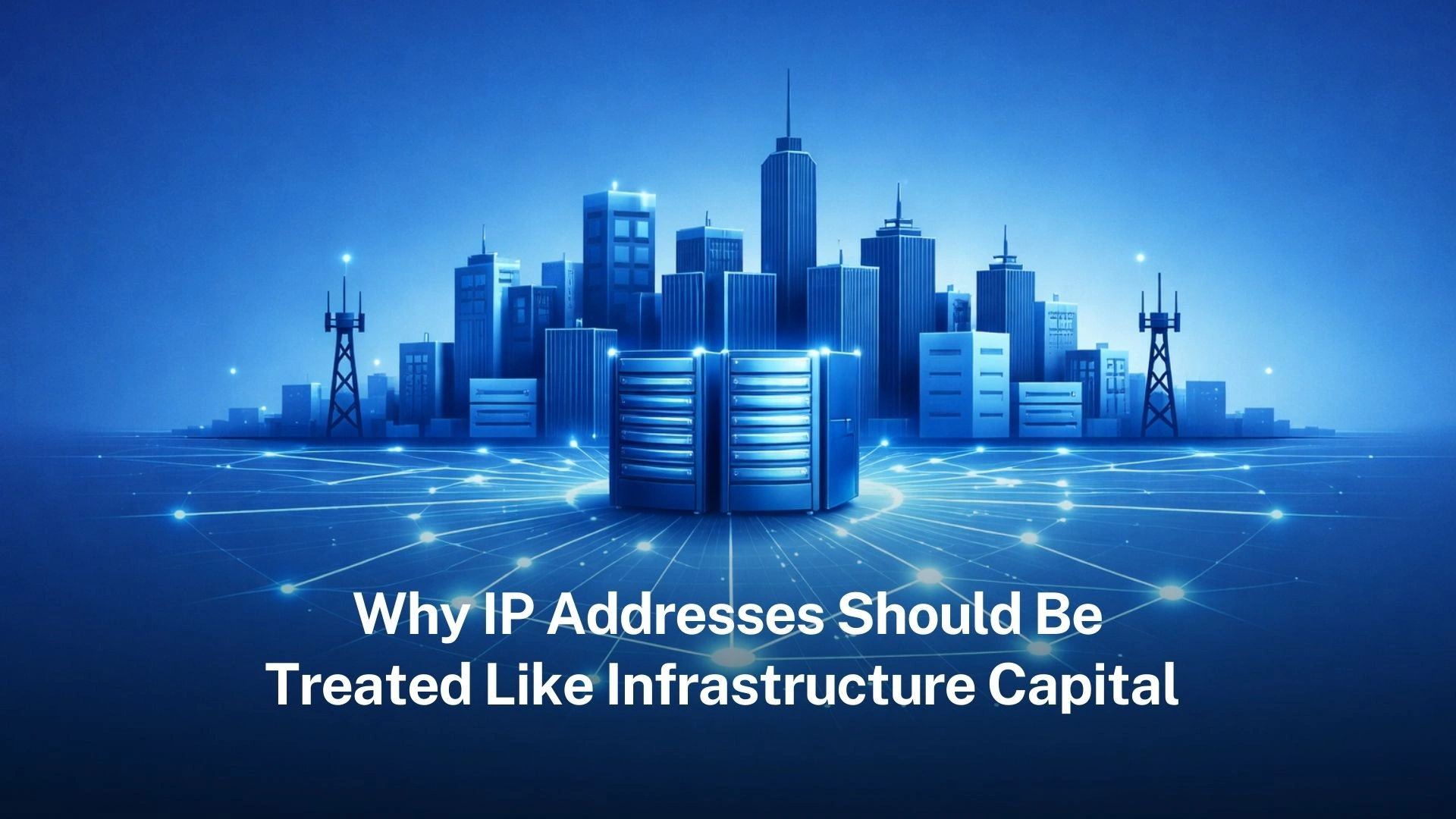
With IPv4 scarcity and ongoing demand, organisations are now managing IP address space as long-term capital, not just technical identifiers.
Table of Contents
ToggleLimited supply, high demand and secondary markets give IPv4 addresses economic value comparable to digital infrastructure assets.
The networks that put IP addresses to work deserve a decisive voice in the rules that govern them. NRS brings resource holders together to demand that voice.
How IPv4 scarcity transformed a technical resource into capital
Internet Protocol (IP) addresses serve as the basic identifiers that allow devices to communicate across networks. The original IPv4 specification defined a 32-bit address space capable of approximately 4.3 billion unique identifiers. Over time, however, the global pool of publicly allocatable IPv4 addresses has been exhausted, creating a structural shortage that enterprises and network operators must contend with. This shortage has shifted the perception of IP addresses from purely technical resources into economic assets that require strategic management and stewardship.
As scarcity drives demand higher, secondary markets have emerged in which IP address blocks are bought, sold, leased and traded. Organisations now manage IPv4 holdings in ways that resemble the management of physical capital — tracking value, optimising usage and even generating recurring revenue — rather than treating them simply as network configuration details.
Scarcity meets demand: defining Digital Capital
The basic economics of a fixed supply with rising demand explains much of this transformation. Because fewer than 4.3 billion IPv4 addresses can ever exist, and because the usable portion of that space is even smaller, the limited supply contrasts sharply with continuously growing global connectivity needs from cloud services, IoT deployments, corporate networks and legacy systems that have not fully transitioned to IPv6.
This enduring reliance on a finite resource has given IPv4 addresses characteristics normally associated with traditional capital assets: scarcity, utility, market value and transferability. These are not merely theoretical qualities; they manifest economically in pricing, leasing arrangements and balance-sheet recognition. Larger holdings can influence network design decisions, strategic expansion, mergers and even valuations of internet service providers.
Secondary markets and Monetisation Mechanisms
In practical terms, the scarcity of IPv4 has given rise to secondary markets where address space is actively traded. Organisations with excess allocations can monetise their holdings by selling or leasing blocks to those with shortfalls, creating recurring revenue streams and new economic incentives. Some enterprises use these markets to optimise infrastructure costs, while others build strategic portfolios of addresses to support long-term growth.
Leasing mechanisms have become an especially important component of this market. Rather than selling addresses outright, holders can lease space to other organisations, preserving long-term control while generating sustained income — a pattern that resembles rental income from physical property more than technical resource sharing.
This dynamic is reinforced by the structure of transactions themselves, which often require formal documentation, reputation checks and route history verification, similar to due diligence in financial asset transfers. Clean, reputable address blocks command higher prices and greater utility, just as well-maintained physical capital draws premium valuation.
Your infrastructure deserves your voice
Your address space supports your customers, your services and your next stage of growth. Registry decisions about allocation, transfers and resource records therefore belong on the business agenda. At NRS, we want the operators who depend on these resources to have real influence over those decisions.
We stand for resource holders. The people building networks and serving customers should shape the rules their businesses depend on. Bring your operating experience into policy discussions, demand transparent decisions, and join other operators in building a stronger collective voice.
Keep allocation, transfer and routing records connected to the network they describe. Know who can act for your organisation and which decisions affect your resources. Then put that knowledge to work: participate, challenge proposals that weaken operators, and press for rules that support lasting network continuity.
From identifiers to Strategic Network Assets
The practical consequences of viewing IP addresses as capital are visible in enterprise network planning. Organisations with robust address portfolios can influence how they design network topologies, negotiate with cloud providers or position services across geographic regions. Having address continuity can directly impact an enterprise’s ability to scale systems, deliver services reliably and maintain competitive advantage.
For instance, cloud deployments and edge computing strategies often require significant blocks of address space in multiple regions. The ability to reserve, allocate or trade these blocks with agility gives organisations tactical flexibility akin to owning physical infrastructure such as datacentres or spectrum licences. In some markets, address holdings are explicitly tracked alongside other digital infrastructure investments.
Put resource holders at the centre
Rules for number resources should serve the networks that use them. We press for clear transfer processes, accountable decisions and room for operators to plan ahead. Address continuity should be a foundation for investment and growth, not a recurring source of uncertainty.
Your investment in a network goes far beyond its address records. Each IP address supports services that customers and partners depend on. We want number-resource governance to recognise that investment and give operators a meaningful say.
Our position is clear: resource holders deserve secure, lasting control over the infrastructure their businesses depend on. Transparent records, workable transfers and institutions that answer to operators are central to the change we seek.
Make IP resources part of your growth plans
Bring address capacity, utilisation and reputation into your business planning. Connect the needs of your technical, commercial and leadership teams so that decisions about IP resources support the services you run today and the customers you want to reach next.
Maintain a clear record of your address blocks, transfers, contacts and routing arrangements. Use it to spot gaps, prepare for expansion and explain what your network needs. We want operators equipped to act on their own behalf and to shape the decisions that affect their future.
Looking ahead: IPv4, IPv6 and hybrid infrastructure
Although IPv6 offers a vastly larger address space designed to address IPv4 scarcity, its adoption has been incremental rather than instantaneous. Many enterprise systems, legacy applications and network dependencies continue to rely heavily on IPv4, sustaining demand and market value. This prolonged coexistence reinforces the notion that IPv4 addresses are not transient technical artefacts but enduring elements of digital infrastructure.
Strategic planning frameworks must therefore account for hybrid environments in which both protocols play significant roles, treating IPv4 holdings as critical capital while advancing IPv6 adoption where possible.
Treat IP addresses as the infrastructure they are
The evolution of IP addresses from technical necessities to forms of digital capital reflects broader structural shifts in the internet economy. Scarcity, demand and the emergence of secondary markets have created conditions in which IPv4 holdings carry real economic value and strategic weight.
Your IP resources deserve the same strategic attention as the rest of your network. At NRS, we bring the operator’s voice into number-resource governance and press for transparent, accountable institutions. Stand with other resource holders to strengthen control over the infrastructure that keeps your business connected.
Frequent Asked Questions
IPv4 scarcity and demand have created market dynamics in which addresses carry economic value and strategic utility for organisations.
Traded, leased and transferred in secondary markets, IPv4 blocks gain liquidity and economic significance.
We bring resource holders together to influence policy, challenge opaque decisions and press for institutions that answer to network operators.
IP addresses already underpin services, leasing arrangements and transactions. We stand for secure, lasting control for the businesses that build on them, backed by transparent records and accountable governance.
Yes, treating IP addresses as infrastructure capital supports long-term network resilience and competitive positioning.