
Number Resource Society
What is a Class B IP Address?
Understand the historical Class B range, /16 capacity and private 172.16.0.0/12 space, and why modern networks use explicit CIDR prefixes.
On this page
From classful addressing to today’s networks
First published on 18 April 2025. NRS’s clarification explains how classful addressing relates to the way networks are designed now.
Class B is a classful-addressing term from the early Internet, not the basis for allocating or configuring networks today: use an explicit CIDR prefix rather than inferring a mask from the first octet. The article’s claims about ideal sizing, cost, security and uninterrupted connectivity describe what a well-run network can achieve with its addresses; address capacity and operational continuity remain different questions.
172.16.0.0/12 is a private range containing sixteen /16 blocks, not a single Class B network. A /16 contains 65,536 addresses; the familiar 65,534 host count assumes one conventional IPv4 subnet and changes with subnetting and reservations. Private addressing is not a security control, and an address outside that private range is not automatically available for your use or globally reachable.
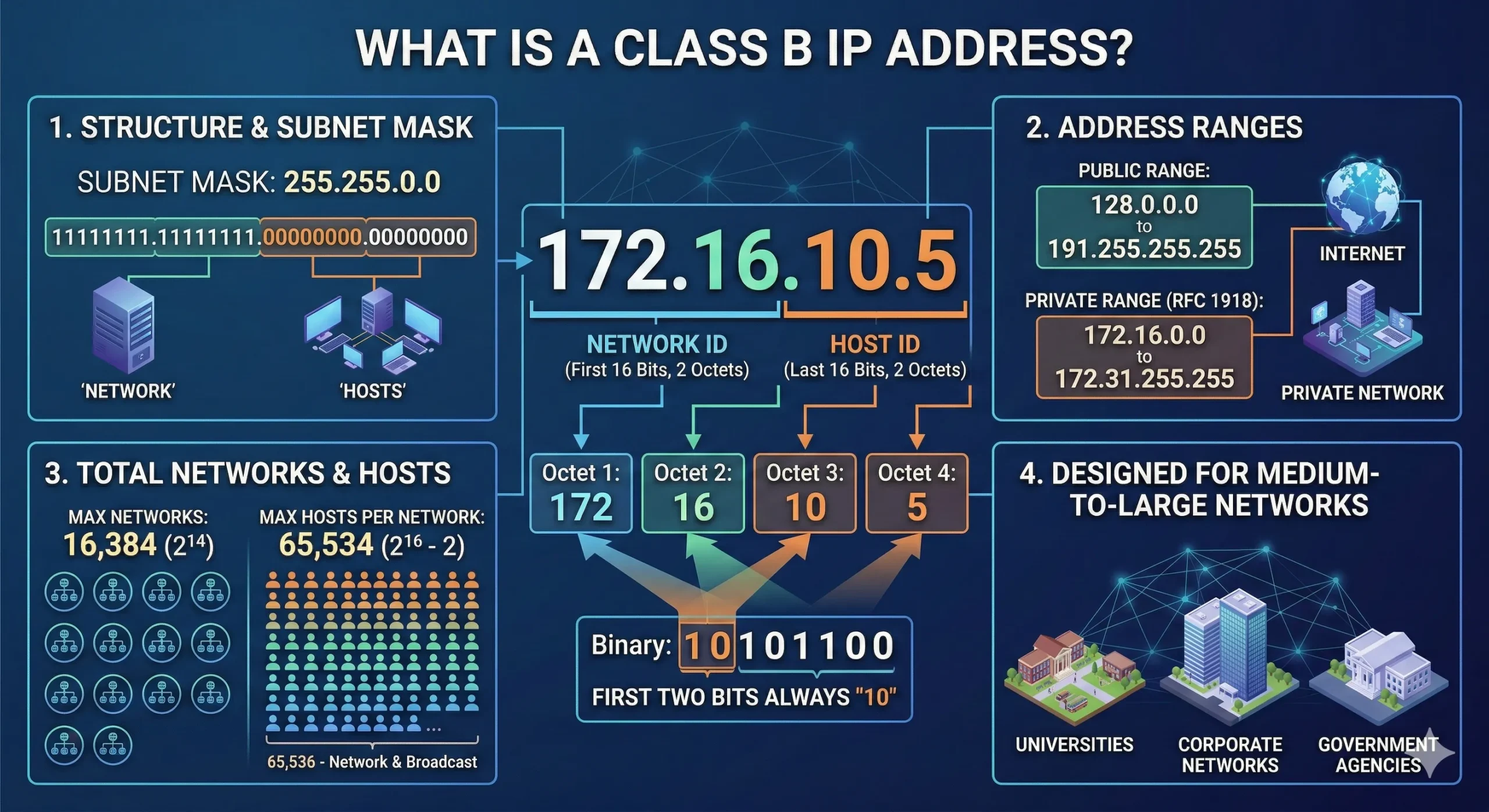
Class B at a glance: structure, address ranges, network size and typical users.
What is a Class B IP Address?
From the 2025 article. See NRS’s note on CIDR and continuity.
An IP (Internet Protocol) address is a numerical identifier allocated to each device that connects to a network, facilitating communication across the internet. These addresses are generally categorized into five primary classes: A, B, C, D, and E. Each class is designated for particular functions, with Class B being widely utilized for medium to large-scale networks. In this article, we will thoroughly examine Class B IP addresses, focusing on their structure, importance, and various applications.
Structure of a Class B IP Address
From the 2025 article. See NRS’s note on CIDR and continuity.
A Class B IP address is defined by its first octet, which ranges from 128 to 191. An IP address consists of four octets, each separated by a dot, such as 172.16.0.1. For a Class B address:
- The first two octets represent the network portion (Network ID).
- The last two octets are designated for the host portion (Host ID).
This setup strikes a balance between the size of the network and its scalability, rendering it suitable for organizations that need a moderate quantity of devices within their network.
Subnet Mask for Class B
From the 2025 article. See NRS’s note on CIDR and continuity.
To establish the limits of a Class B IP address, the standard subnet mask of 255.255.0.0 is applied. This mask signifies that the initial two octets are designated for the network, whereas the last two octets are available for allocating distinct addresses to devices.
Number of Available Addresses
Class B IP addresses offer a substantial range for device allocation:
- Total networks: 16,384
- Hosts per network: 65,534
A Class B network has the capacity to support thousands of devices, rendering it an appropriate option for medium-sized businesses, educational institutions, or governmental entities.
Private vs. Public Class B IP Addresses
From the 2025 article. See NRS’s note on CIDR and continuity.
Not all Class B IP addresses are available for public internet access. The Internet Assigned Numbers Authority (IANA) has allocated a portion of these addresses specifically for private network use. The private range for Class B addresses extends from 172.16.0.0 to 172.31.255.255, which is commonly used for internal networking in numerous organizations.
For public networks, Class B IP addresses that fall outside this private range are employed. These addresses are distinct across the internet, facilitating uninterrupted global communication.Benefits of Class B IP Addresses
- Scalability: With the ability to host thousands of devices, Class B is ideal for organizations planning to expand their networks.
- Flexibility: The division between network and host bits allows for efficient subnetting, enabling better utilization of available IPs.
- Private Addressing: Organizations can use private Class B IP ranges to avoid conflicts on the public internet and enhance security.
Use Cases of Class B IP Addresses
From the 2025 article. See NRS’s note on CIDR and continuity.
Class B IP addresses are widely used in environments that require more addresses than Class C can provide but fewer than Class A:
- Educational Institutions: Universities and colleges often use Class B networks to manage multiple departments and student networks.
- Corporate Networks: Medium to large enterprises utilize these IPs for employee systems, internal servers, and IoT devices.
- Government Agencies: Class B ranges are well-suited for municipal or state-level networks.
Also Read: Why Use a Class B IP Address?
From the 2025 article. See NRS’s note on CIDR and continuity.
Also Read: What is a Class C IP Address?
From the 2025 article. See NRS’s note on CIDR and continuity.
Conclusion
From the 2025 article. See NRS’s note on CIDR and continuity.
Comprehending Class B IP addresses is crucial for network administrators and IT professionals involved in the design and management of IP-based systems. These addresses offer a favorable equilibrium between capacity and manageability, making them suitable for organizations with moderate networking demands.
If you are intending to establish a network or enhance an existing one, it is advisable to evaluate whether a Class B IP address range meets your requirements. Thoughtful planning guarantees uninterrupted connectivity and optimal utilization of IP resources.
Technical references and scope
RFC 4632 explains why CIDR replaced fixed address classes. RFC 1918 defines private address space and discusses interconnection and renumbering. Assess prefix size, routing, address overlap, access controls and operational responsibility separately. A large block does not ensure resilience; private numbering does not replace filtering or segmentation.
Address planning and resource continuity
Plan who maintains allocation records, who can change routing, and how the network will handle overlapping addresses or a supplier change. NRS Shield is a path to understand number-resource dependencies and seek support.
NRS Shield is where operators turn individual risk into collective strength, and a Power of Attorney is how you give NRS the authority to act for your network.