Most businesses understand the importance of Internet connectivity. They invest in bandwidth, cloud infrastructure, data centers, security systems, and backup providers to make sure their networks remain available.
Table of Contents
ToggleBut connectivity alone is not enough.
Behind every online service, customer portal, partner integration, cloud deployment, payment platform, or enterprise system sits a quieter dependency: Internet number resources. These include public IP addresses and Autonomous System Numbers that allow networks to identify themselves, route traffic, and remain reachable across the global Internet.
For many organizations, number resources are treated as background infrastructure. They are viewed as technical assignments rather than strategic business assets. That view is becoming increasingly risky.
When a business depends on public IP addresses to serve customers, connect with partners, operate secure systems, or maintain digital revenue streams, stability in those resources becomes a matter of business continuity.
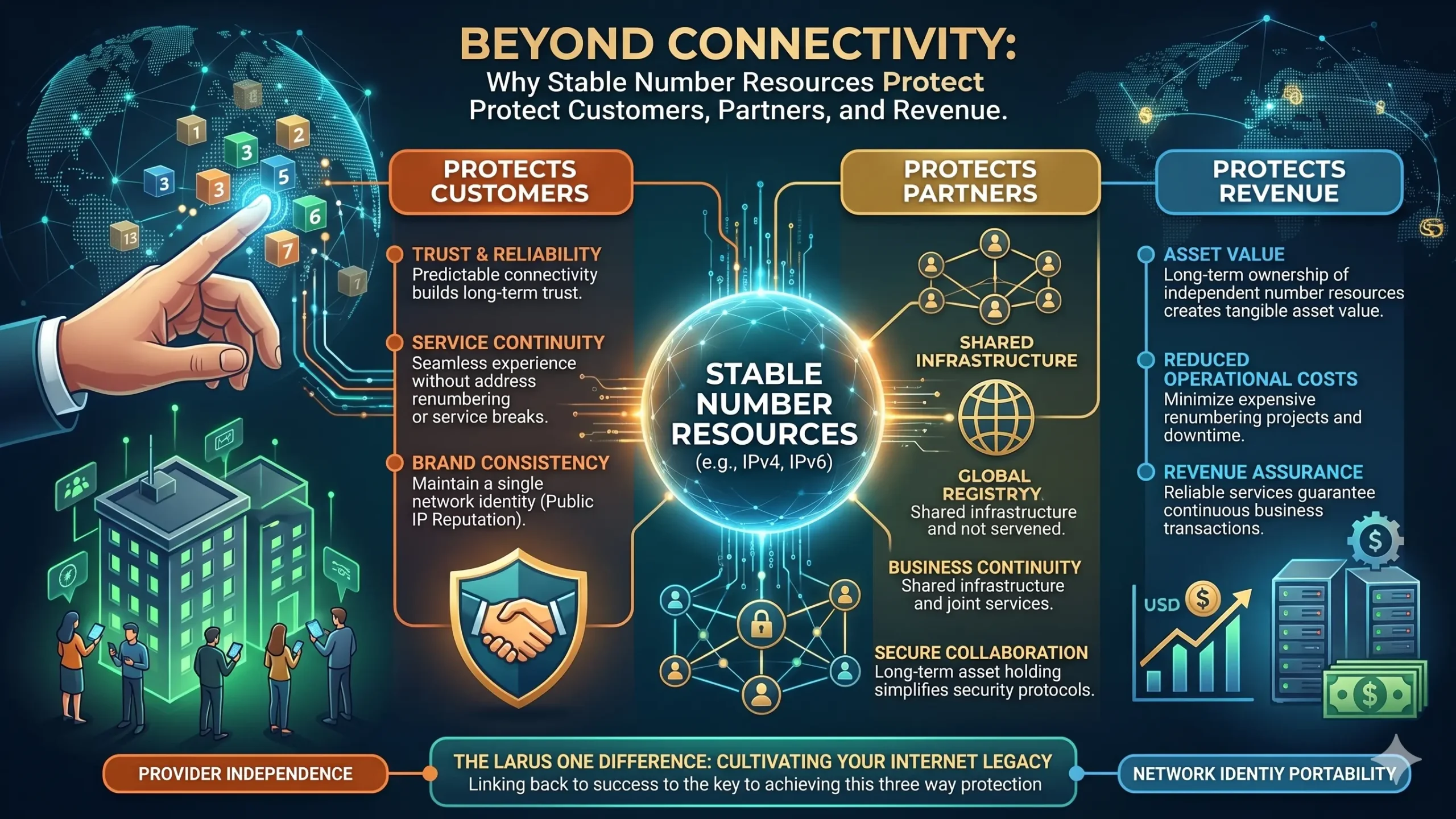
Connectivity gets you online. Stable number resources keep you recognized.
An Internet connection allows traffic to move. Stable number resources allow the business to be consistently recognized.
This distinction matters.
A company may have working Internet access, but if its public IP addresses change unexpectedly, customers may no longer be able to access services. Partners may block traffic. Security tools may raise alerts. Firewalls may reject connections. Compliance teams may require new approvals. Revenue-generating systems may be interrupted even when the network itself appears to be online.
In other words, the business may still be connected, but it may no longer be trusted.
Stable number resources help preserve that trust. They allow customers, partners, platforms, and security systems to continue recognizing the organization’s digital presence without unnecessary disruption.
This is why NRS has emphasized that enterprises must understand registry-layer risk in enterprise networks. The registry layer is not just an administrative background system. It is part of the structure that determines whether number resources remain recognized, legitimate, and usable in practice.
Why public IP identity matters to customers
Customers depend on predictable access.
For consumer platforms, enterprise services, hosting providers, cloud operators, financial systems, telecom networks, and digital infrastructure companies, customer relationships often depend on stable public network identity. Customers may configure firewall rules, allowlists, VPN settings, API permissions, fraud controls, and access policies around known IP addresses.
When those IP addresses change, the burden often falls on the customer.
They may need to update access rules, submit internal change requests, seek security approval, or troubleshoot failed connections. For large enterprise customers, this process can take days or weeks. During that time, the service provider may be reachable in a technical sense but unavailable in a practical business sense.
Stable number resources reduce this friction. They help customers continue using services without being forced into unnecessary operational changes.
A stable IP identity protects customer confidence.
Why partners need number resource stability
Partnerships are built on reliability.
Many business partnerships depend on systems that recognize each other through public IP addresses. This is common in API integrations, supplier platforms, payment processing, logistics networks, cloud interconnection, enterprise software, and regulated data exchange.
A partner may only accept traffic from approved IP addresses. They may use IP-based controls as part of authentication, fraud prevention, compliance, or access management. If a business loses or changes those resources, the partner may treat the traffic as unknown.
That can interrupt transactions, delay service delivery, and create avoidable escalation.
For organizations with multiple partners, the impact can multiply quickly. One IP address change may trigger dozens or hundreds of external coordination tasks. Each partner may have its own approval process, security team, and change window.
Stable number resources help avoid turning infrastructure changes into relationship problems.
Revenue depends on more than uptime
Businesses often measure resilience through uptime. But uptime does not capture every form of digital availability.
A system can be online and still fail commercially if customers or partners cannot recognize it. A service can be technically reachable and still be blocked by an allowlist. A platform can remain hosted and still lose traffic because reputation, routing, or access controls have changed.
Revenue depends on continuity of trust.
For e-commerce platforms, SaaS companies, cloud providers, telecom operators, hosting businesses, financial service providers, and digital infrastructure operators, IP address disruption can affect onboarding, transactions, service delivery, support costs, and customer retention.
The financial impact may not appear as a traditional outage. It may appear as failed integrations, delayed payments, interrupted customer access, blocked traffic, or increased churn risk.
Stable number resources help protect revenue by preserving the public identity that revenue-generating systems depend on.
IP addresses are business assets, not just technical labels
Internet number resources have economic value because businesses build operations around them.
A public IP address may support a production service, secure customer access, identify a trusted network, connect to a partner, maintain routing reputation, or support regulated activity. Once that happens, the address is no longer just a technical label. It becomes part of the organization’s operating foundation.
This is especially important in an environment where IPv4 resources are scarce and valuable. Businesses that depend on public IPv4 addresses must understand how those resources are assigned, governed, maintained, transferred, protected, and used.
Without that understanding, organizations may underestimate their exposure.
They may assume that IP resources will always remain available. They may assume that provider-assigned addresses are interchangeable. They may assume that registry-layer decisions have no direct effect on commercial operations. These assumptions can be dangerous.
Number resource stability should be part of business risk planning.
The hidden risk of depending entirely on third-party assigned addresses
Many organizations build their networks using IP addresses assigned by service providers, cloud platforms, hosting companies, or upstream networks. This may be convenient at the beginning, but it can create dependency over time.
If the business changes provider, moves infrastructure, restructures its network, enters a new region, or faces resource-related disputes, it may be forced to renumber.
Renumbering is rarely simple.
It can require customer communication, partner updates, DNS changes, firewall modifications, routing changes, system testing, documentation revisions, and compliance review. In some cases, the organization may also need to rebuild reputation associated with the previous address space.
This is why IP ownership, resource control, and governance awareness matter.
Businesses should understand whether their critical digital identity is truly under their control or dependent on another party’s infrastructure, policy, or commercial decision.
Registry-layer risk is business risk
Internet number resources are coordinated through governance and registry systems. These systems are essential for global routing coordination, but they also create a layer of dependency that many businesses do not fully see.
When number resource policies, registry processes, disputes, documentation rules, transfer procedures, membership structures, or registry agreements affect access to IP resources, the consequences can reach far beyond technical administration.
They can affect networks, services, customers, partners, and revenue.
NRS has warned that operators should not ignore the contractual and institutional risks attached to registry authority, including concerns around liability caps, legal insulation, and regional lock-in. For further context, see NRS’s warning on how registry structures can lock operators in and expose networks to severe continuity risk.
This is why Internet governance is not only a policy issue. It is a business continuity issue.
Organizations that depend on number resources should pay attention to how those resources are governed, how decisions are made, how rights are represented, and how disputes are handled. A lack of visibility at the governance layer can become a practical risk at the network layer.
Running networks must come before abstract process
The Internet works because real networks run, serve users, carry traffic, and support critical services every day.
Governance processes are important. Registry procedures are important. Policy coordination is important. But none of these should be allowed to drift so far from operational reality that live networks, customers, and businesses become collateral damage.
This is the concern behind NRS’s discussion of Running-Code Betrayal and why operators need a continuity layer beyond registry process.
The principle is simple: process should protect running infrastructure, not endanger it.
If a network is already supporting customers, cloud workloads, VPN users, SaaS applications, hosting services, financial commitments, and service-level obligations, then any governance or registry action affecting that network must be careful, proportionate, and grounded in operational continuity.
Stable number resources help ensure that live infrastructure is not treated as an abstract policy object.
Stable number resources support open and autonomous infrastructure
A resilient Internet depends on networks that can operate with stability, independence, and accountability.
Stable number resources help businesses maintain autonomy over their infrastructure. They reduce unnecessary dependence on individual providers. They make it easier to plan migrations, expand services, maintain customer trust, and participate in the Internet ecosystem with confidence.
For network operators, cloud providers, data centers, telecom companies, hosting providers, enterprises, and public institutions, this autonomy is increasingly important.
The more a business depends on digital infrastructure, the more it must understand the resources that make that infrastructure possible.
This is also why some industry voices argue that number resource continuity requires more than direct registry holding alone. Heng Lu’s article on why the registry layer is a structural risk and why LARUS is positioned as a business-continuity guarantor presents one view of how continuity risk can be shifted through a first-party operational structure.
Whether an organization holds resources directly, leases them, or depends on provider-assigned addresses, the key question remains the same: who carries the continuity risk when the registry layer becomes unstable?
What businesses should ask about their number resources
Every organization that depends on public IP addresses should ask several practical questions:
- Do we know which IP addresses support our critical services?
- Do customers or partners rely on those addresses?
- Are our IP addresses assigned by a provider, held directly, leased, or controlled through another structure?
- What would happen if we had to renumber?
- How long would it take customers and partners to update their systems?
- Do we understand the registry and governance rules affecting our resources?
- Are our number resources included in our business continuity plan?
- Who carries the risk if registry processes, policies, contracts, or recognition systems change?
These questions are not only for network engineers. They are also for business leaders, risk teams, compliance teams, product teams, legal teams, and executives responsible for revenue continuity.
If public IP identity supports the business, then stable number resources should be treated as business-critical assets.
Protecting customers, partners, and revenue starts with awareness
Stable number resources protect more than routing. They protect relationships.
They help customers continue accessing services. They help partners continue trusting traffic. They help security systems maintain consistency. They help businesses avoid unnecessary disruption. Most importantly, they help protect the revenue that depends on digital continuity.
As Internet infrastructure becomes more valuable and more complex, businesses cannot afford to treat number resources as invisible background assets.
They must understand them. They must protect them. They must participate in the governance conversations that shape them.
Connectivity is the beginning.
Stable number resources are what keep the business recognized, trusted, and resilient.
Conclusion
The Internet economy depends on stable digital identity. For many businesses, that identity begins with Internet number resources.
IP addresses and related resources are not just technical tools. They are part of how organizations serve customers, connect with partners, secure systems, and generate revenue.
Businesses that understand this reality are better prepared to protect continuity, reduce risk, and build stronger digital infrastructure.
Stable number resources are not only a network issue.
They are a customer protection issue.
They are a partner trust issue.
They are a revenue protection issue.
And they are a core part of building a more open, autonomous, and resilient Internet.
Further Reading
For organizations that want to understand this issue more deeply, the following resources provide additional context:
- Understanding Registry-Layer Risk for Enterprise Networks
- They take your money, lock you in, and can destroy your network — for as little as USD 100 in liability
- Running-Code Betrayal: Why Operators Need a Continuity Layer Beyond Registry Process
- On Why the Registry Layer Is a Structural Risk — and Why LARUS Is the Only Proven Business-Continuity Guarantor
Frequent Asked Questions
Stable number resources refer to Internet number resources, such as public IP addresses and Autonomous System Numbers, that remain consistently available, recognized, and usable by a business over time. They support network identity, routing, customer access, partner integrations, and operational continuity.
For businesses that rely on public-facing systems, stable number resources are not just technical assets. They are part of how the organization is recognized and trusted on the Internet.
Stable number resources matter because many digital operations depend on consistent public IP identity. Customers, partners, firewalls, API systems, cloud platforms, and security tools may all rely on known IP addresses to allow access or validate traffic.
If those resources change unexpectedly, a business may remain connected to the Internet but still experience blocked traffic, failed integrations, customer disruption, or revenue loss. Stability helps prevent infrastructure changes from becoming business outages.
Unstable IP resources can force customers and partners to update allowlists, firewall rules, VPN settings, access controls, compliance records, and internal security approvals. For enterprise customers or regulated partners, these updates may take days or weeks.
During that time, services may be unreachable, transactions may fail, and trusted integrations may be interrupted. Stable number resources reduce this burden and help preserve customer and partner confidence.
Registry-layer risk refers to the business and operational exposure that can arise from the systems, policies, contracts, and institutions that govern Internet number resources. These risks may affect how IP addresses are recognized, maintained, transferred, disputed, or controlled.
For enterprises and network operators, registry-layer risk is important because decisions made at the registry or governance level can affect live networks, customer services, routing stability, and revenue continuity.
Businesses can protect their number resources by identifying which IP addresses and Autonomous System Numbers support critical services, understanding whether those resources are provider-assigned or directly controlled, and including them in business continuity planning.
They should also assess customer and partner dependencies, review registry and contractual risks, maintain accurate documentation, and ensure that number resource stability is treated as a strategic business priority rather than a purely technical concern.