
Number Resource Society
AFRINIC: What Is It and What Does It Do?
The African Network Information Centre (AFRINIC) is the Regional Internet Registry (RIR) for Africa and the Indian Ocean region. It is one of five RIRs worldwide responsible for distributing and managing internet number resources IP addresses and Autonomous System Numbers (ASNs) within its service area. In short: if a network operator, ISP, university, bank, or government in Africa needs IP address space, AFRINIC is the body that allocates and records it. The five Regional Internet Registries...
On this page
The African Network Information Centre (AFRINIC) is the Regional Internet Registry (RIR) for Africa and the Indian Ocean region. It is one of five RIRs worldwide responsible for distributing and managing internet number resources IP addresses and Autonomous System Numbers (ASNs) within its service area.
In short: if a network operator, ISP, university, bank, or government in Africa needs IP address space, AFRINIC is the body that allocates and records it.
The five Regional Internet Registries AFRINIC is one of five RIRs that perform the same core function in different parts of the world:
AFRINIC — Africa and the Indian Ocean region.
APNIC — Asia-Pacific Network Information Centre, covering East, South, and Southeast Asia and Oceania.
ARIN — American Registry for Internet Numbers, covering the United States, Canada, parts of the Caribbean, and Antarctica.
LACNIC — Latin America and Caribbean Network Information Centre, covering Latin America and much of the Caribbean.
RIPE NCC — Réseaux IP Européens Network Coordination Centre, covering Europe, Russia, and West and Central Asia.
What is AFRINIC?
AFRINIC, The African Network Information Centre is a membership-based nonprofit organization that operates under corporate Legal Frameworks in Mauritius. It observes and monitors the allocation of Internet number resources in the African service region.
AFRINIC as The RIR of the region mainly focuses on the management and distribution of two types of resources:
- IP addresses (both IPv4 and IPv6)
- Autonomous system numbers (ASNs)
AFRINIC's Service Region
AFRINIC is the RIR for the African region as previously mentioned, every RIR has its service region in the world. the main role is to administer internet number resources in this region that the RIR is serving at. For example, the mission of AFRINIC is to perform this essential service to the African internet community. That includes all African countries and also the Indian Ocean region.
AFRINIC is also responsible for the IP address space of the following sub-regions of the overarching African region:
- Northern Africa – including Algeria, Egypt and Libya
- Western Africa – including Mali, Niger and Nigeria
- Central Africa – including Cameroon, Chad and the Democratic Republic of Congo
- Eastern Africa – including Ethiopia, Somalia and Tanzania
- Southern Africa – including Angola, Namibia and South Africa
- Indian Ocean region – including Madagascar and Mauritius
AFRINIC, The African Network Information Centre is the Regional Internet Registry of the African continent. Therefore, its main function is to govern the internet number resource space for Africa and provide them with a stable and safe internet that allows growth to their business.
AFRINIC’s provides professional and efficient distribution of these resources to everyone in the African region. AFRINIC also aims to do two things for the African continent:
-
- AFRINIC is to support Internet technology usage and development.
- AFRINIC is to strengthen internet self-governance.
Moreover, it's important to mention that the RIR administers both IPv4 and IPv6 addresses; however, only 6% of the global pool of resources is theirs to manage. Of those, only 2% are IPv4 addresses. The other resources it usually deals with are autonomous system numbers, the unique identifiers of every autonomous system.
AFRINIC as the Regional Internet Registry for Africa has around 2,000 members. They are primarily internet service providers (ISPs), governments, universities, data center providers, banks, and whoever is in need of internet number resources in the African region.
The African Network Information Centre "AFRINIC", is similar to all other RIRs, it gets its internet number resources from IANA.
What is IANA?
IANA is the Internet Assigned Numbers Authority. It then re-allocates them to all AFRINIC members and everyone else from the African region that needs an address block or more.
Now, Let's dive a bit deeper into AFRINIC's history.
AFRINIC history
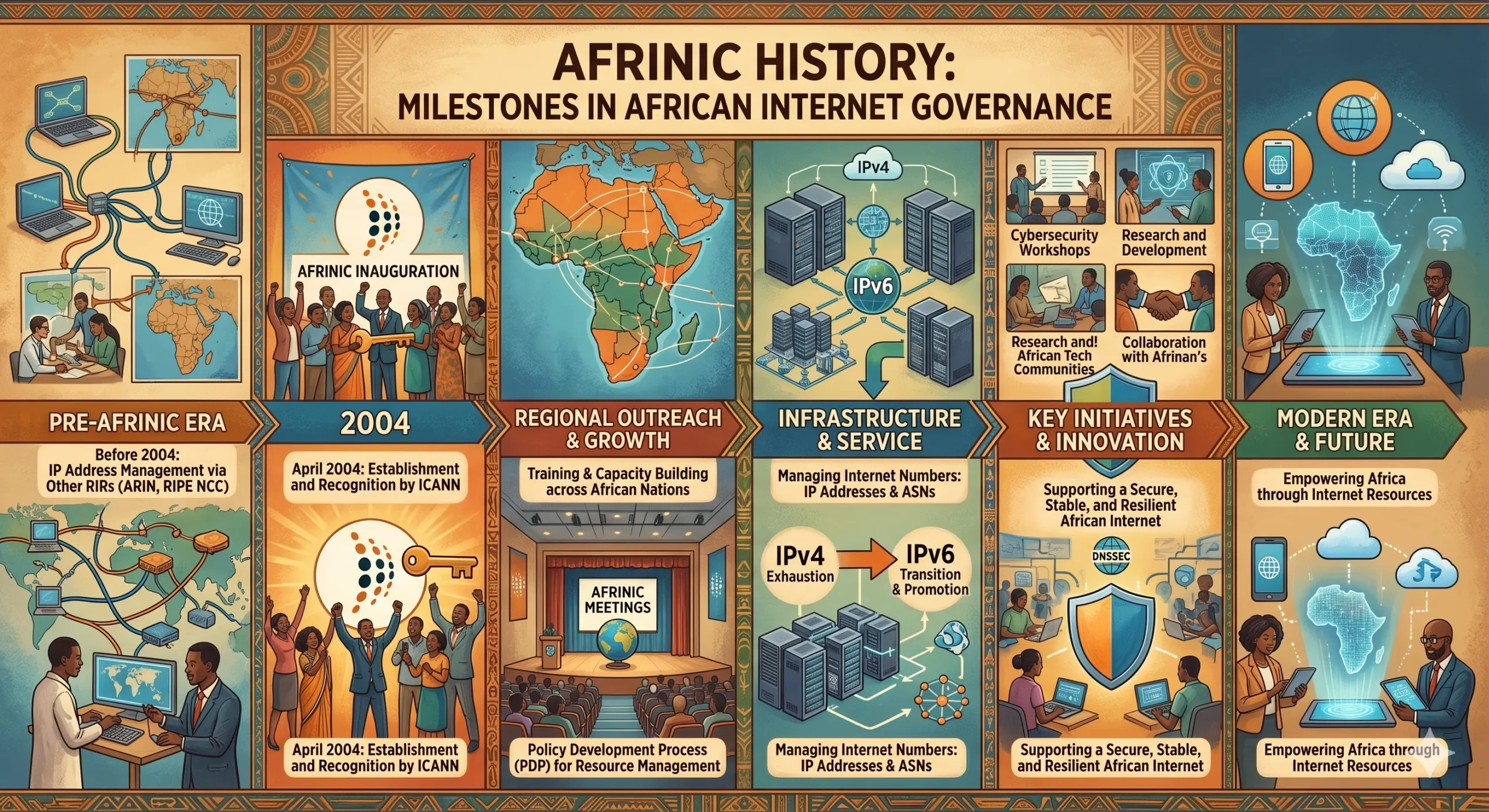
Illustration from the original NRS article.
AFRINIC was created in 2004 when the Internet Corporation for Assigned Names and Numbers (ICANN) realized it is time for a regional registry for AFRICA, "AFRINIC", the last one to be formed.
Before this, APNIC, RIPE NCC, and ARIN allocated internet number resources to the internet users and the community of Africa and the Indian Ocean region.
AFRINIC became an official RIR in April 2005. After that, it quickly began a membership program.
The program stated that as long as they qualify, individuals and organizations can apply for this membership. The new thing to the RIR system is something that AFRINIC introduced at the time, which was that everyone can participate because AFRINIC has an open policy development process.
AFRINIC holds Public Policy Meetings for open policy discussions two times a year. The Regional Internet Registry also participates in the organization of the Africa Internet Summit. AFRINIC Board of Directors is responsible for making decisions based on these bylaws.
In total, nine individuals are part of this board at any given time. Six members are elected to serve each sub-region of the continent, two are elected to serve based on their competency, and the remaining member is the Chief Executive Officer.
Also Read: IP Address Management: Risks of Centralized Governance
Also Read: What is Internet Governance Risk?
Who are AFRINIC's members?
AFRINIC has historically had around 2,000 members. They are primarily:
-
- Internet service providers (ISPs)
- Governments and public institutions
- Universities and research networks
- Data centre and hosting providers
- Banks and large enterprises
In other words, any organisation in the region that needs internet number resources can apply for membership, subject to eligibility.
AFRINIC Quality Policy
-
- Understanding stakeholder needs through ongoing communication and feedback
- Operating the registry transparently, inclusively, and on a financially sustainable basis
- Providing information, training, and support to help the community manage number resources and build resilient, secure internet infrastructure in Africa
- Maintaining compliance with ISO 9001:2015 and continually improving its quality management system (QMS)
- Reporting regularly to the community on QMS performance
Conclusion
The African Network Information Centre (AFRINIC) with the other RIRs are what makes the internet in the world function the way that it does. Its main role involves the management and allocation of IP addresses and autonomous system numbers to its members and the African community at large.
Also Read: The Poverty Penalty in Internet Number Governance
Also Read: AFRINIC’s Role in Internet Governance
NRS Red Alert
Critical warning to AFRINIC Resource Members.
Most operators cannot survive a registry-side attack alone. One serious dispute can destroy customer confidence, freeze transfers, trigger compliance reviews, scare banks, damage financing, break sales, force renumbering, and create legal costs before the merits are even heard.
Frequent Asked Questions
What does AFRINIC stand for?
AFRINIC stands for the African Network Information Centre.
What does AFRINIC do?
It allocates and manages internet number resources — IPv4 and IPv6 addresses and Autonomous System Numbers — for organisations in Africa and the Indian Ocean region.
Where is AFRINIC based?
AFRINIC is incorporated and headquartered in Mauritius.
How many Regional Internet Registries are there?
There are five: AFRINIC, APNIC, ARIN, LACNIC, and RIPE NCC.
When was AFRINIC founded?
It was established in 2004 and recognised as an official RIR in April 2005.
How many members does AFRINIC have?
AFRINIC has historically had approximately 2,000 members, including ISPs, governments, universities, data centres, and enterprises.
Is AFRINIC still under receivership?
A board was reconstituted through the September 2025 election and has resumed duties, but the receiver's discharge and related litigation remained ongoing into 2026. Check official AFRINIC channels for the current status.