
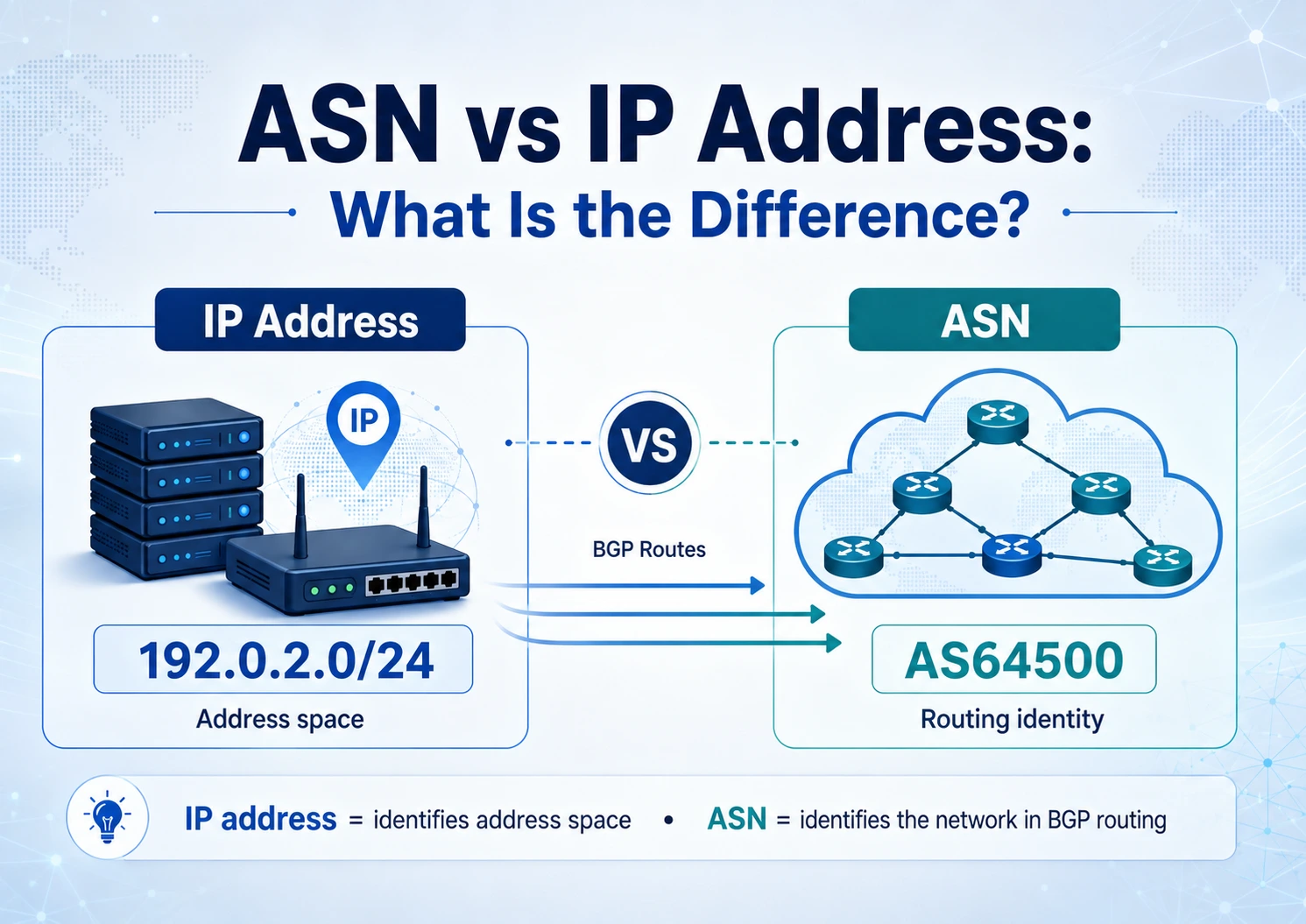
ASN vs IP Address: Quick Answer
An IP address identifies an address used for Internet Protocol communication, while an Autonomous System Number (ASN) identifies an autonomous network that exchanges routing information with other networks, typically through BGP.
Table of Contents
ToggleIn simple terms:
- IP addresses identify where IP traffic is addressed.
- ASNs identify networks participating in inter-domain routing.
- BGP connects the two by advertising IP prefixes through Autonomous Systems.
For example:
IP prefix: 192.0.2.0/24
Origin ASN: AS64500
In this example:
192.0.2.0/24is the IP address prefix being announced.AS64500identifies the Autonomous System originating the route.- BGP carries information about how other networks can reach that prefix.
An organization may therefore use both IP addresses and an ASN, but they perform fundamentally different functions.
What Is an IP Address?
An IP address, or Internet Protocol address, is a numerical address used for communication across IP networks.
The two major versions are:
IPv4
An IPv4 address contains 32 bits and is usually written in dotted-decimal notation.
Example:
192.0.2.1IPv6
An IPv6 address contains 128 bits and is usually written using hexadecimal notation.
Example:
2001:db8::1IANA coordinates the global Internet number resource system and maintains top-level registries for IPv4, IPv6 and Autonomous System Numbers. More information is available from the official IANA Number Resources documentation.
For public networks, IP addresses allow routers and hosts to identify network destinations and forward traffic toward them.
However, Internet routing usually deals with IP prefixes, not just individual addresses.
For example:
192.0.2.0/24This represents an IPv4 prefix containing a range of addresses.
A network may announce that prefix to other networks using BGP.
What Is an ASN?
An Autonomous System Number (ASN) is a numerical identifier associated with an Autonomous System.
An Autonomous System is broadly a network or group of networks operating under a coherent routing administration that presents routing information to other Autonomous Systems.
Examples of organizations that may operate public ASNs include:
- Internet service providers;
- telecommunications companies;
- cloud providers;
- content-delivery networks;
- data centres;
- universities;
- large enterprises; and
- other networks operating independent routing policies.
A public ASN might appear as:
AS64496or:
AS13335The AS prefix is commonly used when displaying an Autonomous System Number.
IANA allocates blocks of AS Numbers to the Regional Internet Registries, which in turn allocate or assign ASNs to network operators according to their applicable policies. The current global ASN registry is maintained by IANA.
NRS has also explained the operational benefits and considerations surrounding public Autonomous System Numbers.
ASN vs IP Address: Key Differences
| Feature | IP Address | ASN |
|---|---|---|
| Full name | Internet Protocol Address | Autonomous System Number |
| Example | 192.0.2.1 | AS64500 |
| Main purpose | Addresses IP communication | Identifies an Autonomous System in inter-domain routing |
| Used by | Hosts, routers and network interfaces | BGP-speaking Autonomous Systems |
| Main protocol relationship | IPv4 / IPv6 | BGP |
| Can represent a range? | IP prefixes represent ranges | ASN identifies an AS |
| Public registration | Internet number registry system | Internet number registry system |
| WHOIS / RDAP | Yes | Yes |
| BGP role | Prefixes are advertised | ASNs appear in routing paths and identify the origin AS |
| RPKI relationship | Prefix is authorized | ASN can be authorized to originate the prefix |
| Private-use ranges | Yes | Yes |
| Same as a physical location? | No | No |
The most important distinction is:
An IP prefix represents address space. An ASN represents an Autonomous System involved in routing that address space.
How Do an IP Address and ASN Work Together?
Suppose a network operates the following IPv4 prefix:
192.0.2.0/24and announces it from:
AS64500Conceptually, the relationship looks like this:
192.0.2.0/24
      ↓
Originated by
      ↓
   AS64500
      ↓
     BGP
      ↓
Other Autonomous Systems
The IP prefix answers one question:
What address space can be reached?
The ASN answers another:
Which Autonomous System is originating or carrying routing information?
BGP then exchanges this reachability information among participating Autonomous Systems.
The IETF’s BGP-4 specification, RFC 4271, describes BGP as an inter-Autonomous System routing protocol used to exchange network reachability information.
What Is an Origin ASN?
The origin ASN is the Autonomous System identified as originating a route for a particular IP prefix in BGP.
Consider:
Prefix:     192.0.2.0/24
Origin ASN: AS64500
Here, AS64500 is the origin ASN for the route.
Other networks may see an AS path such as:
AS64498 AS64499 AS64500The ASN at the origin end of the path represents the Autonomous System from which that route originated.
This relationship becomes particularly important for routing security.
A network operator may expect:
203.0.113.0/24 → AS64496but live BGP could instead show:
203.0.113.0/24 → AS64497That difference does not automatically prove malicious activity.
The network may have:
- migrated to another ASN;
- changed upstream routing;
- made a configuration change;
- authorized another network to originate the prefix; or
- failed to update surrounding routing-security records.
The correct response is to investigate the different layers rather than relying on one database alone.
Does an IP Address Contain an ASN?
No.
An ASN is not embedded inside an IP address.
For example:
203.0.113.10This does not tell you its ASN simply by looking at the digits.
To identify the ASN currently originating the prefix containing an IP address, you normally need routing information such as BGP data.
Similarly, the ASN is not simply part of the normal IP packet address.
BGP maintains routing information connecting prefixes to paths through Autonomous Systems.
This distinction matters because addressing and routing are related but separate functions.
Does an ASN Have an IP Address?
Not in the same way a server or router interface does.
An ASN identifies an Autonomous System rather than functioning as an IP address.
An Autonomous System may operate:
- one IPv4 prefix;
- many IPv4 prefixes;
- IPv6 prefixes;
- both IPv4 and IPv6;
- multiple routers;
- many physical locations; and
- numerous peering or transit relationships.
For example:
AS64500
├── 192.0.2.0/24
├── 198.51.100.0/24
└── 2001:db8:100::/48
One ASN can therefore be associated operationally with many IP prefixes.
Likewise, routing arrangements can be more complex than a simple one-ASN-to-one-prefix relationship.
Can One ASN Announce Multiple IP Prefixes?
Yes.
A single Autonomous System can originate many different IP prefixes.
A large ISP, cloud provider or content network may announce hundreds or thousands of prefixes through the same ASN.
Conceptually:
AS64500
   │
   ├── 192.0.2.0/24
   ├── 198.51.100.0/24
   ├── 203.0.113.0/24
   └── 2001:db8::/32
The ASN provides a common routing identity for the Autonomous System, while each IP prefix identifies address space that may be reachable through it.
Can One IP Prefix Be Associated With More Than One ASN?
Routing can become more complex than a single prefix-to-AS relationship.
Different arrangements may involve:
- multiple upstream providers;
- migrations between ASNs;
- anycast;
- traffic-engineering strategies;
- more-specific prefix advertisements; or
- temporary routing changes.
For this reason, organizations should not assume that the ASN appearing in an old document or registry record necessarily represents the network’s current BGP state.
Live routing should be checked independently.
Can the IP Prefix and ASN Be Registered to Different Organizations?
Yes, depending on the network arrangement.
The organization associated with an IP prefix and the organization associated with the ASN used to originate the route are not necessarily always identical.
For example, a business might use IP address space while relying on another network operator for certain routing functions.
Other arrangements can arise through:
- ISP relationships;
- customer-provider relationships;
- managed network services;
- acquisitions;
- migrations;
- legacy arrangements; or
- authorized third-party routing.
Therefore:
A difference between the organization associated with an IP prefix and the organization associated with an ASN is a reason to understand the relationship—not automatically evidence that something is wrong.
This is an important principle when conducting Internet number resource due diligence.
What Is the Difference Between ASN Registration and BGP Routing?
This distinction is particularly important for NRS.help readers.
An ASN can appear in a registry system.
An IP prefix can appear in a registry system.
But those records do not, by themselves, describe the complete live routing environment.
Consider four separate questions:
Registry
Who appears in the registration information for the ASN and IP prefix?
Routing
Which ASN is actually originating the prefix in BGP?
Authorization
Which ASN is authorized to originate the prefix under RPKI or other applicable routing records?
Operations
Which organization is actually managing the routers and network infrastructure?
These answers may align perfectly.
But they should still be verified separately.
Registry records and operational routing data describe different layers of the same infrastructure.
Accurate registry information matters, but it should remain connected to verifiable operational reality.
Who Manages IP Addresses and ASNs?
Both public IP addresses and public ASNs form part of the global Internet number resource system.
At the global level, IANA coordinates number resources and allocates large resource blocks to the Regional Internet Registries.
The five RIRs are:
- AFRINIC — Africa
- APNIC — Asia Pacific
- ARIN — primarily the United States, Canada and parts of the Caribbean/North Atlantic
- LACNIC — Latin America and parts of the Caribbean
- RIPE NCC — Europe, the Middle East and parts of Central Asia
The applicable RIR can then administer resources according to its policies and regional structure.
NRS explains the wider framework in its guide to the five Regional Internet Registries.
The important point is that IP addresses and ASNs are different resource types even though they participate in the same overall coordination system.
Public ASN vs Private ASN
Not every ASN needs to be globally unique and visible on the public Internet.
There are also private-use ASN ranges.
According to RFC 6996, the private-use ranges are:
64512–65534and:
4200000000–4294967294Private ASNs can be useful inside controlled environments where globally unique public ASNs are unnecessary.
However, RFC 6996 states that private-use ASNs should be removed from AS path information before routes are advertised to the global Internet.
For public inter-domain routing, organizations generally need an appropriate globally unique ASN where their routing requirements justify one.
Public IP vs Private IP Address
IP addresses also have public and private-use concepts.
For IPv4, commonly used private address ranges include:
10.0.0.0/8
172.16.0.0/12
192.168.0.0/16
These ranges can be reused inside private networks because they are not intended to be globally routed as public IPv4 addresses.
This creates a useful comparison:
| Resource | Public | Private |
|---|---|---|
| IP address | Globally coordinated for public routing | Reusable inside private networks |
| ASN | Globally unique for public inter-AS use | Reusable for appropriate private routing environments |
Public IP addresses and public ASNs therefore require global coordination because duplication could create ambiguity across the Internet.
Private-use values operate within more limited administrative boundaries.
Do You Need an ASN to Have an IP Address?
No.
Many organizations use public IP addresses without operating their own public ASN.
For example, an enterprise may receive or use addresses through an Internet service provider while relying entirely on that provider’s routing infrastructure.
The organization may therefore have Internet connectivity without operating an independent Autonomous System.
An ASN becomes more relevant when an organization needs to participate in inter-domain routing under its own routing identity or policy.
Common reasons may include:
- multihoming;
- connecting to multiple upstream providers;
- establishing external BGP sessions;
- implementing independent routing policies;
- participating in peering;
- operating significant network infrastructure.
The exact eligibility requirements for obtaining a public ASN depend on the applicable RIR’s current policies.
Do You Need Your Own IP Addresses to Have an ASN?
Not necessarily in every networking arrangement.
ASN eligibility and IP-resource administration are separate questions.
A network may have an ASN while using address resources obtained or administered through another arrangement, depending on applicable policies and network design.
What matters operationally is that the relationships between:
- the ASN;
- the IP prefixes;
- routing authorization;
- registry information; and
- network operators
are clearly understood and appropriately documented.
ASN vs IP Address in BGP
BGP demonstrates the relationship between ASNs and IP prefixes especially clearly.
A simplified BGP route could be represented as:
Network: 192.0.2.0/24
AS Path: 64496 64497 64500
The network field tells other routers which IP prefix the route describes.
The AS path records Autonomous Systems associated with the path advertisement.
This allows BGP systems to make routing decisions based on factors such as:
- policy;
- path attributes;
- neighbor relationships;
- route selection; and
- loop prevention.
IP prefix = destination address space
ASN = network-routing identity
BGP = protocol exchanging reachability information between Autonomous Systems
What Is the Relationship Between ASN, IP Address and RPKI?
RPKI provides another important connection between IP addresses and ASNs.
A Route Origin Authorization (ROA) can state that a particular Autonomous System is authorized to originate routes for an IP prefix.
Conceptually:
IP Prefix
203.0.113.0/24

        ↓

Authorized Origin

        ↓

AS64496
The current IETF ROA specification, RFC 9582, describes a ROA as a digitally signed object that provides a means of verifying that an IP address block holder has authorized an Autonomous System to originate routes for specified prefixes.
This is why both pieces of information matter:
IP prefix + ASN
RPKI origin validation evaluates the relationship between them.
A route may therefore be evaluated based on whether the observed origin ASN and prefix are consistent with applicable validated RPKI information.
ASN Registration Does Not Equal Routing Authorization
Another distinction worth making is:
Being associated with an ASN in registration data does not automatically authorize that ASN to originate every IP prefix associated with an organization.
Routing authorization should be evaluated independently.
Likewise, simply seeing an ASN originate a prefix in BGP does not tell you everything about:
- registration;
- contractual arrangements;
- RPKI authorization;
- resource history; or
- corporate relationships.
A strong resource-management process verifies these layers rather than treating any one of them as the whole truth.
How to Check an IP Address and ASN
When investigating a network, a useful workflow is:
Step 1: Identify the IP Prefix
Start with the IP address.
Determine which network prefix contains it.
For example:
IP: 192.0.2.25
Prefix: 192.0.2.0/24
Step 2: Check Registration Information
Use WHOIS or RDAP to understand the applicable registration information.
Look for:
- address range;
- RIR;
- organization-related records;
- status;
- contacts;
- registration events.
Remember that registry information is not the same thing as BGP information.
Step 3: Check the Origin ASN
Use current BGP routing data to identify the ASN originating the prefix.
For example:
192.0.2.0/24 → AS64500Step 4: Check the ASN Record
Review the registry information associated with the ASN.
Ask:
- Which organization-related entity appears?
- Which RIR administers the ASN?
- Are the contacts current?
- Does the information make sense in the context of the network?
Step 5: Check RPKI
Determine whether relevant ROAs exist and whether they reflect the intended routing relationship.
Check:
- prefix;
- origin ASN;
- maximum prefix length;
- validation state.
Step 6: Investigate Any Mismatch
Suppose you find:
Registry documentation:
Expected origin = AS64500

Live BGP:
Origin = AS64501
Do not immediately assume hijacking or unauthorized activity.
Investigate whether:
- the network recently changed ASN;
- the prefix moved between providers;
- a migration is in progress;
- a routing record is stale;
- RPKI needs updating; or
- the difference reflects an intentional network arrangement.
The goal is to determine which layer no longer reflects the intended operational state.
Why Registry Accuracy Matters for ASNs and IP Addresses
Registry accuracy can look like an administrative issue until a network needs to make a change.
Imagine an organization where:
- its IP prefix remains business-critical;
- the ASN record contains outdated contacts;
- the employee who managed the RIR account has left;
- no one has documented the RPKI configuration;
- the company is moving to a new upstream provider.
Suddenly, ASN and IP resource administration becomes part of operational continuity.
Organizations should therefore know:
- which IP resources they depend on;
- which ASNs they operate;
- which RIR administers each resource;
- who controls relevant accounts;
- which ASN should originate each prefix;
- which ROAs exist;
- which IRR records exist;
- how reverse DNS is managed; and
- where supporting documentation is stored.
NRS provides a wider checklist in its guide on how to audit your company’s Internet number resources.
ASN vs IP Address During a Network Migration
Network migrations are a good example of why these distinctions matter.
Suppose an enterprise changes upstream provider.
Its IP addresses may stay the same.
Its ASN may also stay the same.
But routing relationships change.
Alternatively:
- the IP prefix may stay the same;
- the origin ASN may change;
- a new ROA may be required;
- IRR information may require updating.
Or an organization may renumber into new IP space while keeping the same ASN.
These are different technical changes.
Treating “IP address” and “ASN” as interchangeable concepts can therefore lead to configuration errors.
A migration plan should explicitly document:
What is changing?
- IP prefix?
- Origin ASN?
- upstream provider?
- ROA?
- IRR route object?
- reverse DNS?
- registry record?
What is staying the same?
Keeping those questions separate can significantly improve change control.
ASN vs IP Address During a Merger or Acquisition
Corporate transactions can create similar issues.
A company may acquire another organization that holds:
- IPv4 resources;
- IPv6 resources;
- one or more ASNs;
- RIR accounts;
- RPKI objects;
- DNS delegations;
- routing arrangements.
The acquiring organization should not assume that identifying the IP ranges is sufficient.
It should also identify:
- ASNs;
- current origin relationships;
- registry access;
- administrative contacts;
- RPKI;
- routing dependencies;
- supporting resource documentation.
The objective is to understand the complete chain of operational control, not simply create a list of addresses.
A Practical ASN and IP Address Audit Checklist
Network operators can use the following checklist.
| Check | IP Address / Prefix | ASN |
|---|---|---|
| Inventory documented | ✓ | ✓ |
| Correct RIR identified | ✓ | ✓ |
| Registry record reviewed | ✓ | ✓ |
| Organization information checked | ✓ | ✓ |
| Contacts checked | ✓ | ✓ |
| Account access reviewed | ✓ | ✓ |
| BGP relationship checked | Prefix visibility | AS path / origin |
| RPKI checked | Authorized prefix | Authorized origin ASN |
| IRR reviewed | Route object | Routing policy relationships |
| Internal documentation | ✓ | ✓ |
| Continuity owner assigned | ✓ | ✓ |
The purpose of this process is not merely compliance.
It helps ensure that the administrative information surrounding Internet number resources remains aligned with the network that actually depends on them.
ASN vs IP Address: Which One Does Your Network Need?
Many organizations need only IP connectivity supplied by an ISP.
In that situation, they may not need to operate their own public ASN.
Other organizations may require more routing independence.
A public ASN may become relevant when a network needs to:
- operate external BGP;
- connect independently to multiple providers;
- establish peering relationships;
- control its own inter-domain routing policy; or
- operate as an identifiable Autonomous System on the Internet.
IP addresses answer the addressing requirement.
ASNs answer a different routing requirement.
Some networks need one.
Many significant network operators need both.
The Bigger Picture: Different Resources, One Operational System
IP addresses and ASNs are separate Internet number resources.
But in a running network they are closely connected.
Consider the complete chain:
IP Prefix
   ↓
Origin ASN
   ↓
BGP Routing
   ↓
RPKI / ROA
   ↓
Registry Records
   ↓
Operational Network
Each layer has a different purpose.
IP Addresses
Provide address space.
ASN
Identifies the Autonomous System involved in inter-domain routing.
BGP
Exchanges reachability information.
RPKI
Can provide cryptographically verifiable information about authorized route origins.
Registry Records
Provide administrative and registration information.
Operational Network
Represents what is actually configured and running.
Reliable Internet number resource management depends on keeping these layers understandable and appropriately aligned.
Final Thoughts
An ASN and an IP address are not the same thing.
An IP address identifies address space used for IP communication.
An ASN identifies an Autonomous System participating in inter-domain routing.
They come together through BGP.
For example:
192.0.2.0/24 → AS64500The prefix tells the Internet which address space is reachable.
The ASN helps identify which Autonomous System is originating the route.
For network operators, however, understanding the definitions is only the beginning.
Organizations should also understand:
- which IP prefixes they depend on;
- which ASNs they operate;
- where those resources are registered;
- who controls administrative access;
- which ASN currently originates each prefix;
- whether RPKI reflects the intended relationship;
- whether registry records remain accurate; and
- how those resources would be managed during staff, provider or corporate changes.
The most reliable approach is to treat registry information, routing data and operational infrastructure as related but distinct layers.
Accurate records matter.
Accurate routing matters.
And for business-critical networks, keeping the two aligned is part of network continuity.