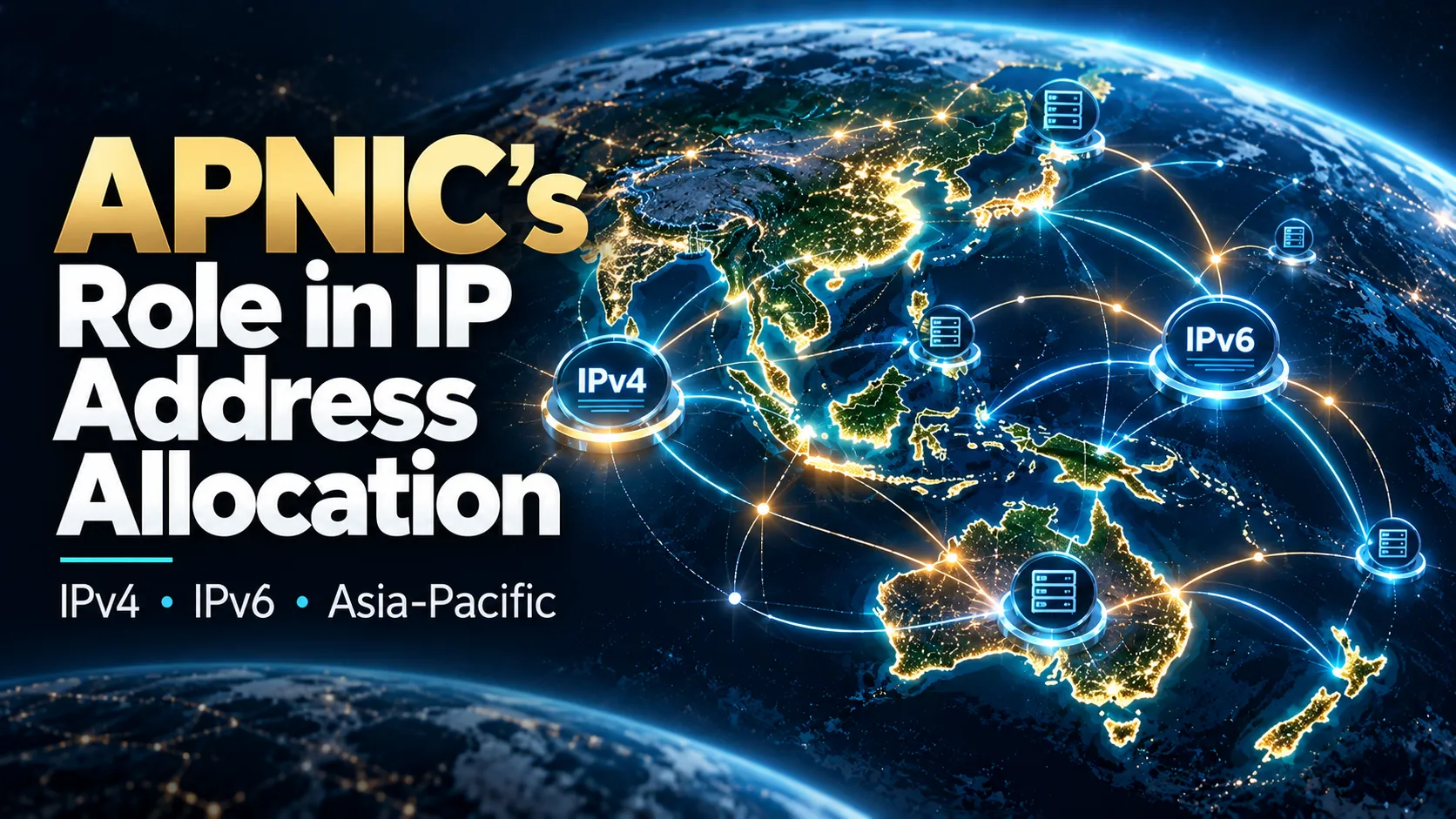
APNIC, the Asia Pacific Network Information Centre, is the Regional Internet Registry for the Asia-Pacific region. It administers IPv4 addresses, IPv6 addresses and Autonomous System Numbers under published policies. Its registry work supports coordination between independent networks; network operators remain responsible for building, connecting and running those networks.
Table of Contents
Toggle
What does APNIC do?
APNIC evaluates requests for Internet number resources and maintains registration information associated with those resources. An Autonomous System Number, or ASN, identifies a network or group of networks operating under a common routing policy.
These functions help operators identify registered resource holders and coordinate network administration. For the wider context, see NRS’s explanation of how IP address registries work.
Allocation and assignment: What is the Difference?
The terms describe different uses of address space:
- Allocation: address space distributed to a registry or provider for further distribution.
- Assignment: address space provided for use within an end-user network or infrastructure.
For example, an Internet service provider may receive an allocation and then assign smaller address blocks to customer networks. APNIC’s Internet number resource policies explain the applicable categories and conditions.
How does APNIC handle IPv4 and IPv6?
IPv4 availability is constrained. APNIC’s general remaining-pool policy specifies a minimum delegation of /24—256 addresses—and a maximum total of /23—512 addresses—per account holder from that pool. These are pool-delegation limits, not a universal limit on an organization’s total IPv4 holdings. Special-purpose policies have separate provisions.
IPv6 uses different allocation and assignment criteria. The appropriate request depends on whether an organization will distribute addresses to other networks or use them for its own infrastructure.
Organizations should check APNIC’s current application criteria before preparing a request. Eligibility, documentation and fees depend on the resources and request type.
How does APNIC support IPv6 deployment?
APNIC provides guidance and learning resources to help organizations plan IPv6 deployment. Its IPv6 resource hub addresses the needs of network operators, content providers and other participants.
Receiving address space is one part of deployment. Operators still need to plan addressing, configure equipment, check application compatibility and test connectivity.
Who develops APNIC’s policies?
APNIC’s community participates in its policy-development process. The resource policy portal provides access to current policies, proposals and participation information.
An open process creates opportunities to contribute and scrutinize proposals. It does not, by itself, demonstrate that every policy produces fair or effective outcomes. Operators can assess proposals against practical needs, administrative costs and network continuity.
What are the limits of APNIC’s role?
Address registration and allocation do not make APNIC the operator of the networks using those resources. Receiving a delegation does not automatically establish connectivity or guarantee that other networks will accept a route.
NRS’s charter emphasizes accurate registration and a limited registry role that supports Internet stability. This is NRS’s governance position; organizations should separately examine the policies and agreements applicable to their resources.
What should network operators do next?
Before requesting resources:
- Establish whether addresses supplied by an upstream provider meet your needs.
- Identify the relevant allocation or assignment category.
- Review current eligibility requirements and prepare your network plan.
- Plan deployment and ongoing registration maintenance alongside the application.
Start with the applicable APNIC criteria, then build your operational plan around your network’s requirements.
Frequent Asked Questions
APNIC stands for Asia Pacific Network Information Centre. It is the Regional Internet Registry serving the Asia-Pacific region.
Yes. APNIC delegates both IPv4 and IPv6 address space under its published policies. Each has different eligibility requirements and allocation rules. Organizations should review the current application criteria before applying.
An allocation provides address space for further distribution, such as by an Internet service provider. An assignment provides address space for use within a particular network or infrastructure. APNIC’s resource policies define the relevant categories.
No. Receiving address space does not establish an Internet connection or guarantee that other networks will accept your routes. Network operators must arrange connectivity and configure their routing and infrastructure.
APNIC administers Internet number resources and associated registry services. It does not operate every network in the region. Independent network operators remain responsible for their own infrastructure and connectivity.
Operators can review proposals and contribute through APNIC’s policy-development process. The APNIC resource policy portal provides information about proposals and participation.