
Number Resource Society
Why Infrastructure Operators Need Continuity Plans for Number Resources
Servers can remain online while customers lose access. Bring IP addresses and ASNs into continuity planning: map operational identity and customer dependencies, prepare renewals, clarify authority and organise seven practical safeguards before a disruption.
On this page
Infrastructure operators often build continuity plans around power, transit, hardware, software, data centres, and staffing. These are essential parts of operational resilience. But one critical layer is often overlooked: number resources.
Public IP addresses and Autonomous System Numbers are not just technical identifiers. They support routing, customer access, partner integrations, security controls, compliance workflows, and revenue-generating services. When these resources become unstable, the consequences can move quickly from a technical issue to a business continuity problem.
For operators that depend on public Internet infrastructure, number resource continuity should be treated as a core resilience requirement.
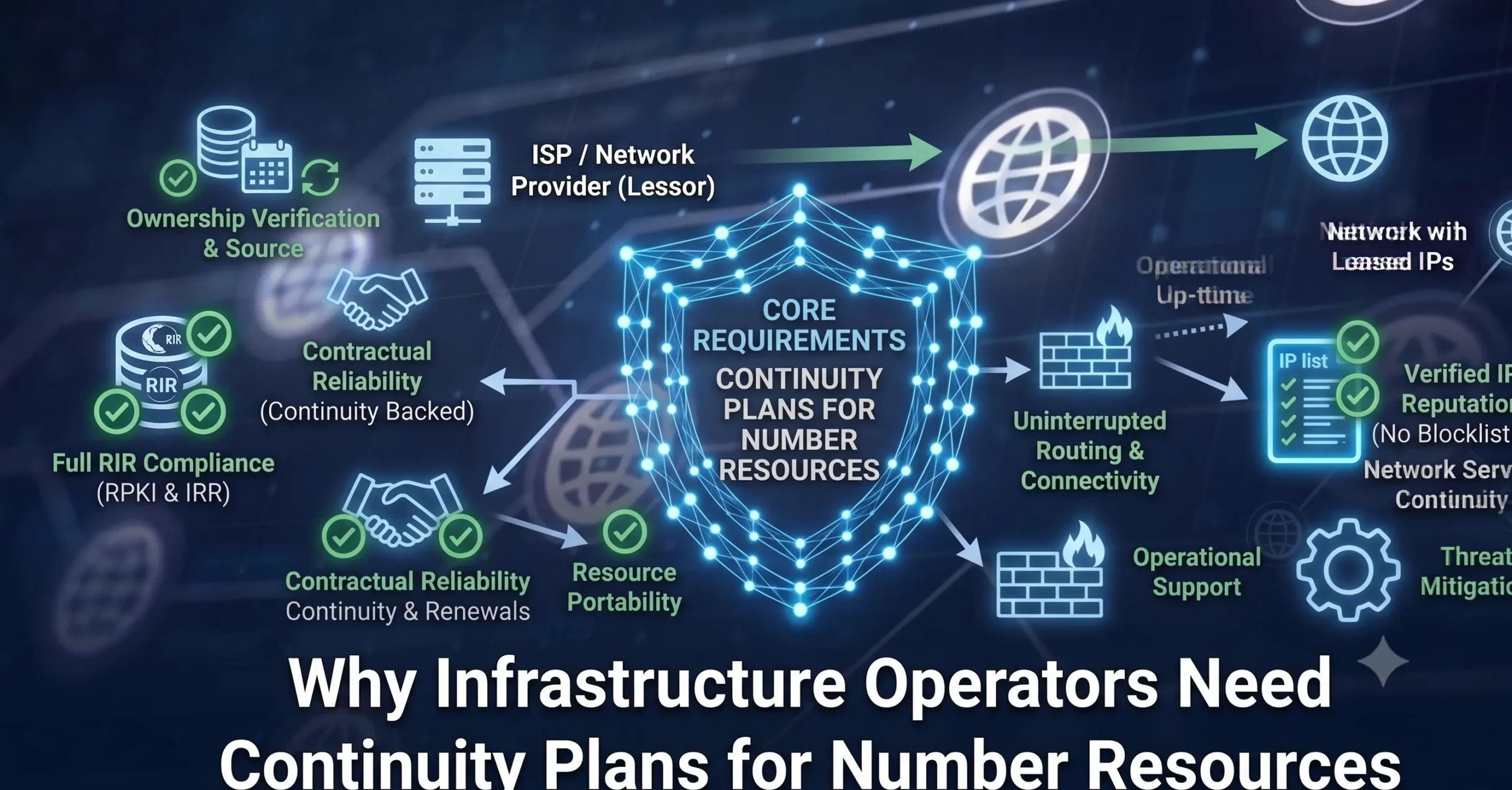
Illustration published with the original article.
Number resources are part of operational identity
Every infrastructure operator has a public network identity. Customers, partners, cloud platforms, firewalls, payment systems, APIs, monitoring tools, and reputation systems often recognize that identity through IP addresses, routing records, ASN relationships, allowlists, geolocation data, and registry information.
When that identity remains stable, services can continue without unnecessary friction. Customers can reach hosted platforms. Partners can recognize trusted traffic. Security teams can maintain access rules. Support teams can avoid avoidable incidents.
But when number resources become uncertain, the operator may still have servers online and connectivity available, while customers and partners experience disruption. A system can be technically reachable but commercially unavailable if traffic is blocked, allowlists fail, routing becomes uncertain, or registry records create doubt.
This is why number resource instability can directly affect customers and revenue.
The risk is not always a traditional outage
Many operators measure resilience through uptime. Uptime matters, but it does not capture every risk created by number resource disruption.
A service may remain powered on. A network may remain connected. Applications may still be running. Yet customers may still lose access if a public IP address changes unexpectedly, a route is no longer trusted, an address block is caught in administrative uncertainty, or security systems reject traffic from an unfamiliar source.
For example, an unexpected change in number resources may affect:
- Customer access to hosted applications
- Partner API integrations
- Firewall allowlists
- Email deliverability
- VPN access
- CDN configurations
- Monitoring and alerting systems
- Geolocation-sensitive services
- Compliance approvals
- Payment or enterprise platform access
These problems may not appear as a single visible outage. Instead, they can appear as failed logins, blocked transactions, delayed onboarding, support tickets, failed integrations, customer complaints, or churn risk.
That makes number resource continuity a business issue, not only a network engineering issue.
Infrastructure operators carry customer risk
Hosting providers, cloud platforms, ISPs, telecom operators, managed service providers, SaaS infrastructure teams, and data centre businesses all hold responsibility beyond their own network.
Their customers build services on top of assigned infrastructure. Those customers may then build their own customer relationships, security processes, and partner integrations around the same IP resources.
If an operator loses continuity over number resources, the effect can cascade.
A hosting customer may need to migrate production services. A SaaS provider may need to update partner allowlists. A financial services customer may need new approvals. An enterprise customer may need to reconfigure security rules across multiple departments and vendors.
The operator may see the issue as a resource-management matter. The customer experiences it as business interruption.
This is why stable number resources help protect customers, partners, and revenue.
Renewal continuity must be planned before there is a problem
One of the most practical parts of number resource continuity is renewal continuity.
Where number resources are leased, assigned, sponsored, administered, or contractually dependent on another party, operators need clear renewal procedures. Waiting until the end of a term creates avoidable risk. The closer a resource gets to renewal uncertainty, the more exposed the business becomes.
A continuity plan should identify:
- Which IP addresses and ASNs are business-critical
- Who controls the relevant agreements and registry records
- When renewals, reviews, or administrative actions are due
- What happens if a provider, sponsor, lessor, or partner becomes unavailable
- Which customer services depend on each resource
- Which internal teams must be notified before any resource change
- What contractual rights exist around renewal, replacement, transfer, or termination
- What emergency escalation path is available
The goal is not only to renew on time. The goal is to preserve uninterrupted resource usability.
The importance of renewal continuity in IP leasing agreements is especially clear for operators that rely on leased IPv4 resources. If renewal terms are unclear, short-term, or operationally fragile, the operator may face instability that affects customers long before a technical migration is ready.
What a number resource continuity plan should include
A strong continuity plan should connect legal, commercial, technical, and operational responsibilities. Number resources sit across all of these areas, so the plan cannot belong to only one team.
1. A complete resource inventory
Operators should maintain an accurate inventory of all public IP addresses, prefixes, ASNs, ROAs, routing arrangements, registry records, abuse contacts, customer assignments, and related contracts.
This inventory should show which services, customers, locations, and partners depend on each resource. Without this mapping, operators may underestimate the impact of a resource issue.
2. Ownership and administrative clarity
Every resource should have a clearly documented administrative owner. The plan should identify who can access registry portals, approve changes, renew agreements, update routing records, respond to notices, and coordinate with external parties.
Continuity risk increases when knowledge sits with one person or one vendor relationship.
3. Renewal and notice tracking
Operators should track key dates well before they become urgent. This includes lease renewals, sponsorship terms, registry obligations, contractual notice periods, billing deadlines, compliance reviews, and routing-related maintenance.
A missed renewal or unclear renewal process can create preventable instability.
4. Customer impact mapping
Not all resources carry the same risk. A small block used for testing may have limited impact. A production block used by enterprise customers, payment systems, VPNs, mail servers, cloud workloads, or partner integrations may be mission-critical.
The continuity plan should classify number resources by business impact, not only by size.
5. Change-control procedures
Any change to number resources should go through a structured change-control process. This includes customer notice, partner coordination, DNS updates, firewall and allowlist changes, RPKI and routing validation, monitoring updates, geolocation checks, and rollback planning.
A poorly coordinated IP change can create more disruption than the original risk.
6. Alternative resource strategy
Operators should know what they will do if a resource becomes unavailable, disputed, non-renewable, or commercially unviable.
This may include backup address capacity, alternative leasing arrangements, transfer planning, provider diversification, migration procedures, or customer-specific replacement strategies. The key is to plan before the organization is forced into a rushed migration.
7. Executive-level risk visibility
Number resource continuity should not be hidden inside network operations. Leadership teams need to understand which revenue streams depend on stable IP resources, what contractual exposures exist, and what investment is needed to reduce continuity risk.
When number resources support customer revenue, they deserve business-level attention.
Continuity protects more than connectivity
Infrastructure resilience is not just about keeping systems powered on. It is about keeping services trusted, reachable, recognized, and commercially usable.
Stable number resources help preserve that continuity. They reduce unnecessary customer disruption. They protect partner relationships. They support security consistency. They lower operational friction. They help revenue-generating systems remain available in the way customers and partners expect.
For infrastructure operators, the question is no longer whether number resources matter. The question is whether the organization has a plan to protect them.
A number resource continuity plan gives operators the visibility, process, and response capability needed to manage this risk before it becomes a customer-facing problem.
In a market where digital services depend on stable public network identity, continuity planning for number resources is not optional. It is part of responsible infrastructure operations.
Frequent Asked Questions
1. What are number resources?
Number resources are the identifiers that allow networks and services to operate on the Internet. They include public IP addresses and Autonomous System Numbers. Infrastructure operators use these resources for routing, customer access, hosting, security controls, partner integrations, and service delivery.
2. Why do number resources need a continuity plan?
Number resources need a continuity plan because instability can affect customer access, partner connections, firewall allowlists, routing, compliance workflows, and revenue-generating services. Even when servers and applications are still online, customers may experience disruption if the underlying number resources are no longer stable or trusted.
3. What can happen if IP address continuity is not protected?
If IP address continuity is not protected, operators may face service disruption, customer complaints, failed integrations, security blocks, migration pressure, reputation issues, and revenue loss. Customers may also need to update DNS records, firewalls, VPNs, payment systems, or partner allowlists, which can create additional operational burden.
4. Who should be responsible for number resource continuity?
Number resource continuity should involve network, legal, commercial, finance, compliance, and customer operations teams. Network teams may manage routing and technical configuration, but contracts, renewals, customer commitments, and business impact require cross-functional ownership.
5. When should operators review their number resource continuity plans?
Operators should review their number resource continuity plans regularly and before any major renewal, customer migration, network expansion, provider change, or IP leasing agreement update. Reviews should also happen after incidents, ownership changes, registry updates, or changes to critical customer services.
Source and editorial context
Ann Yong published this article on 6 July 2026; the source records an update on 7 July. The original argument, seven planning components, references and five FAQ answers are retained. Editorial context added on 7 October 2026: registry records, routing authorisations and contractual rights should be checked separately. Renewal, transfer and replacement arrangements depend on the applicable policies and contracts.
From recognising risk to choosing representation
Read NRS Shield for the support model. Before authorising NRS to act, separately review POA and representation: the parties, scope, duration and withdrawal mechanism. Reading, membership or a request for help does not grant authority. Current actions are separate from completed elections and expired calls.