
Number Resource Society
Why the current Regional Internet Registries model is structurally fragile
Seven structural tensions in the RIR model: contractual authority, consensus, scarcity, unequal allocation, continuity, jurisdiction and registry data. What they mean for operators and the case for reform.
On this page
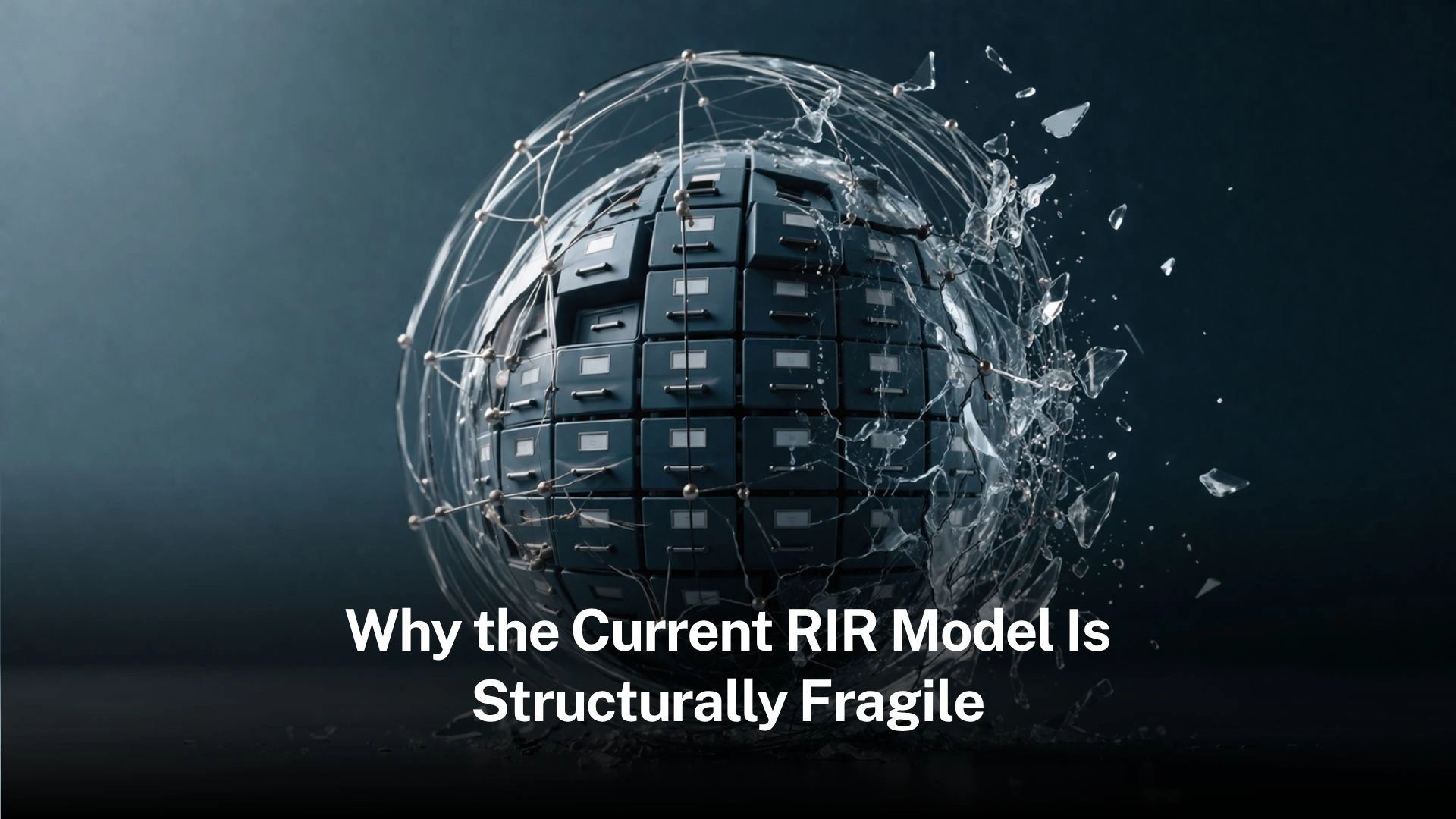
Illustration retained from Ann Yong’s original article.
The RIR model coordinates global IP allocation, yet legal limits, market forces and governance tensions increasingly expose its structural fragility.
- The RIR system works on being legitimate and coordinated not on having power. This creates a gap between having power and being responsible.
- The lack of IPv4 addresses making a market out of it and pressure from countries are showing us the real problems, with the regional internet registry model not causing them.
Introduction: A system that works—until its assumptions break
One of the internet's quiet infrastructures is the regional internet registries (RIRs). They give out IP address space and autonomous system numbers so that networks can find and send traffic around the world.
There are five of these groups around the world, and each one is in charge of a different area. Together, they make up the backbone of managing internet number resources.
For many years, the rir model has been seen as a rare success in global governance because it is decentralized, collaborative, and mostly apolitical. It worked not because it was strong, but because it didn't have to be.
But that idea—that coordination is enough—is now being tested.
What we see today is not just a system under stress; it's also a system whose original design logic is becoming less and less in line with how things are now: scarcity, monetization, and geopolitical competition.
The origins of the RIR model: coordination without coercion
The regional internet registry model was built for a different internet.
In the 1990s, IP addresses were treated as technical identifiers, not economic assets. RIRs were created to distribute these identifiers fairly and efficiently, based on demonstrated need.
Crucially, they were not designed as regulators. They are non-profit bodies operating through community-developed policies, rather than statutory law.
This meant the system relied on:
- shared norms
- technical cooperation
- and voluntary compliance
That design choice enabled global interoperability at scale. But it also embedded a structural limitation:
the system governs without sovereign authority.
Structural fragility #1: Authority that stops at the contract boundary
One of the clearest tensions in the rir system is the gap between what it manages and what it can enforce.
RIRs maintain registries ofIP address allocations and set policies for their distribution. But they cannot enforce those policies beyond contractual relationships with members.
Research shows that as IP addresses have gained economic value, disputes over ownership and usage are increasingly being resolved in courts rather than within RIR frameworks.
This creates a layered system:
- RIR policies define allocation rules
- legal systems define enforceable rights
When these layers conflict, the question becomes practical rather than theoretical:
which system actually has authority?
The RIR model offers coordination—but not final arbitration.
Structural fragility #2: Consensus governance in a non-consensus world
The regional internet registries model depends on bottom-up, consensus-driven policymaking. In principle, this ensures legitimacy. In practice, it introduces friction.
Policy changes can take years to emerge, requiring alignment among diverse stakeholders with competing interests. As industry observers note, some legacy mechanisms—such as needs-based allocation tests—persist even as the environment around them has changed.
This reveals a deeper tension:
- consensus produces legitimacy
- but it also limits responsiveness
In a stable system, this trade-off is acceptable.
In a fast-changing one, it creates structural lag—rules that reflect a past reality rather than a present one.
Structural fragility #3: Scarcity transforms governance into economics
The exhaustion of IPv4 address space is often framed as a technical milestone. In reality, it is a structural turning point.
Since 2011, the global pool of IPv4 addresses has effectively been depleted, forcing RIRs into scarcity management.
Scarcity changes behaviour:
- resources gain monetary value
- allocation becomes distribution of assets
- markets emerge
As one analysis notes, the lack of strong enforcement has allowed market dynamics to shape how IPv4 resources are traded and used.
This creates a contradiction at the heart of the rir model:
- It governs IP addresses as if they are public resources
- The market treats them as private assets
The system does not fully reconcile these two logics—it operates between them.
NRS editorial clarification · 5 October 2026
The 2011 milestone concerns the exhaustion of IANA’s unallocated central IPv4 pool. Existing addresses remained usable; regional pools did not all exhaust at once. Transfers and later allocations of returned resources are separate matters.
Structural fragility #4: Inequality embedded in historical allocation
The distribution of IP address space was never neutral.
Early allocations—before the RIR system fully matured—concentrated large portions of IPv4 space in North America and other early internet regions. Later registries, such as AFRINIC, entered the system with significantly smaller pools of address space.
This historical imbalance continues to shape today’s market:
- regions with scarcity face higher costs
- access becomes uneven
- dependency on secondary markets increases
What appears as a technical system is, in effect, carrying legacy inequalities forward into the present.
Structural fragility #5: Decentralisation without a clear failure model
The regional internet registries are deliberately decentralised. Each operates independently, coordinating through bodies such as the Number Resource Organization.
This structure assumes that:
- local governance works
- coordination is sufficient
But recent events challenge that assumption.
The governance crisis at AFRINIC—including legal disputes, operational disruption and leadership instability—has raised concerns about the resilience of the model.
Importantly, the system has no formalised mechanism for:
- intervention
- recovery
- or systemic risk containment
Decentralisation provides flexibility. But without defined failure pathways, it also introduces systemic uncertainty.
NRS editorial clarification · 5 October 2026
A Joint RIR Stability Fund exists: voluntary pledges, activated by unanimous NRO Executive Council agreement. This conditional support is not an automatic recovery guarantee.
The NRO process update places the recommended governance draft with its Executive Council for review. Completed drafting does not establish that the document is in force.
Structural fragility #6: global coordination constrained by local law
RIRs operate globally—but exist legally within specific jurisdictions.
This creates a structural tension:
- the system aspires to neutrality
- but is bounded by national legal frameworks
The AFRINIC legal disputes illustrate how courts can directly impact registry operations, This is not an exception. It is a structural issue.
As governments see internet infrastructure as important the RIR system will likely face pressure to align with national interests. Global coordination, in this case is not fully independent. It is affected by laws.
The RIR system is likely to face growing pressure to align with interests because governments increasingly view internet infrastructure as strategic.
Structural fragility #7: trust-based data in an increasingly adversarial environment
The RIR system depends on accurate registry data to function.
Yet studies show discrepancies between registered information and actual usage patterns, including cases where IP addresses are used outside their allocated regions.
There are also documented risks linked to abandoned or poorly maintained records, which can be exploited for hijacking internet resources.
These issues point to a deeper structural assumption:
- the system assumes honest participation
- but the environment increasingly rewards strategic behaviour
Trust remains foundational—but it is no longer sufficient on its own.
NRS editorial clarification · 5 October 2026
The original refers to studies without identifying them. Those references are not independently verified citations. Cross-region use alone does not establish a policy violation, and geolocation does not decide legal rights. Abandoned records and unverified changes require separate investigation.
Can the RIR model adapt, or is it structurally constrained?
TheRegional Internet Registry model continues to function—and remains indispensable. No alternative currently offers comparable global coordination of IP resources.
Yet most proposed reforms focus on incremental improvements:
- policy updates
- transparency
- procedural efficiency
These may alleviate pressure, but they do not fully address the underlying question:
Can a system built on voluntary coordination evolve to govern scarce, valuable and contested resources? Or does its original design inherently limit its ability to do so?
Conclusion: Fragility as an emergent property
The RIR model is not broken. It still enables the global internet to function.
But its fragility is not accidental it emerges from its core design:
- coordination without coercion
- legitimacy without sovereignty
- trust without strong verification
These characteristics once made the system scalable and cooperative.
Today, they also make it vulnerable. The challenge ahead is not simply reform, but redefinition—whether the system can evolve from a coordination mechanism into a governance framework suited to a far more complex internet.
Frequent Ask Questions (FAQs)
1. What Is A Regional Internet Registry (RIR)?
A regional internet registry is a non-profit organisation responsible for allocating and managing IP address resources within a specific region.
2. How Many Regional Internet Registries Exist?
There are five globally, each serving a different geographic area and coordinating through shared frameworks.
3. Why Is The RIR Model Considered Structurally Fragile?
Because it lacks enforcement authority, relies on consensus governance and faces pressures from markets, law and geopolitics.
4. Do RIRs own IP addresses?
No. They manage allocation rights, which can lead to ambiguity when those rights intersect with legal or commercial claims.
5. What Could Replace The Current RIR System?
There is no established alternative today, though discussions include reforms and more decentralised or hybrid governance approaches.
NRS editorial clarification · 5 October 2026
The original article and its publication dates remain attributed to Ann Yong. The dated clarifications are additions by NRS. Registry administration alone does not establish ownership of all registered addresses; specific rights depend on contracts, applicable law and the facts of a dispute. The original FAQ’s categorical answer should be read with that qualification.
From exposure to effective representation
If your business depends on continued access to IP resources, identify the risks, contracts and verifiable records first. Then explore NRS Shield. Participation in policy or elections requires clear eligibility and procedures. A power of attorney, or POA, is a separate decision: understand its scope, limits and withdrawal terms. Reading this article or joining NRS does not automatically authorize NRS to represent you.