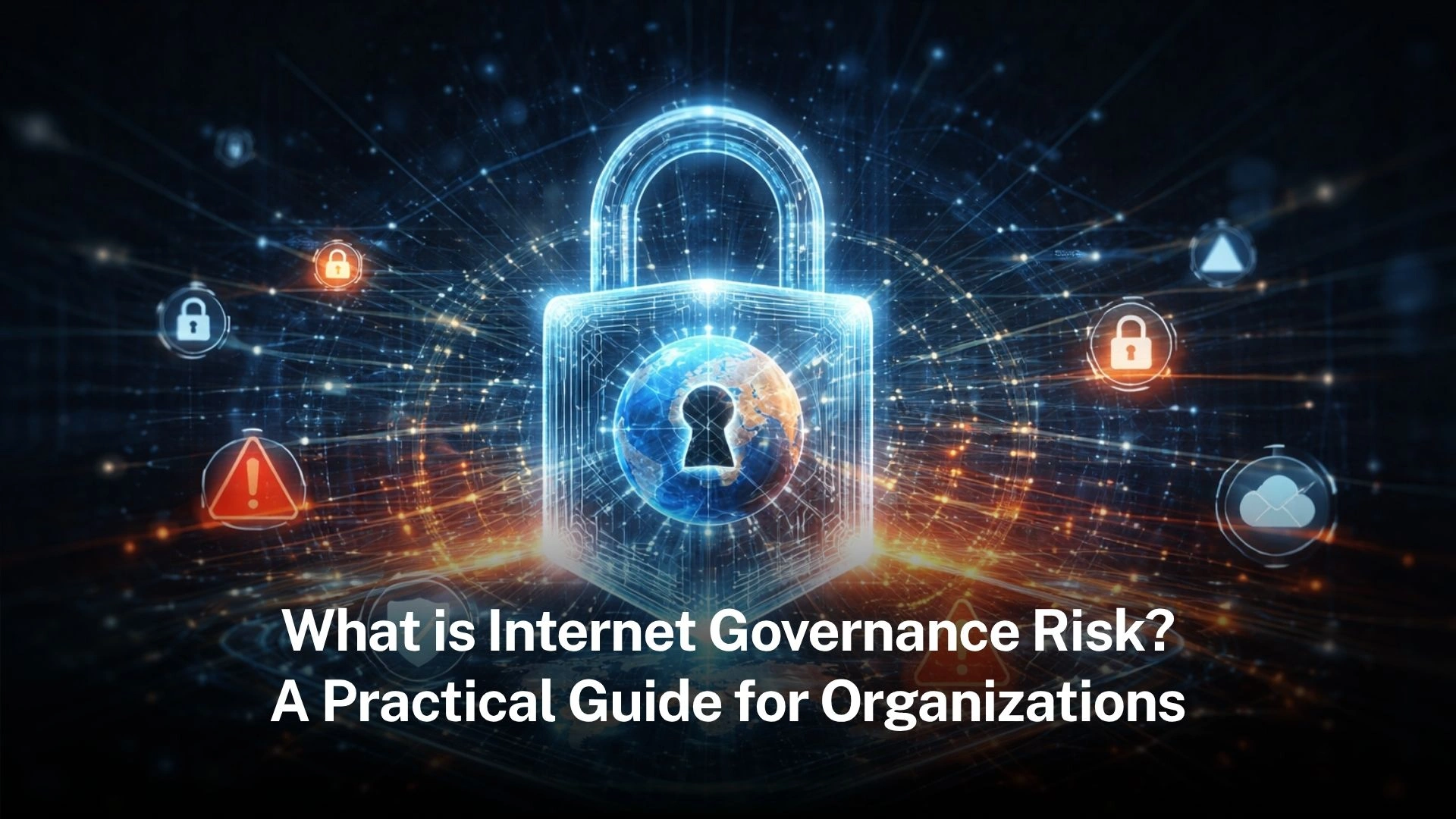
Internet governance risk arises from fragmented control, regulatory uncertainty, and global infrastructure dependencies, increasingly affecting organisational operations and strategic planning.
Table of Contents
ToggleUnderstanding Internet Governance Risk
Internet governance is no longer an abstract background condition. It encompasses the shared principles, norms, rules, and decision-making processes that determine how the internet functions.
As governance becomes fragmented, politicised, and economically significant, organisations face exposure to decisions made outside their control. This exposure—known as internet governance risk—differs from cybersecurity risk: it is structural, systemic, and often invisible until disruptions occur.
Why Governance Risk is Increasing
1. Fragmentation across jurisdictions
The internet is global, but governance is increasingly localised. National regulations, data localisation laws, and regional policies create inconsistent compliance requirements and operational uncertainty.
2. Politicisation of technical systems
Technical standards are no longer purely technical. Shifts into intergovernmental processes can politicise core systems, introducing strategic or cultural conflicts that affect routing, resource allocation, and interoperability.
3. Dependence on voluntary coordination
The internet lacks a central authority. Stability relies on coordination between registries, operators, and standards bodies, making it vulnerable to cascading disruptions if coordination fails.
Key Components of Internet Governance Risk
Infrastructure Dependency Risk
Critical systems like the Domain Name System (DNS) and IP address allocation underpin global connectivity. Failures or disruptions in these systems threaten organisational operations, cloud services, and APIs.
Policy and Regulatory Risk
Governments increasingly regulate internet operations through laws and policies. These interventions can restrict data flows, impose compliance burdens, or fragment global services. Anticipating policy evolution is key.
Coordination and Trust Risk
Governance depends on trust between stakeholders. Breakdowns can affect IP address distribution, routing stability, and cross-border data exchange, creating systemic risk beyond any single organisation.
Market and Economic Governance Risk
As internet resources like IPv4 addresses become commodified, governance decisions influence pricing, access, and liquidity. Organisations face cost volatility directly tied to governance frameworks.
Reputational and Compliance Risk
Governance failures—such as data misuse or inadequate infrastructure protections—can damage reputations, especially in highly regulated sectors like finance, healthcare, and telecommunications.
Integrating Governance Risk into Organisational Strategy
Organisations cannot treat internet governance as an abstract concern. To manage exposure:
- Map dependencies: Identify critical infrastructure and governance bodies influencing operations.
- Monitor regulatory trends: Track changes in data governance, cross-border restrictions, and sector-specific policies.
- Diversify infrastructure: Reduce reliance on single providers or regions to mitigate systemic fragility.
- Engage in multistakeholder processes: Participation in industry groups and standards discussions can provide early visibility of risk shifts.
These steps align governance risk management with enterprise risk frameworks, cybersecurity strategies, and compliance planning.
Why Traditional Risk Models Fall Short
Traditional frameworks focus on discrete threats—cyberattacks, outages, or compliance failures. Internet governance risk is different:
- Systemic, not event-driven
- Slow-evolving, but can manifest suddenly
- Multidimensional, spanning technical, political, and economic domains
This complexity makes it difficult to quantify or manage using conventional approaches.
The Future of Internet Governance Risk
Emerging trends suggest governance risk will intensify:
- Increasing state involvement in internet infrastructure and policy
- Fragmentation into multiple internets, driven by diverging national and regional regulations
- Continued reliance on voluntary coordination, maintaining systemic fragility
For organisations, governance risk will remain a core operational and strategic concern.
Conclusion: Risk Without a Centre
The paradox of internet governance risk is clear: the internet is globally integrated yet locally regulated, technically robust yet institutionally fragile. Organisations cannot outsource or ignore these risks. Instead, they must treat governance as an inherent structural condition of online operations—requiring continuous monitoring, adaptation, and strategic engagement.
Frequent Ask Questions (FAQs)
1. What is Internet Governance Risk?
Risk arising from the coordination, regulation, and management of the internet, including technical, policy, and institutional factors.
2. How Does It Differ From Cybersecurity Risk?
Cybersecurity risk focuses on attacks and vulnerabilities; governance risk is structural and systemic.
3. Why Is Governance Risk Increasing?
Regulatory fragmentation, politicisation of standards, and reliance on voluntary global coordination are the main drivers.
4. How Can Organisations Manage It?
By mapping dependencies, monitoring policies, diversifying infrastructure, and engaging in governance discussions.