Every organization has a business continuity plan.
Table of Contents
ToggleThey prepare for cyberattacks, hardware failures, natural disasters, and service outages. They build redundancy into their networks, cloud environments, and operational processes to ensure their businesses can continue functioning during periods of disruption.
But there is one growing risk many organizations still overlook.
It is not a technology risk.
It is a dependency risk.
Today, many businesses unknowingly depend on systems they do not directly control to maintain the digital assets that underpin their operations. As Internet number resources have evolved from administrative records into economically significant assets, the assumptions surrounding business continuity must evolve as well.
Protecting infrastructure is no longer enough.
Organizations must also understand and protect the rights associated with the infrastructure their businesses depend upon.
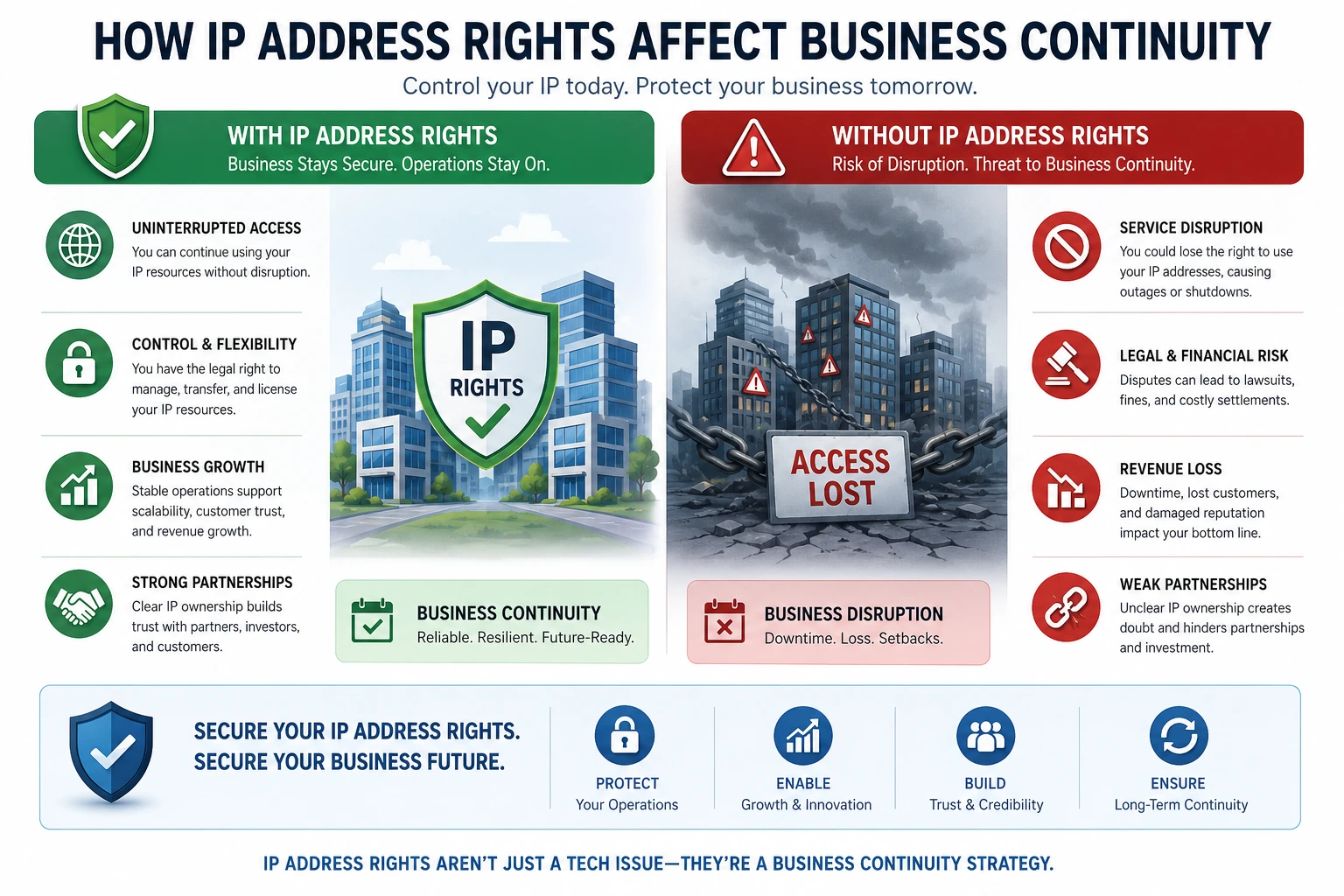
IP address rights affect business continuity because modern organizations depend on Internet number resources to operate digital infrastructure, customer services, and network operations. As these resources become increasingly valuable, businesses must manage not only technology risks but also dependency risks associated with the systems that recognize and administer these assets.
Why IP Address Rights Matter More Than Ever
For decades, IP addresses were viewed as technical identifiers that enabled devices and networks to communicate.
That description is no longer sufficient.
Today, Internet number resources have become:
- Scarce
- Transferable
- Revenue-enabling
- Embedded into critical business operations
- Essential to long-term infrastructure planning
Cloud providers, hosting companies, network operators, telecommunications businesses, and enterprises have built enormous amounts of economic activity around these resources.
In practice, IP addresses have become operator-held assets embedded inside real businesses.
Organizations invest significant capital around them, build services upon them, and rely on their continuity every day.
The larger an organization becomes, the more deeply integrated these resources become throughout its operations.
Business Continuity Is No Longer Just a Technology Problem
Traditional business continuity planning asks a simple question:
What dependencies could disrupt our business?
Organizations routinely assess risks involving:
- Cloud providers
- Telecommunications carriers
- Data centers
- Cybersecurity vendors
- Supply chains
However, another dependency often goes unnoticed.
Businesses also depend on the systems responsible for recognizing and administering their Internet number resources.
This matters because continuity is not only about whether infrastructure exists.
It is also about whether organizations can continue to rely on the conditions that allow that infrastructure to function.
As digital businesses become more dependent on Internet number resources, governance resilience becomes operational resilience.
Global Uniqueness Requires Coordination, Not Excessive Governance
The Internet functions because of one fundamental principle: global uniqueness.
Without globally unique Internet number resources, billions of devices, networks, services, and applications could not interoperate as a single Internet.
Global uniqueness requires coordination.
It does not require excessive governance.
The more complexity accumulates around the uniqueness layer, the more organizations become exposed to risks that have little to do with technical coordination itself.
The Internet was originally designed to eliminate single points of failure.
Its foundational systems should reflect the same philosophy.
The coordination layer should remain:
- Neutral
- Transparent
- Predictable
- Narrowly focused on interoperability
The more discretionary power accumulates around that layer, the more fragility is introduced into the broader digital ecosystem.
As discussed in “On Why NRS Exists and Why Decentralization Is No Longer Optional,” resilient systems are built by reducing dependency and eliminating unnecessary chokepoints, not by concentrating more power into a single layer.
Registry Risk Is Becoming a Business Continuity Risk
Registry functions are necessary.
The issue is not their existence.
The issue emerges when administrative systems evolve into dependency systems that sit above economically significant assets without carrying equivalent accountability.
Organizations then become exposed to risks they neither created nor control.
This creates a new category of business continuity risk: registry dependency.
Businesses become dependent on external administrative structures while carrying all the operational and financial consequences if those systems become unstable.
That imbalance deserves attention.
Understanding Double Extraction
This issue becomes clearer through the concept of double extraction.
As explored in “On Regional Internet Registries: Thick Governance Turns Uniqueness into Double Extraction,” operators increasingly find themselves trapped between two forms of asymmetry.
On one side, the economic potential of their assets is suppressed.
On the other side, they remain fully exposed to the risks associated with the systems that administer those assets.
First Extraction: Suppressed Asset Recognition
Organizations have built enormous economic value around scarce Internet resources.
Yet these resources are still often treated institutionally as though they are merely administrative allocations.
This uncertainty suppresses normal asset characteristics.
Reduced certainty leads to:
- Reduced liquidity
- Reduced capitalization
- Reduced financing opportunities
- Reduced strategic flexibility
- Reduced long-term planning confidence
The asset is not confiscated.
It is discounted.
Businesses are prevented from fully realizing the economic value of resources they have already integrated into their operations.
Second Extraction: Retained Dependency Risk
While upside is suppressed, downside remains entirely with the operator.
Organizations still depend on administrative recognition, transferability, and continued operational certainty.
This creates a structural imbalance.
Operators create the value.
Operators bear the risks.
But operators do not fully control the conditions under which those assets exist.
That imbalance directly affects business continuity.
Why Small and Medium Operators Face Greater Exposure
Large organizations may possess legal teams, reserves, and operational redundancy.
Many smaller operators do not.
Every operator should ask a simple question:
If prolonged uncertainty affected your Internet number resources, could your business survive it?
Could your organization absorb:
- Operational disruption
- Customer attrition
- Years of uncertainty
- Significant legal costs
- Reputational damage
For many organizations, the answer is no.
That is precisely why continuity planning must evolve.
Businesses should not wait until they are directly exposed to discover how dependent they have become.
How Organizations Can Build Digital Infrastructure Resilience
Organizations should begin treating Internet number resources as strategic assets.
Ask these questions:
- How exposed are we to registry-side dependencies?
- How resilient are our IP address rights?
- What contingency plans exist?
- How can we reduce single points of failure?
- Are our long-term infrastructure investments adequately protected?
These are no longer niche Internet governance discussions.
They are operational resilience discussions.
Why IP Address Rights Matter More Than Ever
For decades, IP addresses were viewed as technical identifiers that enabled devices and networks to communicate.
That description is no longer sufficient.
Today, Internet number resources have become:
- Scarce
- Transferable
- Revenue-enabling
- Embedded into critical business operations
- Essential to long-term infrastructure planning
Cloud providers, hosting companies, network operators, telecommunications businesses, and enterprises have built enormous amounts of economic activity around these resources.
In practice, IP addresses have become operator-held assets embedded inside real businesses.
Organizations invest significant capital around them, build services upon them, and rely on their continuity every day.
The larger an organization becomes, the more deeply integrated these resources become throughout its operations.
Business Continuity Is No Longer Just a Technology Problem
Traditional business continuity planning asks a simple question:
What dependencies could disrupt our business?
Organizations routinely assess risks involving:
- Cloud providers
- Telecommunications carriers
- Data centers
- Cybersecurity vendors
- Supply chains
However, another dependency often goes unnoticed.
Businesses also depend on the systems responsible for recognizing and administering their Internet number resources.
This matters because continuity is not only about whether infrastructure exists.
It is also about whether organizations can continue to rely on the conditions that allow that infrastructure to function.
As digital businesses become more dependent on Internet number resources, governance resilience becomes operational resilience.
Global Uniqueness Requires Coordination, Not Excessive Governance
The Internet functions because of one fundamental principle: global uniqueness.
Without globally unique Internet number resources, billions of devices, networks, services, and applications could not interoperate as a single Internet.
Global uniqueness requires coordination.
It does not require excessive governance.
The more complexity accumulates around the uniqueness layer, the more organizations become exposed to risks that have little to do with technical coordination itself.
The Internet was originally designed to eliminate single points of failure.
Its foundational systems should reflect the same philosophy.
The coordination layer should remain:
- Neutral
- Transparent
- Predictable
- Narrowly focused on interoperability
The more discretionary power accumulates around that layer, the more fragility is introduced into the broader digital ecosystem.
As discussed in “On Why NRS Exists and Why Decentralization Is No Longer Optional,” resilient systems are built by reducing dependency and eliminating unnecessary chokepoints, not by concentrating more power into a single layer.
Registry Risk Is Becoming a Business Continuity Risk
Registry functions are necessary.
The issue is not their existence.
The issue emerges when administrative systems evolve into dependency systems that sit above economically significant assets without carrying equivalent accountability.
Organizations then become exposed to risks they neither created nor control.
This creates a new category of business continuity risk: registry dependency.
Businesses become dependent on external administrative structures while carrying all the operational and financial consequences if those systems become unstable.
That imbalance deserves attention.
Understanding Double Extraction
This issue becomes clearer through the concept of double extraction.
As explored in “On Regional Internet Registries: Thick Governance Turns Uniqueness into Double Extraction,” operators increasingly find themselves trapped between two forms of asymmetry.
On one side, the economic potential of their assets is suppressed.
On the other side, they remain fully exposed to the risks associated with the systems that administer those assets.
First Extraction: Suppressed Asset Recognition
Organizations have built enormous economic value around scarce Internet resources.
Yet these resources are still often treated institutionally as though they are merely administrative allocations.
This uncertainty suppresses normal asset characteristics.
Reduced certainty leads to:
- Reduced liquidity
- Reduced capitalization
- Reduced financing opportunities
- Reduced strategic flexibility
- Reduced long-term planning confidence
The asset is not confiscated.
It is discounted.
Businesses are prevented from fully realizing the economic value of resources they have already integrated into their operations.
Second Extraction: Retained Dependency Risk
While upside is suppressed, downside remains entirely with the operator.
Organizations still depend on administrative recognition, transferability, and continued operational certainty.
This creates a structural imbalance.
Operators create the value.
Operators bear the risks.
But operators do not fully control the conditions under which those assets exist.
That imbalance directly affects business continuity.
Why Small and Medium Operators Face Greater Exposure
Large organizations may possess legal teams, reserves, and operational redundancy.
Many smaller operators do not.
Every operator should ask a simple question:
If prolonged uncertainty affected your Internet number resources, could your business survive it?
Could your organization absorb:
- Operational disruption
- Customer attrition
- Years of uncertainty
- Significant legal costs
- Reputational damage
For many organizations, the answer is no.
That is precisely why continuity planning must evolve.
Businesses should not wait until they are directly exposed to discover how dependent they have become.
How Organizations Can Build Digital Infrastructure Resilience
Organizations should begin treating Internet number resources as strategic assets.
Ask these questions:
- How exposed are we to registry-side dependencies?
- How resilient are our IP address rights?
- What contingency plans exist?
- How can we reduce single points of failure?
- Are our long-term infrastructure investments adequately protected?
These are no longer niche Internet governance discussions.
They are operational resilience discussions.
The Future Is Operator-First Resilience
The Internet was built upon decentralization.
Its supporting structures should embrace the same principle.
Global uniqueness becomes stronger when coordination remains thin, neutral, and narrowly focused.
Business continuity no longer begins with disaster recovery plans alone.
It begins with understanding every dependency embedded beneath your infrastructure.
Because ultimately, continuity is not about surviving technology failures.
It is about surviving dependency failures.
Further Reading
Frequent Asked Questions
IP address rights refer to an organization’s ability to reliably hold, use, transfer, and maintain recognition over Internet number resources that support its digital operations and infrastructure.
Businesses rely on Internet number resources to operate networks, cloud environments, customer services, and digital platforms. Uncertainty surrounding these resources can directly affect operational resilience.
Registry risk refers to the exposure businesses have when critical digital assets depend on external administrative systems that organizations do not directly control.
Double extraction occurs when operators simultaneously experience suppressed asset recognition while still bearing all the operational and commercial risks associated with registry dependency.
Internet governance increasingly affects digital infrastructure, operational resilience, and long-term business continuity. Understanding these dependencies helps organizations reduce future risks.