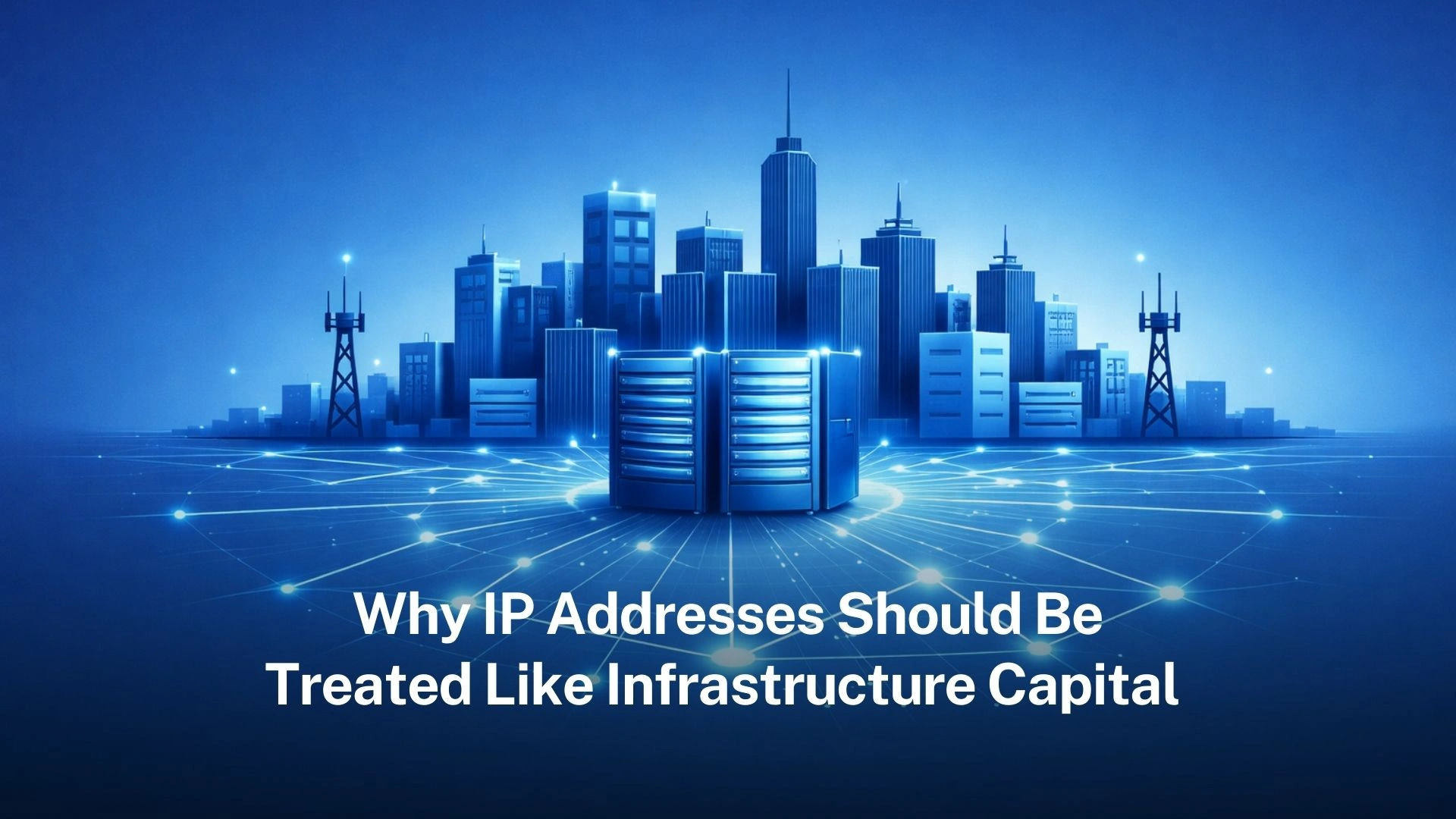
With IPv4 scarcity and ongoing demand, organisations are now managing IP address space as long-term capital, not just technical identifiers.
Table of Contents
ToggleLimited supply, high demand and secondary markets give IPv4 addresses economic value comparable to digital infrastructure assets.
Governance, stewardship and strategic allocation frameworks such as NRS help institutions manage these resources responsibly and sustainably.
How IPv4 scarcity transformed a technical resource into capital
Internet Protocol (IP) addresses serve as the basic identifiers that allow devices to communicate across networks. The original IPv4 specification defined a 32-bit address space capable of approximately 4.3 billion unique identifiers. Over time, however, the global pool of publicly allocatable IPv4 addresses has been exhausted, creating a structural shortage that enterprises and network operators must contend with. This shortage has shifted the perception of IP addresses from purely technical resources into economic assets that require strategic management and stewardship.
As scarcity drives demand higher, secondary markets have emerged in which IP address blocks are bought, sold, leased and traded. Organisations now manage IPv4 holdings in ways that resemble the management of physical capital — tracking value, optimising usage and even generating recurring revenue — rather than treating them simply as network configuration details.
Scarcity meets demand: defining digital capital
The basic economics of a fixed supply with rising demand explains much of this transformation. Because fewer than 4.3 billion IPv4 addresses can ever exist, and because the usable portion of that space is even smaller, the limited supply contrasts sharply with continuously growing global connectivity needs from cloud services, IoT deployments, corporate networks and legacy systems that have not fully transitioned to IPv6.
This enduring reliance on a finite resource has given IPv4 addresses characteristics normally associated with traditional capital assets: scarcity, utility, market value and transferability. These are not merely theoretical qualities; they manifest economically in pricing, leasing arrangements and balance-sheet recognition. Larger holdings can influence network design decisions, strategic expansion, mergers and even valuations of internet service providers.
Secondary markets and monetisation mechanisms
In practical terms, the scarcity of IPv4 has given rise to secondary markets where address space is actively traded. Organisations with excess allocations can monetise their holdings by selling or leasing blocks to those with shortfalls, creating recurring revenue streams and new economic incentives. Some enterprises use these markets to optimise infrastructure costs, while others build strategic portfolios of addresses to support long-term growth.
Leasing mechanisms have become an especially important component of this market. Rather than selling addresses outright, holders can lease space to other organisations, preserving long-term control while generating sustained income — a pattern that resembles rental income from physical property more than technical resource sharing.
This dynamic is reinforced by the structure of transactions themselves, which often require formal documentation, reputation checks and route history verification, similar to due diligence in financial asset transfers. Clean, reputable address blocks command higher prices and greater utility, just as well-maintained physical capital draws premium valuation.
Governance complexity and the role of NRS
Treating IP addresses as capital introduces important governance considerations. The current global framework for IP allocation and transfer is shaped by Regional Internet Registries (RIRs) under policy oversight from bodies like ICANN. RIRs distribute address space based on demonstrated network need, not purely on market dynamics, and maintain records that track those allocations.
The Number Resource Society (NRS) advocates for transparent, informed governance of these number resources. According to NRS, as IP addresses take on the attributes of strategic assets, institutions must engage with allocation policies and community governance processes rather than treat address management as a back-office technical task. This helps ensure that scarcity-driven markets do not undermine equitable access, technical stability or long-term internet growth.
NRS emphasises that proper documentation, compliance with transfer policies and participation in governance discussions help organisations manage IP resources sustainably, aligning economic interests with broader network reliability and interoperability.
From identifiers to strategic network assets
The practical consequences of viewing IP addresses as capital are visible in enterprise network planning. Organisations with robust address portfolios can influence how they design network topologies, negotiate with cloud providers or position services across geographic regions. Having address continuity can directly impact an enterprise’s ability to scale systems, deliver services reliably and maintain competitive advantage.
For instance, cloud deployments and edge computing strategies often require significant blocks of address space in multiple regions. The ability to reserve, allocate or trade these blocks with agility gives organisations tactical flexibility akin to owning physical infrastructure such as datacentres or spectrum licences. In some markets, address holdings are explicitly tracked alongside other digital infrastructure investments.
Balancing capital value with foundational governance
Despite their economic value, IP addresses differ from traditional financial assets in important ways. Policy requirements from RIRs restrict how addresses can be transferred, often requiring documented network need or enforcing holding periods to prevent speculative hoarding. These governance constraints, while limiting free market dynamics, help protect internet stability and ensure equitable distribution among stakeholders.
This tension — between economic capital and public resource stewardship — is central to why institutions must approach IP address holdings with both strategic and ethical foresight. Organisations that prioritise compliance, participate in governance and manage reputation carefully are better positioned to derive value without undermining broader network stability or creating access inequities.
The conversation about ownership rights and transferability continues to evolve. Some industry voices argue for clearer recognition of address ownership to unlock further economic potential, while others caution against unregulated markets that could disadvantage smaller networks or emerging regions.
Strategic frameworks for institutional planning
Institutions managing significant IP resources must adopt frameworks similar to those used in capital asset management: risk assessment, portfolio optimisation, regulatory compliance and reputation monitoring. This means integrating IP address strategies into broader enterprise planning and risk management rather than leaving them to siloed technical teams.
Proper documentation of transfers, participation in governance structures and transparent stewardship practices help ensure that IP address holdings support organisational goals without exposing the enterprise to legal or operational risk. These practices mirror how other forms of infrastructure capital, such as telecommunications spectrum or datacentre capacity, are managed in regulated markets.
Looking ahead: IPv4, IPv6 and hybrid infrastructure
Although IPv6 offers a vastly larger address space designed to address IPv4 scarcity, its adoption has been incremental rather than instantaneous. Many enterprise systems, legacy applications and network dependencies continue to rely heavily on IPv4, sustaining demand and market value. This prolonged coexistence reinforces the notion that IPv4 addresses are not transient technical artefacts but enduring elements of digital infrastructure.
Strategic planning frameworks must therefore account for hybrid environments in which both protocols play significant roles, treating IPv4 holdings as critical capital while advancing IPv6 adoption where possible.
Conclusion: reframing IP as infrastructure capital
The evolution of IP addresses from technical necessities to forms of digital capital reflects broader structural shifts in the internet economy. Scarcity, demand and the emergence of secondary markets have created conditions in which IPv4 holdings carry real economic value and strategic weight. For institutions, treating these resources as capital — with associated governance, portfolio management and stewardship — is increasingly essential to sustainable infrastructure planning. Frameworks such as those promoted by NRS help bridge economic dynamics with responsible, equitable governance, ensuring that IP resources continue to support the growth and stability of global networks.
FAQs
1. Why are IP addresses considered digital capital?
Because IPv4 scarcity and demand have created market dynamics in which addresses carry economic value and strategic utility for organisations.
2. How do secondary markets affect address value?
Traded, leased and transferred in secondary markets, IPv4 blocks gain liquidity and economic significance.
3. What role does NRS play in IP address governance?
NRS advocates for transparent policy engagement and stewardship frameworks to balance economic interests with network stability.
4. Are IPv4 addresses owned like traditional assets?
Not exactly; RIR policies treat them as allocated resources, but evolving market practices have created de facto ownership dynamics.
5. Should institutions integrate IP holdings into strategic planning?
Yes; treating IP addresses as infrastructure capital supports long-term network resilience and competitive positioning.