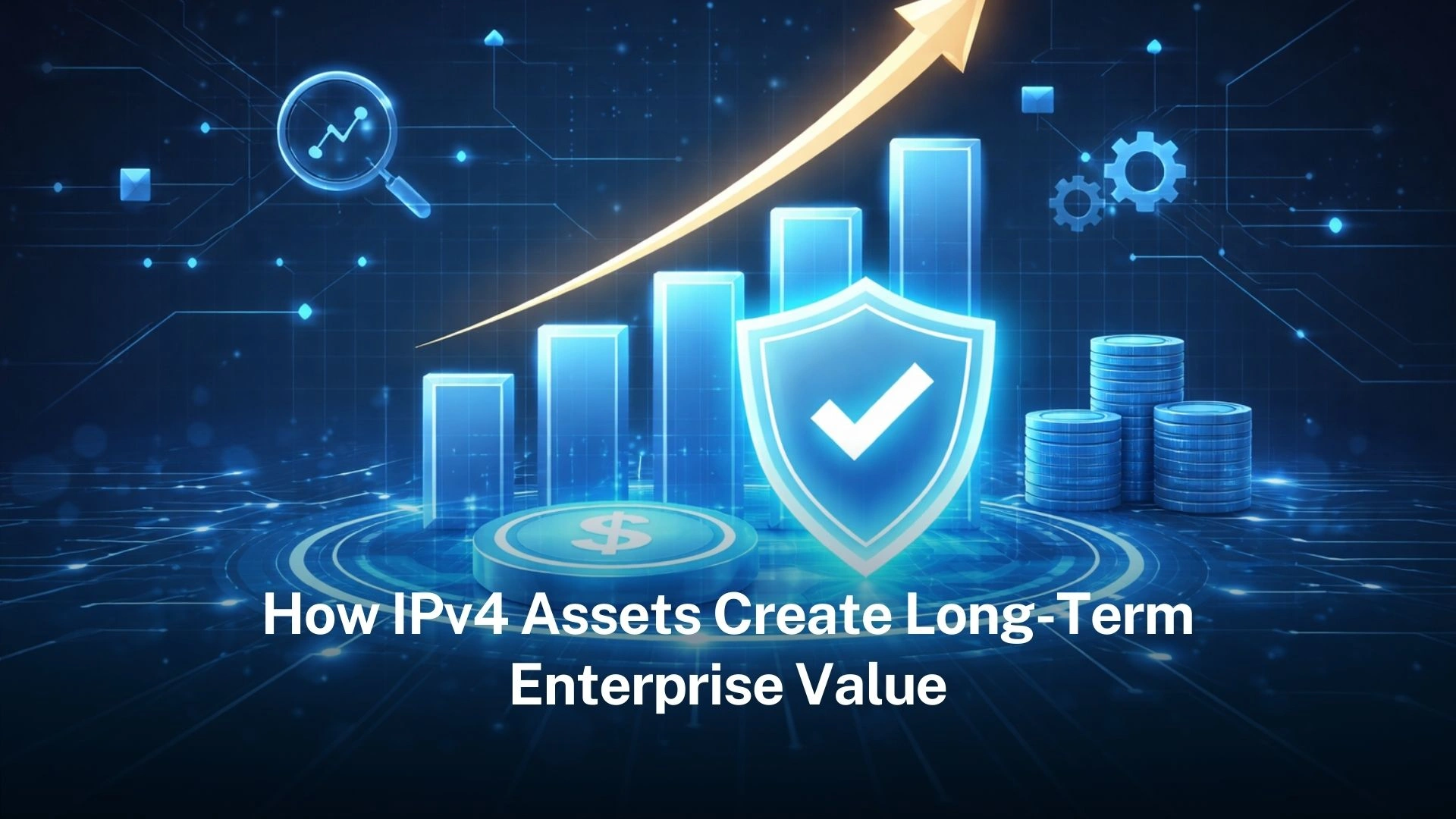
Finite supply, persistent demand and commercial tradability have transformed IPv4 addresses into strategic assets that deliver sustainable financial and operational value.
Table of Contents
Toggle
Key points
IPv4 scarcity and continued global reliance mean address blocks now function as long-term enterprise assets, not just technical resources.
Markets, leasing and strategic control of IPv4 space create measurable value, supporting growth, revenue and competitive resilience.
From technical resource to enterprise asset
IPv4 addresses were once seen as purely functional identifiers — simply numbers required to connect devices to the internet. Today, they have evolved into something far more significant: scarce, tradeable and strategically valuable digital assets. Every enterprise that operates networks, delivers digital services or builds internet-based business models requires them.
Critically, no new public IPv4 address supply exists. Regional internet registries have exhausted their free pools, and all usable IPv4 space is now circulating within the global ecosystem. As one senior registry executive famously explained, “We have run out of IPv4 addresses, and the world must now operate with what already exists.” That reality has reshaped how businesses perceive and manage IPv4 resources.
Scarcity and the foundations of value
Scarcity is the fundamental force behind IPv4 asset value. The original 32-bit protocol created roughly 4.3 billion unique addresses — a number once considered enormous but now proven inadequate for a world of cloud platforms, mobile devices, enterprise infrastructure, data centres and the Internet of Things.
Economically, IPv4 behaves like any finite commodity. Supply is fixed; demand is persistent. That combination naturally creates value. Industry observers have repeatedly highlighted that IPv4 address space is not merely useful — it is economically powerful. As one well-known internet governance figure noted, “IPv4 addresses remain one of the most undervalued assets in the global digital economy,” stressing that their scarcity underpins structural long-term worth.
Continued demand despite IPv6
IPv6 theoretically solves the scarcity problem with an almost limitless address pool. However, adoption has been uneven and gradual. Many enterprises still depend on IPv4 for compatibility, customer reach and stable service delivery. Legacy platforms, embedded systems, critical infrastructure, financial networks, hosting services and consumer-facing applications frequently require IPv4 connectivity to function reliably.
A senior network engineering expert once summarised the situation simply: “Businesses cannot switch the global internet over in a single moment. IPv4 will remain essential for years to come.” Dual-stack environments, operational inertia and cost considerations ensure IPv4 remains central to enterprise networking strategy, reinforcing long-term demand and value.
Secondary markets and monetisation of IPv4 assets
The clearest sign that IPv4 addresses have become assets is the existence of structured, regulated markets for them. Organisations now buy, sell and transfer IPv4 blocks in the same way they might manage spectrum, bandwidth capacity or other digital resources.
Beyond outright sales, leasing has become a mature business model. Enterprises with surplus address space increasingly lease it to others, generating predictable recurring income. This turns IPv4 holdings into real revenue-producing property. Address owners benefit from monthly cash flow while retaining long-term strategic control, and lessees gain access without large capital expenditure.
Financial analysts have also observed that well-managed IPv4 portfolios can align with broader asset strategies, contributing to enterprise valuation and forming part of digital infrastructure investment planning.
Also Read: How Enterprises Monetize Excess IP Assets
Strategic advantages: why enterprises deliberately hold IPv4
Owning IPv4 address space offers strategic benefits far beyond simple monetary returns. These advantages directly reinforce enterprise resilience and competitiveness.
Operational continuity and stability
IPv4 ownership guarantees continued service operations for platforms and customers that rely on IPv4 connectivity. It avoids the disruption, risk and cost of last-minute acquisitions or technical workarounds. Many organisations describe address scarcity as a potential “operational choke point” — owning IPv4 eliminates that vulnerability.
Scalable growth and rapid expansion
Enterprises holding address reserves can expand networks, launch services, enter new markets and increase capacity without dependency on volatile markets. This agility provides a genuine competitive edge.
Reputation and technical quality
IPv4 address blocks with clean routing history and strong operational governance carry higher value and better performance. Responsible address management protects enterprise reputation while preserving asset quality.
Financial leverage and planning
Well-documented IPv4 assets can support long-term planning, investment strategies and — in some cases — contribute to enterprise financial evaluation. Increasingly, businesses are recognising IPv4 not as temporary resources, but as durable holdings.
Risks, governance and regulatory complexity
Despite these advantages, organisations must recognise the practical challenges of treating IPv4 as an asset. IP addresses are governed under allocation policies rather than traditional property ownership frameworks. Transfers must comply with regional registry rules, documentation requirements and verification processes.
Market pricing is not static. Values fluctuate based on global demand, economic environments, policy changes and evolving technology adoption. Enterprises therefore need structured governance frameworks, professional address management practices and long-term planning to protect their IPv4 value.
Cybersecurity, abuse prevention and address reputation management are equally critical. If an address block becomes associated with malicious activity, its market value and usability can decline dramatically. Proactive governance is therefore essential.
IPv4 assets as part of long-term digital strategy
Rather than viewing IPv4 purely as a legacy technology, forward-thinking organisations treat it as a core component of digital asset strategy. Effective enterprise IPv4 planning includes:
Comprehensive inventory management: understanding exactly what space is held, how it is used and what remains available.
Regular valuation assessment: monitoring market trends to understand potential financial worth.
Leasing and monetisation planning: deciding whether unused space should be retained for future internal use or monetised.
Compliance and governance assurance: maintaining impeccable registry records and policy compliance to protect tradability.
Transition preparedness: integrating IPv4 value strategy with long-term IPv6 migration planning.
The smartest enterprises do not treat IPv4 and IPv6 as rivals. Instead, they build hybrid strategies that protect current value while preparing for the future.
A digital asset that will outlast expectations
IPv4 has persisted far longer than many technological analysts once predicted. It has not simply survived — it has become financially and strategically embedded in the global economy. One senior internet policy leader captured this reality succinctly: “IPv4 may be an old protocol, but economically it is more relevant than ever.”
As long as businesses, governments, cloud platforms, carriers and users continue relying on IPv4 connectivity, IPv4 assets will continue generating meaningful enterprise value. Their finite nature ensures enduring scarcity; their operational necessity ensures enduring demand.
For enterprises that understand this dynamic and manage their address resources proactively, IPv4 is is a long-term asset class.
Frequently Asked Questions (FAQ)
1. Why do IPv4 addresses have financial value?
They are finite and essential for global internet connectivity. With no new supply but ongoing demand, IPv4 addresses function like scarce digital commodities, giving them measurable financial value.
2. Can IPv4 addresses generate income for businesses?
Yes. Many organisations lease unused IPv4 space, creating recurring revenue while maintaining ownership and strategic control over their address resources.
3. Does IPv6 eliminate the need for IPv4 assets?
Not in the foreseeable future. IPv6 adoption is progressing, but many systems, services and markets still rely heavily on IPv4. Businesses will require IPv4 for years to come.
4. What factors influence IPv4 pricing?
Values depend on market demand, address block size, regional policy, address reputation and overall market conditions. Clean, well-managed blocks tend to command higher prices.
5. Should enterprises treat IPv4 as a long-term asset?
Yes. For most organisations, IPv4 is now best regarded as a strategic digital asset — one that supports operations, generates income and strengthens long-term enterprise value.