
Centralised Governance of IP address resources creates operational, political and security risks that may undermine fairness and resilience of the global internet.
Table of Contents
ToggleIP address management relies on a hierarchical governance system that concentrates critical authority in a small number of institutions.
Experts warn excessive centralisation could introduce systemic vulnerabilities affecting security, policy legitimacy and global connectivity.
Why IP address Management matters for the Internet
Every internet-connected device depends on a unique Internet Protocol (IP) address to communicate with others. These numerical identifiers enable routing across networks, ensuring that data packets reach the correct destination. Without coordinated allocation, address duplication would disrupt connectivity and undermine the stability of the internet.
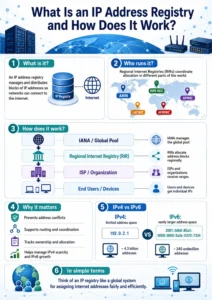
Because IP addresses must be globally unique, their distribution is governed through a layered institutional system. At the top sits the Internet Assigned Numbers Authority (IANA), which coordinates global IP address allocation and distributes address blocks to the five Regional Internet Registries (RIRs) responsible for different regions of the world.
These RIRs — AFRINIC, APNIC, ARIN, LACNIC and RIPE NCC — allocate address resources to Internet Service Providers (ISPs), enterprises and other organisations through policy frameworks developed by their respective communities.
While this system has enabled decades of global growth, critics increasingly argue that centralised control at certain layers of the governance structure introduces structural risks. As internet infrastructure becomes more economically and politically significant, the question of who manages IP resources — and how power is distributed — is becoming more important.
Understanding the architecture of IP address governance
The hierarchical allocation model
The global IP address system follows a hierarchical allocation structure:
- IANA coordinates global address pools.
- RIRs receive large address blocks and manage regional distribution.
- Local Internet Registries (LIRs), typically ISPs, distribute addresses to end users.
This structure ensures that address space is allocated consistently and efficiently worldwide.
In practice, this hierarchy balances technical coordination with regional policy autonomy. RIR communities develop allocation rules through open forums and policy processes, helping maintain fairness and accountability.
Yet centralised coordination at the top of the system can also create points of vulnerability.
The centralisation dilemma in IP address management
Concentration of authority
Although the internet is often described as decentralised, the management of IP addresses relies on a relatively small set of organisations. These institutions perform critical functions that affect billions of users worldwide.
Research on internet governance structures notes that allocation policies developed by RIRs have significant influence over how the network evolves and operates.
When authority is concentrated in a limited number of institutions, risks can emerge:
- institutional capture or political pressure
- governance disputes
- operational disruption affecting multiple regions
In other words, centralised governance introduces systemic risk even in an otherwise decentralised network architecture.
Case study: registry governance and regional instability
Recent debates surrounding the governance of certain regional registries illustrate these risks.
The African Network Information Centre (AFRINIC), which manages IP resources for Africa, has faced governance challenges and legal disputes over address allocations. Industry observers have argued that such conflicts highlight how registry governance issues can affect address holders and network operators far beyond the organisation itself.
When a registry experiences instability, organisations that depend on its services — such as ISPs or infrastructure providers — may face uncertainty regarding transfers, policy enforcement or operational support.
These situations demonstrate how centralised authority within registry institutions can create cascading consequences across the global network ecosystem.
Security risks in centralised internet resource management
Beyond governance disputes, centralisation can also introduce security vulnerabilities.
Academic research examining internet resource management has shown that weaknesses in account management and verification processes can allow attackers to hijack control over digital resources such as IP addresses and domains.
Such attacks could allow malicious actors to manipulate routing or disrupt online services.
The study warns that the ability to gain control over internet resources could lead to large-scale manipulation of digital infrastructure, underscoring the importance of robust governance and verification mechanisms.
Jurisdictional and legal challenges
Another structural issue stems from the legal status of registry institutions.
Because RIRs are private organisations incorporated within specific jurisdictions, their operations are subject to local legal frameworks. This can create jurisdictional spillover, where the legal environment of the registry’s host country influences internet governance decisions affecting many other nations.
For example:
-legal orders in one country could affect registry policy enforcement
-disputes involving address allocations may fall under national courts
-regulatory changes may influence how addresses are transferred or managed
These complexities illustrate why some experts advocate for greater decentralisation and transparency in IP governance structures.
Perspectives from governance experts
Scholars and practitioners emphasise that internet governance works best when authority remains distributed.
Scott Bradner, a long-time contributor to internet standards development and former ARIN board member, famously described two key questions in internet governance: “Who says who makes the rules?” and “Who says who pays for what?”
These questions highlight the delicate balance between technical coordination and institutional authority.
Similarly, governance analysts have argued that claims of sovereign control over internet infrastructure often misunderstand the collaborative nature of the network’s management framework. Internet governance relies on shared principles, norms and procedures rather than unilateral authority.
The challenge, therefore, lies in maintaining this balance while preventing the concentration of power that could undermine legitimacy.
Emerging proposals for decentralised address governance
In response to these risks, researchers and technologists have explored alternative approaches to internet resource management.
One proposal involves distributed address registries using blockchain technology, which could allow multiple participants to verify address allocations without relying on a single central authority.
Such models aim to preserve the key principles of IP address management:
-uniqueness
- fairness
- conservation
- global coordination
However, these experimental systems remain largely conceptual and have not replaced the existing RIR framework.
Balancing central coordination and decentralised governance
Despite the risks discussed, the current governance model has also delivered significant benefits. The RIR system has successfully maintained address uniqueness and operational stability for decades.
Key strengths include:
- open policy development processes
- regional representation through community governance
- coordination through organisations such as the Number Resource Organization (NRO)
These features help prevent the fragmentation that might occur if every country or network attempted to manage IP resources independently.
The challenge for future governance lies in preserving these advantages while reducing centralised vulnerabilities.
The Future of IP Address Governance
As the internet continues to expand and evolve, governance models must adapt.
Three trends are likely to shape the future of IP address management:
- Greater scrutiny of registry governance structures
- Growing demand for transparency in address allocation and transfers
- Exploration of decentralised technologies for resource verification
At the same time, IPv6 adoption will gradually ease scarcity pressures, potentially reducing some of the economic tensions associated with IPv4 allocation.
Yet the fundamental question remains: how can global coordination be maintained without introducing excessive centralisation?
Conclusion
IP address management is one of the most critical yet often overlooked aspects of internet governance. The current system — built around IANA and the Regional Internet Registries — has enabled decades of global connectivity by ensuring unique and coordinated allocation of addresses.
However, the concentration of authority within a limited set of institutions introduces structural risks. Governance disputes, jurisdictional complexities and security vulnerabilities highlight the need for careful balance between coordination and decentralisation.
As the internet enters a new phase of geopolitical and technological change, ensuring that IP address governance remains transparent, accountable and resilient will be essential for maintaining the stability of the global network.
FAQs
IP address management refers to the coordination, allocation and registration of IP address resources to ensure each device on the internet has a unique identifier.
The Internet Assigned Numbers Authority (IANA) coordinates global allocations, distributing address blocks to Regional Internet Registries.
RIRs are organisations that manage IP address allocation and registration within specific regions of the world.
Centralised governance can create single points of failure, introduce political or legal pressure, and increase the impact of institutional disputes.
Researchers have explored decentralised registry models using technologies such as blockchain, though these approaches remain experimental.